


If I were opening a restaurant in the UAE, I’d plan the kitchen in zones first, not by random equipment deals. That means I’d lock in the cooking line, cold storage, prep, washing, ventilation, fire safety, and hygiene points before placing orders. It matters because kitchen equipment can take up 45%–55% of setup cost, and a mid-sized restaurant may spend around AED 120,000–300,000 on equipment alone.
Here’s the short version of what I’d check first:
- Cooking line: range, oven, fryer, grill or griddle
- Cold storage: reach-in fridge/freezer, undercounter chiller, or walk-in
- Prep area: Grade 304 stainless steel tables and separate prep stations
- Washing area: three-compartment sink, dishwasher, grease trap
- Ventilation and fire safety: exhaust hood, ducting, suppression, gas shut-off
- Hygiene rules: separate handwash sinks, cleanable surfaces, equipment clearance from floor
- Utilities and timing: gas, power load, drainage, and ordering 75–90 days before opening
A few numbers matter straight away: cold food must stay at 5°C or below, exhaust systems need cleaning every 3 months, and equipment should sit at least 150 mm above the floor for cleaning access. I’d also keep a 10%–15% budget buffer for install changes, utility work, or site issues.
Quick comparison
| Area | What I’d focus on | Key UAE point |
|---|---|---|
| Cooking | Match equipment to menu and peak covers | Gas is often used for high-heat cooking |
| Refrigeration | Size storage by daily use and bulk stock | Use T3-rated units for UAE heat |
| Prep | Stainless steel tables and separate prep tasks | Raw and ready-to-eat food must stay apart |
| Warewashing | Sink setup, dishwasher type, grease trap | Three-compartment sink is required |
| Ventilation | Hood coverage, duct route, make-up air | Stack height and filter setup matter |
| Fire safety | Suppression, shut-off, extinguishers | Must match authority approval rules |
| Compliance | Handwash points, wall finish, floor finish | Dubai Municipality and Civil Defence checks apply |
So the main point is simple: I’d buy for menu, volume, space, and approval rules first, and only then compare brands and prices.
Equipment Checklist by Kitchen Zone
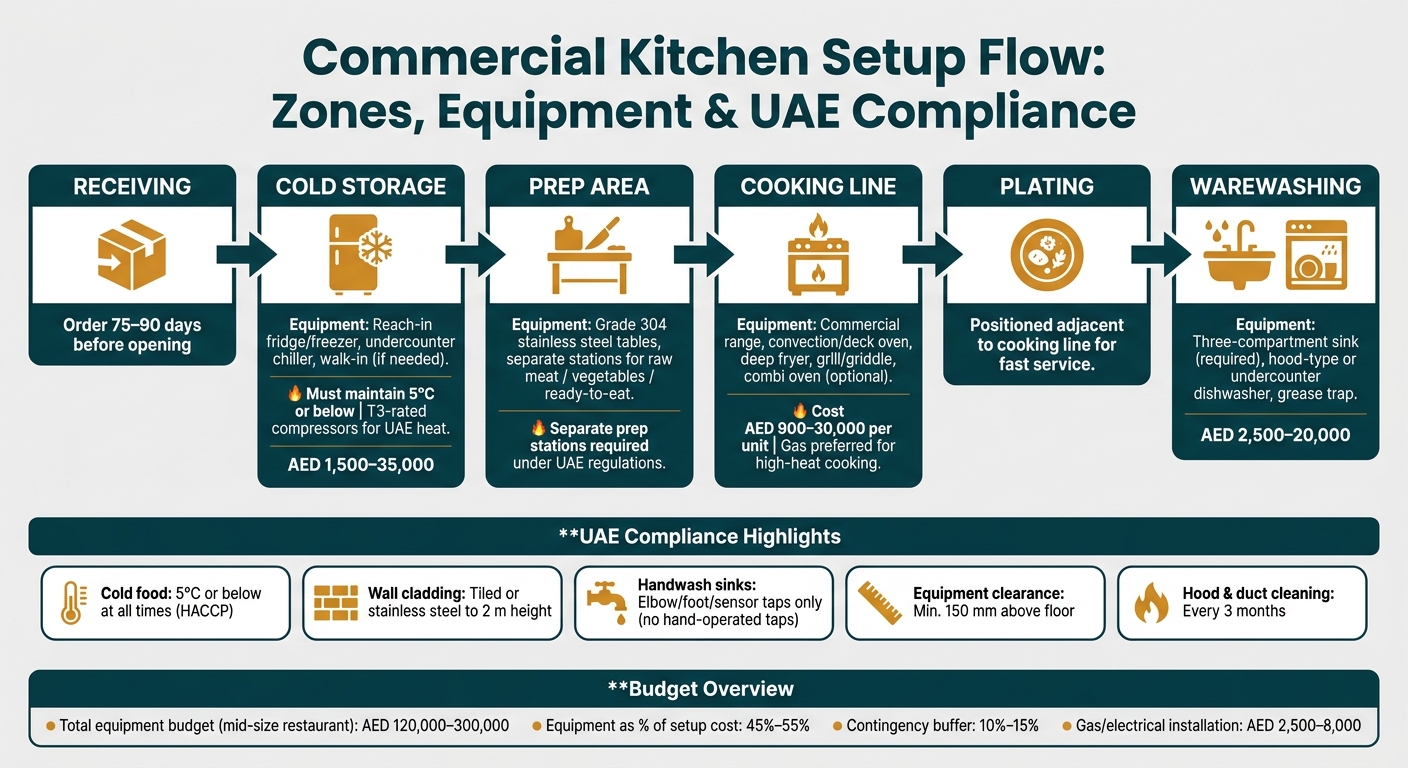
Commercial Kitchen Setup Flow: Zones, Equipment & UAE Compliance
Plan equipment in the same order food moves through the kitchen so you don’t miss key items or create bottlenecks before opening: receiving → cold storage → prep → cooking → plating → warewashing. Each zone needs its own equipment, and buying in the wrong sequence can throw the whole workflow off. Start with the cooking line, then move through cold storage, prep, warewashing, and storage in that order.
Cooking line equipment
The cooking line needs the closest attention because this is where output, speed, and service pressure all meet. For most restaurant concepts, the core setup includes a commercial range, a convection or deck oven, a deep fryer, and a grill or griddle. In UAE commercial kitchens, gas is usually the first choice for high-heat cooking and fast temperature recovery. In the UAE, cooking equipment usually costs between AED 900 and AED 30,000 depending on the type and capacity.
Once the core line is set, let the menu guide the rest. A combi oven is often a smart addition because it can steam, roast, and bake in one unit, which helps a lot in smaller kitchens. Menu-specific equipment like a tandoor or pizza deck oven should only be bought if the menu calls for it day in, day out. After you’ve locked in cooking capacity, you can size refrigeration around daily ingredient turnover.
Refrigeration and food preparation equipment
Cold storage isn’t optional, and in the UAE, refrigeration units need tropicalised compressors that can handle high ambient temperatures. Standard reach-in refrigerators and freezers cover day-to-day ingredient storage, while undercounter chillers built into the prep line can cut down staff movement during service. Refrigeration equipment ranges from AED 1,500 to AED 35,000.
For prep, Grade 304 stainless steel worktables are the standard in UAE commercial kitchens. Regulations in the UAE also require separate prep stations for raw meat, vegetables, and ready-to-eat food to reduce cross-contamination risk. Depending on your menu and output, you may also need a food processor, slicer, or mixer. Once cold storage and prep are covered, the next step is washing and sanitation.
Warewashing, storage, and smallwares
A three-compartment sink is required under Dubai Municipality standards and is used for washing, rinsing, and sanitising. For dishwashing, the right machine comes down to volume. Hood-type dishwashers fit high-turnover restaurants, while undercounter units work for smaller cafés or bars. In the UAE, commercial dishwashers usually range from AED 2,500 to AED 20,000. A grease trap is also required.
Then come the items staff will reach for every single shift. NSF-certified wire shelving, wall racks, and airtight ingredient bins help keep stock neat and easy to access. Core smallwares include:
- Cookware
- Pans
- Hotel pans
- Tongs
- Spatulas
- Ladles
- Calibrated digital thermometers
Ventilation, Fire Safety, and Compliance Requirements
Once you’ve locked in the main equipment list, pause before buying. Ventilation, fire safety, and hygiene rules are the last checkpoint, and they often decide what you can and can’t install.
Extraction and air management equipment
Every cooking line needs a commercial exhaust hood sized to fully cover the equipment below it, plus grease-resistant ducting vented outdoors. The exhaust stack must extend at least 2 m above the nearest building, and hoods and ducts need professional cleaning every 3 months.
Airflow matters just as much as the hood itself. You need to maintain negative pressure, supply make-up air through a FAHU, and add ESP and carbon filters for heavy-grease cooking stations.
After the extraction setup is defined, match it with the right suppression and shut-off systems. If those pieces don’t line up, you’re asking for trouble later.
Fire safety equipment for commercial kitchens
Commercial kitchens need hood-built fire suppression, gas shut-off valves, rated extinguishers, fire blankets, and emergency lighting.
That covers the life-safety side. From there, the focus shifts to finishes, wash points, and surfaces that can stand up to daily cleaning.
Hygiene and food safety compliance points
Use Grade 304 stainless steel for all remaining food-contact surfaces. For coastal sites, switch to Grade 316. In food handling areas, walls must be tiled or clad in stainless steel to a height of at least 2 metres.
Handwash stations must be separate from food prep sinks. They also need elbow-operated, foot-operated, or sensor-based faucets. Standard hand-operated taps do not meet Dubai Municipality rules.
Flooring should be seamless and non-absorbent, with coved wall junctions to help stop bacterial build-up. Equipment must also sit at least 150 mm above the floor on legs or wheels, so staff can clean underneath and pest control teams can do their job.
For cold storage, use refrigeration units with digital temperature displays to support temperature logs and inspections. Under HACCP rules, cold food must stay at or below 5°C at all times.
sbb-itb-19c3c9a
How to Choose the Right Equipment Without Overspending
Once you know what equipment you need, the next step is to cut that list down to what actually fits your menu, expected volume, and budget.
Match equipment to menu, volume, and available space
Start with the menu. Buy equipment only if it supports a dish or prep task you’ll use from day one.
Then look at your busiest service window. The goal is simple: handle peak volume without creating bottlenecks. Bigger isn’t always better. Oversized units eat up floor space, put extra pressure on power and gas capacity, and push your upfront spend higher. That matters because kitchen equipment can make up 45% to 55% of total setup cost.
It also pays to check utilities early. Before you commit to any high-load appliance, confirm your gas connections and available power load. It’s a lot better to catch a mismatch on paper than after delivery.
If space is tight, multi-use equipment can do a lot of heavy lifting. A combi oven, for example, can replace several separate appliances while saving space and labour.
Once you’ve sized the main cooking line, move on to refrigeration. This is one of those choices that shapes both daily workflow and spend.
Refrigeration format comparison
Refrigeration format has a big effect on cost, storage, and how smoothly the kitchen runs.
| Format | Typical Use Case | Storage Capacity | Floor Area Required | Approx. Budget (AED) |
|---|---|---|---|---|
| Reach-in | Daily-use ingredients; quick access on the line | Moderate | Small (vertical footprint) | AED 5,000–15,000+ |
| Undercounter | Prep stations; tight spaces; cloud kitchens | Low | Minimal (fits under worktables) | AED 3,000–8,000 |
| Walk-in | Bulk storage; high-volume purchasing | Very high | Large (dedicated room required) | AED 20,000–50,000+ |
Check build quality, cleaning access, and service support
Price matters. But once you open, uptime and local support matter even more.
A cheaper unit can end up costing more if it fails during a busy week and the spare parts aren’t stocked in the UAE. Before buying, check that spare parts are available locally and that fast on-site technician support is in place.
Cleaning access is another point people sometimes underestimate. Go for equipment that’s easy to clean and inspect. If a unit is awkward to reach or clean properly, it can create problems during Dubai Municipality's mandatory quarterly inspections.
It’s also smart to leave room in the budget for surprises. Set aside a 10% to 15% contingency fund from the start to cover hidden costs such as specialised installation or utility upgrades. That buffer helps you avoid last-minute cuts to items you can’t do without.
Final Equipment Planning Checklist Before Opening
Pre-opening equipment review
Once your purchase decisions are locked in, do one last install check before opening. Go zone by zone and make sure the full flow works in order: receiving, prep, cook, plate, wash.
Each appliance also needs to match the site’s power supply, gas pressure, and commissioning needs before sign-off. For gas equipment, this part matters a lot. A formal gas commissioning inspection and certificate are required before your operating licence is approved.
For refrigeration, confirm units hold 5°C or below and use T3-rated compressors suited to UAE heat. Timing matters too. Plan equipment orders 75–90 days before your target opening date so you have enough time for production, shipping, and customs clearance.
Common buying mistakes to avoid
Use this last review to catch the mistakes that cost the most.
Don’t buy residential-grade appliances. They don’t hold up under commercial duty cycles. And don’t under-size cold storage, especially when summer peak loads hit.
You’ll also want to check that handwash sinks, three-compartment sinks, and grease traps are installed and approved. Another common slip-up is spending too much on menu-specific equipment before the core setup is covered. If the cooking line, refrigeration, and warewashing aren’t fully sorted first, your budget can disappear fast.
Key takeaway for UAE restaurant owners
Start with your zones, menu, volume, and workflow. That gives you the right base for your equipment list. After that, confirm UAE authority rules for hygiene, gas, and fire safety before you buy anything. Dubai Municipality, ADAFSA, and Civil Defence all have rules that affect both what you can buy and how it must be installed.
Then compare your budget with the full install cost, not just the sticker price. A mid-sized restaurant usually needs AED 120,000 to AED 300,000 in equipment alone. Professional gas and electrical installation usually adds AED 2,500–8,000.
FAQs
How do I size equipment for peak service?
Size equipment around your menu, expected output, and how your kitchen moves during service. Work out peak demand first, so your setup can handle the rush without slowing down or being pushed too hard.
If you're running a higher-volume kitchen, look at double-basket fryers, large-capacity combi ovens, and walk-in cold rooms. In the UAE, tropicalised refrigeration should be high on your list. It’s built for hotter conditions, which matters when summer heat is no joke. Also check that equipment capacity lines up with local power limits and energy efficiency requirements.
What equipment can wait until after launch?
Systems like cooking lines, refrigeration, ventilation and sanitation need to be up and running before you open. In the UAE, that’s part of meeting health and safety rules.
Some purchases can wait. Specialised smallwares, extra backup prep tools and decorative buffetware often fall into the nice-to-have pile, not the need-it-now pile.
Put compliance and food safety equipment first. That means items like hoods, grease traps and approved refrigeration should come before the extras.
Which approvals should I secure before ordering?
Before you order any equipment, get official sign-off on your kitchen layout from the Dubai Municipality Food Safety Department or the local food safety authority, along with Civil Defence.
Send in detailed architectural drawings so the layout can be checked against rules for ventilation, drainage, fire safety, and municipal compliance. This step can save you from costly redesigns, fines, or even closure. It also makes sure your equipment fits local commercial food safety and fire safety rules.
