


If your refrigeration cannot hold 4°C or below in a Dubai kitchen, it is the wrong setup. In summer, ambient heat can pass 45°C, so I would focus on T3-rated units, correct sizing, and clean layout before I look at price alone.
Here’s the short version:
- I’d use walk-in cold rooms for bulk stock, reach-ins for day-to-day kitchen use, undercounter fridges for line stations, and blast chillers for hot food cooling.
- I’d keep chilled food at 4°C or below, raw meat and seafood at 0°C to 4°C, and frozen stock at −18°C or below.
- I’d check for ECAS or EQM conformity, food-safe 304 stainless steel, readable digital temperature displays, and proper power and drainage setup.
- I’d place units close to use points but away from cookline heat, with enough airflow and cleaning access.
- I’d plan for monthly gasket checks, more coil cleaning during March to May, and total ownership cost, not just the unit price in AED.
A simple buying rule: match the unit to the kitchen zone, then match the spec to Dubai heat.
| Unit | Best use | Typical size | Main point |
|---|---|---|---|
| Walk-in cold room | Bulk storage | 6 m³ to 200 m³+ | Back-of-house stockholding |
| Reach-in fridge/freezer | Daily service stock | 400 L to 1,500 L+ | Near prep and cook stations |
| Undercounter fridge | Line-side ingredients | 100 L to 300 L | Saves steps during service |
| Blast chiller | Cooling cooked food | 10 kg to 100 kg+ per cycle | For safe hot-to-cold handling |
| Freezer room/upright freezer | Long-term frozen stock | Varies | Protein and seafood holding |
If I were planning a restaurant kitchen in Dubai, I’d treat refrigeration as a food safety and workflow system first, and an equipment purchase second.
Commercial refrigeration types and where each unit fits in your kitchen
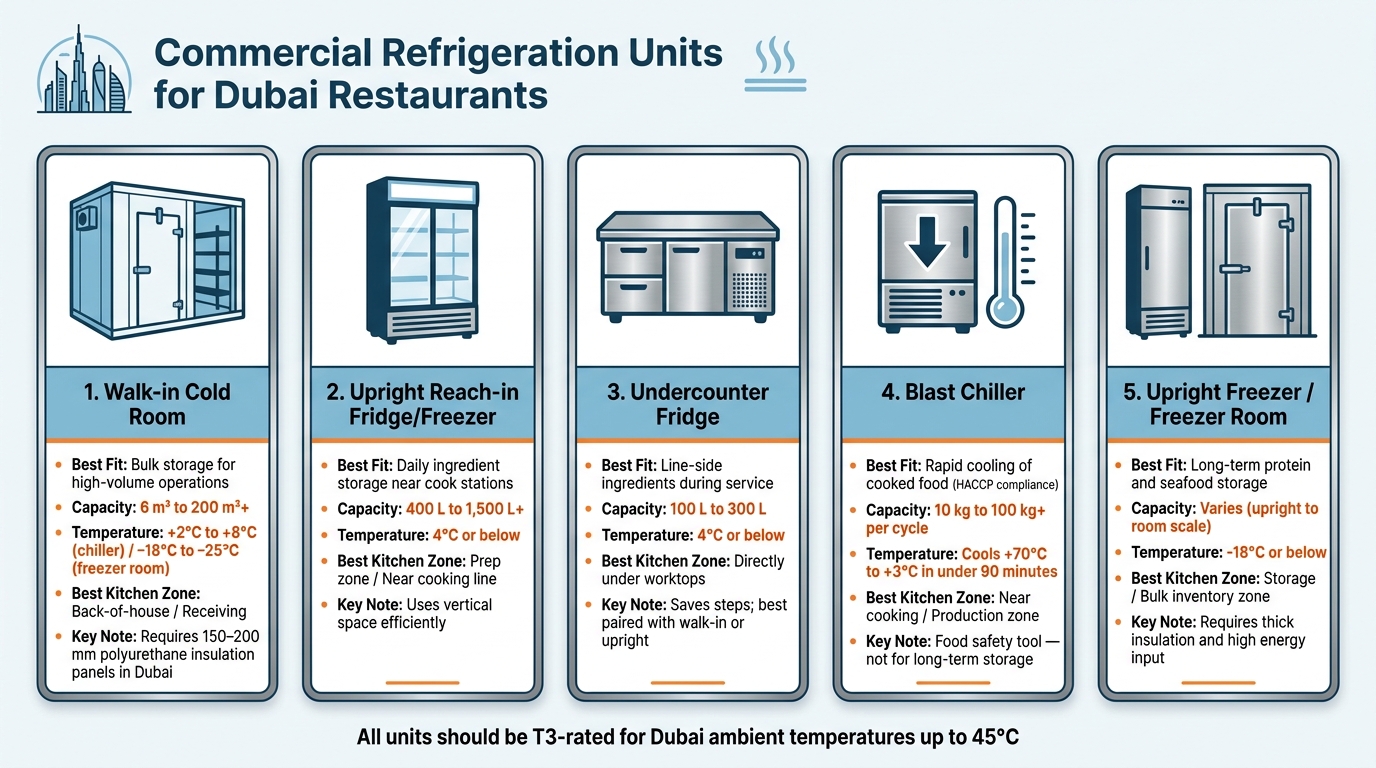
Commercial Refrigeration Units for Dubai Restaurants: Quick Comparison Guide
Match refrigeration to your menu, service volume, delivery schedule, and floor space. The goal is simple: put the right unit in the right zone so your team can work faster and store food safely.
Use this quick reference before the breakdown below:
| Unit Type | Best Fit | Capacity | Benefits | Trade-offs | Best Kitchen Zone |
|---|---|---|---|---|---|
| Walk-in Cold Room | Bulk storage for high-volume operations | 6 m³ to 200 m³+ | Organised bulk storage | High install cost, large footprint | Back-of-house / Receiving |
| Upright Reach-in | Daily ingredient storage | 400 L to 1,500 L+ | Uses vertical space well | Limited bulk capacity | Prep zone / Near cooking line |
| Undercounter Unit | Ingredients at the line | 100 L to 300 L | Saves space, speeds up service | Small capacity, frequent door openings | Directly under worktops |
| Blast chiller | Rapid cooling for HACCP / batch cooking | 10 kg to 100 kg+ per cycle | Stops bacterial growth, preserves quality | Not for long-term holding | Near cooking / Production zone |
| Freezer storage (upright freezer or freezer room) | Long-term protein and seafood storage | Varies (upright to room) | Stops bacterial growth entirely | High energy use, needs thick insulation | Storage / Bulk inventory zone |
Walk-in cold rooms and freezer rooms for bulk storage
Start with bulk storage, then work forward to line-side units.
Walk-in chillers and freezer rooms make sense when your kitchen takes large deliveries, stores several protein categories, or runs a broad menu that calls for well-organised stock. Walk-in chillers usually run between +2°C and +8°C, while freezer rooms run between −18°C and −25°C.
Layout matters here. A walk-in needs proper shelving clearance and enough internal air movement so cold air can reach every corner. In Dubai, freezer rooms need 150 mm to 200 mm polyurethane insulation panels to maintain those negative temperatures, compared with 100 mm panels used in standard chiller rooms. Floor insulation is also a must in freezer rooms. Without it, ground frost heave can develop and crack the building's foundation over time.
Reach-in, undercounter, and prep fridges for line efficiency
Upright reach-in chillers and freezer cabinets are the kitchen workhorses. They sit close to the stations that use them most, like the hot line, garde manger, pastry, and beverage, so chefs can grab what they need without trekking back to the storeroom. Capacity usually ranges from 400 L to 1,500 L+.
Undercounter and worktop prep fridges sit right beneath prep counters at salad, sandwich, pizza, and pastry stations. That keeps ingredients within arm’s reach and cuts extra movement during service. Capacity is much smaller, usually 100 L to 300 L, so these units work best alongside a walk-in or upright cabinet, not on their own as the main storage setup.
Blast chillers and blast freezers for safe hot-to-cold handling
A blast chiller is not a storage fridge. It’s a food safety tool built to bring cooked food down from +70°C to +3°C in under 90 minutes. That speed helps safe cooling and supports HACCP control.
You’ll often see blast chillers in hotels, central production kitchens, and catering operations where batch cooking is part of the daily routine. Put the unit beside the cook line or finishing area so food can go in straight after cooking. After blast chilling, the food should move to a standard chiller or freezer for holding. Use the blast chiller for rapid cooling only, then transfer the food to cold holding.
Next comes compliance, because even the best layout falls apart if temperature control and hygiene rules aren’t met.
sbb-itb-19c3c9a
UAE food safety rules and refrigeration compliance basics
Dubai’s heat calls for T3-rated refrigeration, not T1 units made for cooler ambient conditions. T1 units are usually rated for spaces up to 32°C, so they can struggle to keep food at safe temperatures during peak UAE summer service. Before you buy, check that the unit has a valid ECAS or EQM Certificate of Conformity for commercial foodservice use in the UAE.
That starting point affects everything else: how you track temperatures, how you log checks, and which storage setup fits your kitchen.
Temperature control, monitoring, and HACCP records
Dubai Municipality requires chilled food to stay at 4°C or below and frozen products at −18°C or below. The table below shows the storage targets and daily checks most kitchens need:
| Food Category | Recommended Storage Temp (°C) | Monitoring Needs | Key Handling Notes |
|---|---|---|---|
| Chilled Raw Proteins (Meat, Poultry, Seafood) | 0°C to +4°C | Daily logs or continuous data logging | Use tropical-rated reach-ins; monitor closely |
| Dairy Products | +1°C to +5°C | Daily checks | Maintain strict rotation; avoid door-side placement |
| Fresh Produce | +1°C to +7°C | Temperature and humidity | Humidity control may be required for leafy greens |
| Frozen Ingredients | −18°C or below | Continuous digital display; alarms | Thicker insulation is required |
In many restaurants, twice-daily manual temperature logs are still the standard. Central kitchens and high-volume sites often need continuous data-logging thermometers that can export records for audits. Inspectors usually prefer digital displays that can be read from outside the unit instead of dial thermometers. Your records should cover both storage units and goods-in checks at receiving.
Materials, hygiene design, and installation requirements
Dubai Municipality expects refrigerator interiors and shelving to be non-porous, food-safe, and easy to clean. Grade 304 stainless steel is the accepted industry standard for casings and shelving. It stands up well to corrosion and is simple to sanitise in a busy commercial kitchen.
Door seals matter more than many operators think. Insulated doors with automatic closers and seal controls help keep out hot, humid air. Freezer doors also need anti-condensation heaters in the frame to stop ice build-up around the seal.
On the installation side, units should be mounted on 150 mm legs for cleaning access, or sealed to the floor. Coved floor-to-wall junctions are required by Dubai Municipality to remove dirt traps. Power supply should be 220–240V AC, 50Hz with a 30mA ELCB/RCD. For larger walk-ins, you’ll also need to coordinate with UAE Civil Defence on refrigerant type and charge limits.
With compliance covered, the next step is sizing and placing each unit around menu demand, deliveries, and workflow.
How to size and place refrigeration in a Dubai kitchen
Once compliance is sorted, the next step is simpler in theory and harder in practice: pick refrigeration that fits how the kitchen actually works.
Capacity planning based on menu, deliveries, and stock rotation
Don’t size refrigeration around today’s covers alone. And don’t guess based on where you hope the business will be next year. Size it for peak covers, then work backwards from your menu mix, delivery frequency, stock-holding days, and peak service demand.
In Dubai’s heat, that margin matters. Storage planning needs to account for stored volume, door openings, product load, air leakage, and light load. Get the size and layout right, and you help keep food safe, protect recovery time, and cut waste.
Separation matters too. Raw and cooked items should sit in separate zones or in dedicated units to reduce cross-contamination. It also makes sense to leave room for growth from day one.
Use this guide to match refrigeration to the restaurant format and service load:
| Restaurant Type / Zone | Recommended Refrigeration | Main Use | Placement Notes |
|---|---|---|---|
| Café / Small Kitchen | Reach-ins & Undercounters | Daily fresh stock & milk | Under worktops to preserve floor space and keep service fast |
| Full-Service Restaurant | Walk-in Chiller + Uprights | Bulk produce & line ingredients | Bulk storage in back-of-house; line fridges near prep |
| Bakery | Dough Retarders & Display Chillers | Fermentation & finished cakes | Humidity-controlled retarders and display units |
| Pizzeria / Salad Bar | Prep Counters (Pizza/Salad) | Toppings & assembled items | High-turnover prep line |
| Catering / Central Kitchen | Blast Chillers & Freezer Rooms | Bulk cook-chill & long-term storage | Must support HACCP data logging |
Layout rules that protect workflow and temperature stability
Placement matters just as much as the unit itself. Put refrigeration in the right spot, and staff walk less, doors stay shut more often, and temperatures hold more steadily. That’s the difference between a kitchen that flows and one that keeps fighting itself.
Keep refrigeration close to where ingredients are used, but don’t place it near heat sources. Undercounter and prep-table units work best at salad, pizza, and sandwich stations. Walk-ins and bulk uprights usually belong in the back-of-house near the delivery entrance.
In tight kitchens, front-breathing units can be a smart fix because they allow zero-clearance installation.
Poor make-up air can create negative pressure, put strain on door seals, and lead to temperature swings. That’s why refrigeration and ventilation planning should happen together from the start.
Next, factor in energy use and maintenance, because both affect long-term operating cost.
Energy use, maintenance, and working with Silverline Kitchens
Energy efficiency, cleaning schedules, and lifecycle costs
In Dubai, refrigeration cost is a lifecycle call, not just a buying call. A unit with a low upfront price can end up costing more through higher power use, more repairs, and a shorter working life. For local conditions, specify T3-rated units. T1 units are not built for sustained heat in Dubai. After that, cost mainly comes down to two things: maintenance discipline and load management.
Beyond the rating, three things have the biggest effect on running costs: insulation quality, compressor type, and door seal condition. High-density PIR panels cut thermal gain. Inverter compressors adjust output based on demand instead of running flat out all the time, which can reduce energy use by 20% to 35% compared with fixed-speed systems. Door gaskets also wear out fast in UAE heat, so they should be checked every month.
Condenser coils need extra attention during sandstorm season, which usually runs from March to May. Dust build-up makes the compressor work at higher system pressure. That is why monthly coil cleaning during this period, and quarterly cleaning for the rest of the year, helps reduce the risk of early compressor failure.
A simple service routine usually includes:
- Monthly: check door gaskets and drain lines
- Monthly in sandstorm season, quarterly otherwise: clean condenser coils
- Quarterly: check refrigerant pressure and calibrate temperature probes
- Annually: carry out electrical and insulation audits
These checks help cut breakdown risk. But the full cost picture only shows up when you look at total ownership cost. Higher-spec T3/inverter units cost more at the start, yet they can lower five-year ownership cost through lower energy use, fewer repairs, and less downtime.
How Silverline Kitchens supports compliant refrigeration planning
Once the operating cost side is clear, the next step is getting the specification and installation right. Silverline Kitchens supports refrigeration planning through thermal load calculations, equipment specification, layout design, drainage coordination, ventilation planning, installation, and after-sales service.
Silverline Kitchens also supports compliance with Dubai Municipality, Civil Defence, and HACCP requirements for restaurants, cafés, bakeries, and catering facilities across the UAE. After installation, after-sales support is available for supplied equipment, including servicing, repairs, and help with reducing downtime when issues come up.
FAQs
How do I know what refrigeration capacity my restaurant needs?
Assess your storage volume, menu needs, and day-to-day kitchen flow. The goal is simple: pick a unit that fits how your team works, not just what looks right on paper.
You’ll need to decide if the space is mainly for bulk storage of raw ingredients or for fast-turnover refrigeration near prep lines. Those are two very different jobs, and one cabinet rarely does both well.
A few things matter straight away:
- Fresh vs frozen stock levels: Work out how much chilled stock and frozen stock you hold at any one time.
- Door-opening frequency and peak cooling load: A unit that’s opened all day during service needs to recover temperature fast.
- Kitchen heat and access needs: Hot kitchens, tight corners, and busy walkways can all affect performance and placement.
- Avoiding units that are too small or too large: Too small, and staff start overloading shelves. Too large, and you waste space, power, and money.
- Capacity that supports your HACCP plan and any blast chilling: Your setup should match your food safety process, especially if products move from blast chilling into chilled storage.
Think of it like fitting out a storeroom in a busy restaurant: if the fridge can’t keep up with service, your whole line feels it. But if it’s oversized for your actual stock levels, you’re paying for space you don’t use.
When should I choose a blast chiller instead of a standard fridge?
Choose a blast chiller when you need to cool hot food fast. A standard fridge is made for storage and holding temperature. A blast chiller does a different job: it brings food down from 70°C to 3°C or -18°C within 90 minutes.
That speed matters for HACCP cook-chill compliance. It also helps limit bacterial growth and protects food texture, which can take a hit when cooling is too slow.
This makes blast chillers a strong fit for operations that prep in volume and serve later, such as:
- Catering
- Banqueting
- Cloud kitchens
If you're cooking in bulk and need food ready for later service, a blast chiller is the right tool. A fridge simply isn't built for that kind of cooling job.
What should I check before installing refrigeration in a Dubai kitchen?
Before you install refrigeration in your Dubai kitchen, check compliance, site readiness, and system design first. This isn’t just box-ticking. If these basics are off, the whole setup can turn into a headache later.
Make sure the layout and equipment meet Dubai Municipality Food Safety Department rules and HACCP standards. Also check that the building’s electrical supply can handle the units, especially larger models. A walk-in or heavy-duty fridge can put a lot more load on the system than people expect.
In Dubai and across the UAE, high ambient temperatures matter. So the equipment you choose needs to be built for that kind of heat. It also helps to plan refrigeration as one connected system instead of treating each unit as a separate purchase. That usually makes spacing, airflow, and storage logic much easier to manage.
Storage design matters too. Keep raw and ready-to-eat items separate to cut the risk of cross-contamination. Digital thermometers should be visible from the outside, so staff can check temperatures without opening doors again and again. And don’t miss clearance rules, including 150 mm floor access for cleaning under the units.
