


Designing a commercial kitchen in the UAE is a multi-step process that requires careful planning, regulatory compliance, and an efficient workflow. Here's a quick breakdown of what to expect:
- Approvals First: Secure permits from Dubai Municipality, Civil Defence, and other relevant authorities. This can take 15–30 working days.
- Site Evaluation: Ensure the space meets size, utility, and drainage requirements. For example, Dubai Municipality mandates a minimum of 300 sq. ft. for kitchens.
- Budgeting: Costs include design packages (starting at AED 5,000), equipment, and compliance expenses. Plan for contingencies to avoid delays.
- Workflow Design: Focus on unidirectional flow (Receiving → Storage → Cooking → Serving → Washing) to reduce contamination risks.
- Equipment Selection: Choose tools based on your menu and ensure they meet UAE standards, like CE certification and fire safety compliance.
- Final Installation: Follow approved layouts, test equipment, and prepare for inspections. Staff training and maintenance planning are also essential.
Each step ensures your kitchen is safe, efficient, and ready for operations in line with UAE regulations.
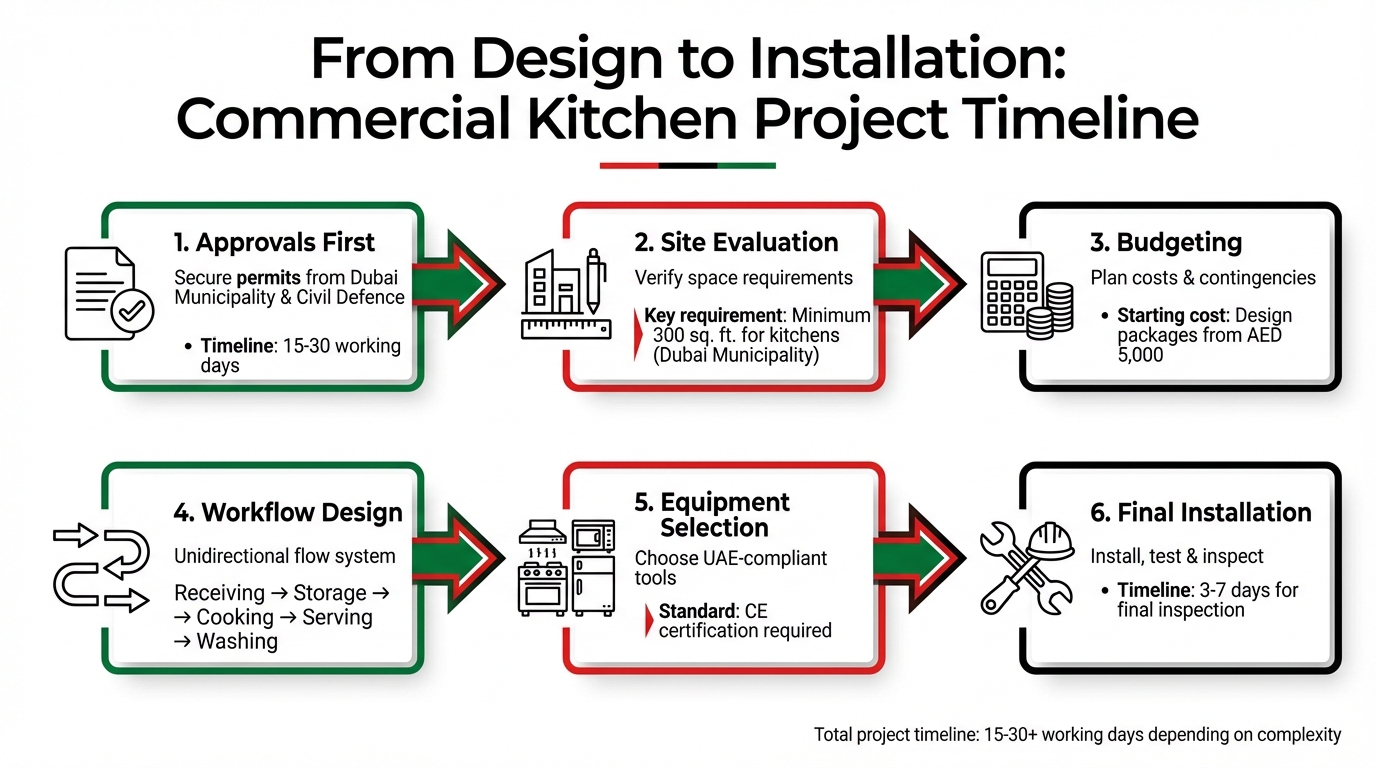
Commercial Kitchen Project Timeline: 6 Steps from Design to Installation in UAE
Initial Consultation and Requirements Assessment
The first step in any commercial kitchen project is setting the groundwork. This phase defines the kitchen's purpose, evaluates the site's ability to meet those goals, and outlines the financial resources needed. Getting this right from the start can save you from costly mistakes and delays later on.
Understanding Client Goals and Requirements
The menu is the backbone of kitchen design - it influences nearly every decision you'll make.
"Your menu is the DNA of your entire kitchen design. A high-volume burger joint, a delicate patisserie, and a fine-dining seafood restaurant have wildly different equipment and workflow needs." - Tina, LeadsToV
During this stage, provide a detailed, itemised menu. Include the dishes you plan to serve, the equipment you'll need, expected customer capacity, and peak service times. For instance, a café serving 50 customers daily will have vastly different requirements compared to a restaurant handling 300 covers. Whether you need tandoors, pizza ovens, or specialised pastry stations, this is the time to lay it all out.
Additionally, ensure the property is properly zoned for F&B operations to secure a trade licence. You'll need key documents, including the landlord's No Objection Certificate (NOC), site drawings (architectural and MEP), and any guidelines from master developers like Emaar or Nakheel if applicable.
Once goals are clear, the next step is to assess if the site can meet these needs.
Site Evaluation and Feasibility Study
A proper site evaluation ensures the kitchen layout supports an efficient, unidirectional workflow, which is crucial to avoid cross-contamination. Start by confirming the space meets minimum size requirements: Dubai Municipality mandates at least 300 square feet for commercial kitchens and 750 square feet for restaurants. Ergonomic considerations are also key, with counter heights typically ranging from 85–95 cm and aisle widths between 107–122 cm to allow safe movement for staff.
The evaluation also needs to address utility infrastructure. Commercial kitchens demand significant power, so apply early for an electrical load assessment from DEWA or ADDC to confirm whether the existing supply is sufficient or if upgrades are needed. Gas supply availability is another critical factor, especially for kitchens relying on traditional cooking methods.
Structural checks should include proper drainage slopes to prevent water pooling, routes for exhaust ducting, and locations for grease traps to meet local regulations.
Budget Planning and Cost Estimation
After evaluating the site, it's time to create a realistic budget that covers all design and compliance costs. Professional kitchen design packages that meet Dubai Municipality standards are typically priced at AED 5,000 plus VAT. These packages include 2D and 3D layouts, MEP drawings, and necessary documentation for regulatory submissions.
Here are some example costs to consider:
- Professional design packages: AED 5,000 plus VAT
- Hot holding cabinets (15 GN 2/1 capacity): AED 14,322
- Undercounter ice cube machines (42 kg/day): AED 4,800
- Stainless steel plate warmers: AED 2,858
- Aluminium shelving units: AED 990
Don't forget to include costs for compliance, approvals, and utility connections. Cutting corners during this phase often leads to expensive redesigns or reconstructions later. Factor in installation costs, staff training, and a contingency fund for unexpected challenges to ensure your financial plan is thorough.
sbb-itb-19c3c9a
Design Phase: Creating the Kitchen Layout
After confirming your site evaluation and budget, the design phase begins. This is where your kitchen's requirements are transformed into a detailed plan that balances workflow efficiency with UAE regulatory standards. This blueprint is essential for choosing layouts that optimise operations while ensuring compliance.
Planning Efficient Kitchen Layouts
The layout of your kitchen plays a huge role in how efficiently it operates. For instance, assembly line layouts are perfect for high-volume, quick-service restaurants like burger joints. They create a streamlined, linear workflow that reduces cross-contamination risks. On the other hand, island hub designs work well for larger, square kitchens, with cooking equipment placed centrally and prep areas around the edges. This setup allows for greater flexibility, especially for kitchens with diverse menus.
To keep things running smoothly, divide the kitchen into key zones: Receiving & Storage, Preparation, Cooking & Production, Assembly & Pick-up, and Washing. This zoning approach simplifies operations and ensures tasks flow in an organised manner.
"A kitchen should feel like a sequence, not a room. Every step matters: Cold Prep → Cooking Line → Pass / Expo → Dish Drop → Cleaning / Stewarding." - Muhammad Rady, RadyInterior
When designing, ensure aisles are 107–122 cm wide and work surfaces are 85–95 cm high. This helps staff move around easily and reduces strain. Keep clean areas (like food prep and cooking) separate from dirty areas (like dishwashing and waste disposal) to meet Dubai Municipality hygiene standards. Materials matter too - use 304-grade stainless steel for work surfaces and ensure floors have proper coving with curved edges rising at least 10 cm to prevent bacteria buildup.
With an efficient layout in place, the next step is to ensure every design detail aligns with UAE regulations.
Meeting UAE Compliance Standards
Adhering to UAE regulations is non-negotiable. Authorities like Dubai Municipality and ADAFSA require HACCP-based zoning, which includes dedicated sinks for handwashing, food prep, and warewashing. Civil Defence regulations demand kitchen hoods with automatic fire suppression systems (like ANSUL) and IP66-rated electrical outlets in wet areas.
Ventilation is another key aspect. High-efficiency systems, often specified based on equipment BTU output, can cut energy use by up to 25%. For cooking, commercial induction systems are gaining popularity. They transfer over 90% of their energy to cookware, compared to just 40–50% for gas, reducing ambient heat and eliminating open flames - an advantage for meeting strict fire safety standards.
Compliance not only ensures safety and hygiene but also enhances your kitchen's overall performance.
Grease Trap and Drainage Planning
In the UAE, grease traps are a must. They should be placed near dishwashing stations and pot-wash sinks to efficiently capture fats, oils, and grease before they reach the plumbing system. Regular cleaning and easy access for inspections are crucial.
Flooring design is equally important. Floors should slope towards drains to prevent water pooling, and waste disposal routes should be planned to avoid disrupting food prep workflows. Keep washing zones physically separated from cooking areas to minimise cross-contamination risks.
Sourcing and Selecting Equipment
Once your kitchen layout aligns with UAE regulations, it's time to focus on choosing the right equipment. This step is crucial as it directly affects your kitchen's efficiency, operating costs, and ability to pass inspections. Let’s dive into the key considerations when sourcing equipment that meets both your needs and local standards.
Core Equipment for Commercial Kitchens
The type of food you serve dictates your essential equipment. For instance, a busy burger joint will need heavy-duty grills and fryers, while a bakery requires deck ovens and proofing cabinets. Catering operations often rely on large bratt pans for preparing food in bulk.
Every commercial kitchen should be divided into specific functional zones:
- Storage: Includes walk-in chillers, freezers, and food-grade shelving.
- Preparation: Features stainless steel prep tables, vegetable washing sinks, and separate stations for handling meat, poultry, and fish.
- Cooking: Requires combi ovens, ranges, fryers, grills, and induction cooktops.
- Service: Uses heat lamps and heated gantries to keep food at the correct temperature.
- Washing: Includes commercial dishwashers with an 82°C final rinse, three-compartment sinks, and hand-wash stations with non-manual taps.
To ensure durability and hygiene, all equipment should be made from 304-grade stainless steel. Cooking areas must also include fire suppression systems, like ANSUL, approved by Civil Defence, along with properly sized exhaust hoods.
Energy-Efficient and Compliant Equipment Options
Energy-efficient equipment not only reduces utility costs but also helps meet regulatory standards. For example, induction ranges transfer over 90% of energy directly to cookware, minimising heat output and reducing the strain on air conditioning - a key advantage in the UAE's extreme heat. High-efficiency ventilation systems can cut energy use by up to 25% compared to traditional systems. Refrigeration units should be capable of maintaining consistent temperatures even in high ambient heat and include features like digital temperature monitoring and food-grade seals.
Compliance is non-negotiable. All equipment must adhere to standards set by Dubai Municipality, ADAFSA, and Civil Defence. Look for the CE (Conformité Européenne) certificate to confirm international safety and performance standards. Electrical outlets in wet areas should have IP66 waterproof ratings, and all wiring must be installed by certified technicians to preserve warranties.
Comparing Equipment Features and Capacities
Once you've identified energy-efficient options, evaluate equipment based on functionality, capacity, and compliance. Take combi ovens, for example - they combine steam and convection cooking, offering precise temperature control and energy-saving insulation. Induction ranges provide quick, accurate cooking without open flames, enhancing both safety and efficiency. For washing, commercial dishwashers must reach a final rinse temperature of 82°C and include triple-filtration systems to meet health standards.
Refrigerators and freezers must operate reliably even in ambient temperatures up to 50°C. Exhaust hoods should have built-in fire suppression systems and grease filters to ensure both safety and efficiency. Don’t forget smaller essentials like colour-coded cutting boards, GN pans, and thermometers - they’re just as vital for maintaining compliance and smooth operations.
When selecting equipment, prioritise models that offer at least a two-year warranty and ensure local after-sales support is available, including access to spare parts. Leave enough space around units for easy cleaning and maintenance - overcrowding can lead to unnecessary servicing costs. Finally, make sure every piece of equipment matches your municipality-approved layout to avoid issues during inspections.
Approval and Procurement Process
Once your kitchen design is finalised and equipment is selected, the next critical step is obtaining regulatory approvals and sourcing materials. This phase is essential to ensure your kitchen operates legally, and getting it right from the start can save you both time and money.
Navigating UAE Regulatory Approvals
In the UAE, several authorities oversee commercial kitchen approvals. Dubai Municipality (DM) or ADAFSA in Abu Dhabi evaluate food safety, hygiene, and layout compliance, ensuring adherence to the UAE Food Code and HACCP guidelines. Dubai Civil Defence (DCD) is responsible for fire safety approvals, covering ventilation systems, exhausts, and mandatory fire suppression systems like ANSUL. Lastly, the Department of Economy and Tourism (DET) issues trade licences once all municipal and safety requirements are met.
The approval process follows a specific sequence. First, submit detailed layout drawings that depict a unidirectional food flow - from receiving to storage, preparation, cooking, serving, and washing. The design approval process typically takes 7–14 working days, while the final inspection adds another 3–7 days. Altogether, the process can take 15–30 working days if all documentation is in order.
Do not begin your kitchen fit-out until your drawings are approved. Making changes to a non-compliant kitchen can be far more expensive than planning correctly from the outset.
To avoid unnecessary delays, ensure you have all required documentation ready before submission.
Documentation and Submission
Having complete and accurate documentation is crucial. Your submission should include:
- Architectural plans showing kitchen layout, zoning for raw and cooked food, and staff movement patterns.
- Technical drawings for Mechanical, Electrical, and Plumbing (MEP) systems, exhaust and ventilation designs, and drainage with grease trap details.
- Equipment specifications confirming compliance with the UAE Food Code, including Conformité Européenne (CE) certification for safety and performance standards.
- A Food Safety Management Plan outlining HACCP principles, pest control, cleaning schedules, and waste management procedures.
- Administrative documents such as a No Objection Certificate (NOC) from your property owner, staff training records, and health screenings.
Submit these drawings through the relevant authority's online portal. Inspectors often flag missing elements like dedicated hand wash sinks with non-manual taps and soap dispensers in prep areas, so ensure these are clearly marked on your plans. Walls must feature smooth, washable finishes like epoxy paint or stainless steel cladding, and floors should be anti-slip with seamless, coved edges at wall bases.
Procurement of Materials and Equipment
Once your approvals are in place, you can move on to procuring materials and equipment. Only begin this step after receiving your approved drawings, as all installed equipment must match the specifications and placements outlined in the approved plans. Any discrepancies can result in inspection failures.
When sourcing equipment, prioritise food-grade materials such as Grade 304 stainless steel for general use or Grade 316 for coastal areas. Ensure all appliances carry CE certification before purchasing. Your procurement list should include items required by UAE law, such as:
- Non-manual taps for hand wash stations.
- Properly designed grease traps with the correct slopes to prevent backflow.
- High-density polyethylene (HDPE) cutting boards.
Additionally, coordinate with utility providers like DEWA in Dubai or ADDC in Abu Dhabi to confirm electrical load capacity, as commercial kitchens require high electrical output and certified wiring. For ventilation, source kitchen hoods and exhaust systems equipped with grease filters that align with your approved ducting plans to manage heat and odour effectively.
Maintain a detailed equipment list with full specifications, ensuring all surfaces are smooth, washable, and hygienic. By following these steps, you’ll set your kitchen up for a successful inspection and operation.
Installation and Handover
With approvals finalised and equipment ready, your commercial kitchen project enters its last stage. This is where the vision laid out in your designs becomes a fully operational workspace. Every detail during this phase aligns with UAE regulations, ensuring the kitchen is inspection-ready and fully functional.
Site Preparation and Installation Sequence
Once all materials and equipment are on-site, the installation process begins. This phase follows a carefully planned sequence to ensure systems are installed correctly and meet UAE standards. Technicians start by setting up specialised electrical circuits to handle heavy-duty appliances.
Plumbing work comes next, including the installation of water inlets, drainage systems, and grease traps. It’s essential to ensure floors slope by 1–2% towards drains to avoid water pooling, which can lead to hazards. Fire suppression systems, such as ANSUL, must be installed by vendors approved by Civil Defence.
Professional installers then transport and position large equipment according to the approved layout. It’s crucial to leave enough space around each unit for maintenance, as overcrowding can make cleaning and repairs difficult. Technicians assemble the units and connect gas, water, and electrical lines, checking for leaks and load capacity. Licensed contractors should handle gas and electrical connections to ensure compliance and maintain warranties.
Testing and Ensuring Equipment Performance
Once installation is complete, thorough testing ensures everything is functioning as it should. Each piece of equipment undergoes performance checks - ovens, refrigerators (which must maintain 0–4°C for chillers), and exhaust hoods are tested to confirm they meet both performance expectations and regulatory requirements.
Your kitchen will also undergo two key inspections at this stage. Dubai Municipality officers will check that the installation matches approved plans, ensuring hand-wash stations are equipped with non-manual taps, ventilation systems work efficiently, and food flow follows a unidirectional path (from Receiving → Storage → Preparation → Cooking → Serving → Washing) to minimise contamination risks. Civil Defence inspectors will test fire suppression systems and extraction equipment to confirm compliance with Fire Life Safety standards. Final municipal inspections typically take 3–7 working days to complete after installation.
Staff Training and After-Sales Support
With the kitchen operational, the focus shifts to equipping your team and ensuring long-term support. Before handover, staff training is conducted on equipment usage, HACCP workflows, and proper hand-washing protocols. This includes training on high-precision induction ranges - capable of transferring over 90% of energy directly to cookware - and emergency procedures, such as locating master gas shut-off valves .
"Our service doesn't stop at handover - it's just getting started. We provide 24 months of free aftercare on replacements and parts, as long as the warranty remains active."
– Silverline Kitchens
To maintain smooth operations, it’s a good idea to implement a maintenance log from day one. This log tracks all servicing activities, supports warranty claims, and simplifies future health inspections. If your equipment includes IoT connectivity, it can alert you to potential issues before they disrupt your operations.
Conclusion
From initial design to the final installation, each step in creating a commercial kitchen highlights the importance of compliance and efficiency.
Building a successful commercial kitchen in the UAE goes beyond just selecting equipment and allocating space. It requires a well-structured process that adheres to Dubai Municipality standards, Civil Defence regulations, and HACCP guidelines. This ensures your kitchen operates both legally and safely at all times. Every stage, from consultation to handover, must be planned with these requirements in mind.
As Kitchen Works puts it:
"Compliance is the foundation of profitability. A compliant kitchen protects your licence, ensures food safety, and prevents shutdowns."
Taking the time to finalise layout drawings and secure approvals before purchasing equipment avoids unnecessary expenses and delays. Incorporating a unidirectional food flow system not only prevents cross-contamination but also boosts operational efficiency.
FAQs
What approvals are needed to set up a commercial kitchen in the UAE?
If you're planning to establish a commercial kitchen in the UAE, securing the right regulatory approvals is non-negotiable. The Dubai Municipality (DM) plays a central role in overseeing food safety, hygiene, and operational standards. One key requirement is obtaining a food establishment permit. This permit ensures your kitchen’s layout, design, and equipment align with stringent health, safety, and environmental guidelines. Additionally, your kitchen must meet HACCP (Hazard Analysis and Critical Control Points) standards, which are essential for maintaining food safety.
Fire safety is another critical area. Approval from Dubai Civil Defence (DCD) is mandatory, ensuring your kitchen is equipped with proper fire suppression systems and emergency protocols. Depending on your location, you might also need waste management permits and must comply with local zoning laws. To operate legally and efficiently, you’ll need to submit detailed plans that demonstrate compliance with these regulations.
How can I make sure my commercial kitchen layout complies with UAE hygiene and safety standards?
To ensure your commercial kitchen layout aligns with UAE hygiene and safety standards, it's crucial to adhere to regulations set by Dubai Municipality and other local authorities. The layout should support an efficient workflow while clearly separating areas like storage, preparation, cooking, and cleaning. This helps minimise the risk of cross-contamination. Use materials like stainless steel, which are both durable and easy to clean, and make sure your kitchen has proper ventilation, fire safety systems, and effective waste management in place.
Complying with HACCP (Hazard Analysis Critical Control Point) standards is a must for food safety. This means adopting safe food handling practices, keeping your food safety plans up to date, and ensuring all equipment and surfaces are food-safe. Securing the necessary approvals for your kitchen layout from Dubai authorities is another key step, as it ensures compliance and makes inspections hassle-free.
Working with experienced kitchen design professionals who understand UAE-specific requirements can simplify the process. This ensures your kitchen is not only safe and hygienic but also fully operational and ready for business.
What are the best energy-efficient equipment options for a commercial kitchen in the UAE?
To improve energy efficiency in a commercial kitchen in the UAE, it’s crucial to select appliances specifically designed to lower energy consumption while maintaining top performance. Focus on commercial-grade equipment that adheres to UAE standards and incorporates energy-saving features like advanced insulation, variable speed motors, and smart controls. Some great examples include energy-efficient ovens, refrigerators, and induction cooktops.
Ventilation also plays a key role. Choose extraction and ventilation systems equipped with energy recovery capabilities to capture and reuse heat, which can ease the load on HVAC systems. Pair this with LED lighting and intelligent power management systems to further cut down on energy use and operational expenses. Always verify that your equipment complies with local energy efficiency and safety regulations to ensure alignment with UAE requirements.
