


Restaurants in the UAE face high energy costs, especially in kitchens where energy consumption can be 10 times greater per square metre than other commercial spaces. Using energy-efficient kitchen equipment can cut energy bills by 20–40%, reduce HVAC strain, and ensure compliance with strict UAE regulations. Here's what you need to know:
- Combi Ovens: Save up to 52.2% energy with models featuring smart standby modes and AI cooking sequences. Costs range from AED 8,000 to AED 61,824.
- Induction Cooktops: Operate at 90% efficiency, reducing energy use by 40–50% and cutting cooling costs in hot kitchens. Prices start at AED 735.
- Refrigeration Units: High-efficiency models with AI compressors save 25–35% energy and are built for UAE's 43°C+ conditions. Single-door chillers start at AED 7,400.
- Dishwashers: Advanced systems with heat recovery reduce energy use by 20–30%, while water-efficient models cut costs by AED 1,835 annually.
- Fryers and Griddles: High-efficiency models reduce energy use by 15–25% and lower HVAC loads.
- LED Lighting: Cuts energy use by 30–60%, emits less heat, and reduces cooling costs.
- Ventilation Systems: Demand-Controlled Ventilation (DCV) saves 20–40% energy by adjusting fan speeds based on activity.
Key Energy Efficiency Factors in UAE Commercial Kitchens
Lowering energy costs in UAE kitchens starts with focusing on three major areas: cooking equipment, which accounts for 30–40% of energy use, refrigeration, which operates 24/7, and ventilation and exhaust systems. By optimising these areas, restaurant owners can significantly cut down on electricity bills.
The UAE’s extreme heat presents unique challenges. With outdoor temperatures often soaring past 45°C, HVAC systems face extra pressure to keep kitchens cool. This means that heat from cooking equipment not only impacts food preparation but also drives up cooling costs. A smart approach is to group heat-producing appliances together and position cold storage units separately. This setup reduces the strain on refrigeration compressors, leading to lower energy consumption.
Another critical factor is equipment sizing. Oversized appliances, like combi ovens or refrigeration units running below capacity, waste energy every hour they operate. Choosing equipment that matches your menu and service needs is a simple yet effective way to improve efficiency. Refrigeration units, in particular, should be rated for tropical/high-ambient temperatures (43°C+). Standard units not built for UAE conditions often fail prematurely and consume more power.
Ventilation systems are another area with room for improvement. Traditional exhaust systems operate at full speed regardless of activity levels, consuming unnecessary energy. Upgrading to demand-controlled ventilation (DCV), which uses sensors to adjust fan speeds based on heat and activity, can cut ventilation energy use by up to 40%. This technology offers immediate and measurable savings.
"The kitchen is where a sustainable fit-out project is won or lost, because choices made during this phase determine operating costs for years ahead." - USBC Interiors
Finally, efficient kitchen layout design plays a significant role in reducing energy use. A well-thought-out layout that optimises workflow, places equipment logically, and incorporates proper heat zoning can lower total energy consumption by 10–15%. Companies like Silverline Kitchens specialise in designing layouts tailored to UAE conditions, ensuring compliance and long-term efficiency.
sbb-itb-19c3c9a
1. Energy-Efficient Combi Ovens
A combi oven combines convection, steam, and combination cooking into one appliance, making it an excellent space and cost-saving solution for kitchens in the UAE.
These ovens are designed with advanced heat management features, such as triple-glazed doors, enhanced chamber insulation, and smart standby modes like Unox's SMART.Energy system. These modes detect idle periods, reducing fan speed and temperature to minimise unnecessary heat emissions. In a region where outdoor temperatures can soar, minimising excess heat is crucial to keeping air-conditioning costs in check.
ENERGY STAR®-certified combi ovens can cut energy consumption by up to 52.2% when cooking 50 kg of food daily. Some models, like Electrolux Professional's "Plan-n-Save", use AI-driven technology to optimise cooking sequences, reducing preheating times and saving up to 20% more energy. Additionally, automated cleaning systems such as SkyClean offer savings on water, detergent, and energy - potentially lowering running costs by around 15%.
"Up to 10% profit thanks to green efficiency. Savings on water, energy and chemicals translate into a higher profitability." - Electrolux Professional
When installing a combi oven in the UAE, keep in mind that local regulations require installation under an exhaust hood, with gas models needing Civil Defence approval. Pricing varies depending on the model: entry-level units range from AED 8,000–18,000, mid-range models cost AED 20,000–35,000, and high-end options, like the Unox CHEFTOP-X™, can exceed AED 40,000, with some models priced at AED 61,824. Given that kitchen equipment accounts for over 40% of energy bills, investing in certified models can lead to significant savings, often paying for themselves within a few years. To further improve energy efficiency, consider complementing your setup with induction cooktops and hobs.
2. Induction Cooktops and Hobs
Induction cooktops are becoming a go-to choice for modern commercial kitchens, and it’s easy to see why. Unlike gas burners - which waste 45–60% of their energy as heat - induction technology transfers up to 90% of energy directly to the cooking vessel. This makes them incredibly efficient, especially in kitchens running multiple stations during peak hours.
One standout benefit of induction cooktops is their ability to keep ambient heat to a minimum. This means your kitchen’s air conditioning system doesn’t have to work overtime - an important advantage in the UAE’s hot climate. In fact, operators have reported energy savings between 40–50% after switching to induction ranges.
From a regulatory angle, induction and electric kitchens are often approved more quickly by UAE Civil Defence and municipal authorities. The absence of open flames significantly lowers fire risks, simplifying the licensing process - an appealing feature for cloud kitchens.
"A unit costing 20% more upfront but consuming 30% less electricity will typically pay back the price premium within 18–24 months of operation in a busy UAE kitchen." - HorecaHut
When it comes to costs, entry-level induction units start at around AED 735, while high-end models range from AED 7,350 to AED 55,000. For instance, the TEKA IZS 91cm 5‑zone built‑in flex induction hob is priced at approximately AED 6,349. Over a five-year period, transitioning from a traditional gas range to an induction setup can save around AED 38,500. These savings come from reduced energy consumption, lower maintenance costs, and less demand on ventilation systems. The payback period typically falls between 18–36 months.
Before making the switch, ensure your kitchen is equipped with 3‑phase power (380–415V) and dedicated circuits. Also, verify that all equipment meets mandatory ESMA/ECAS certification requirements.
With induction cooktops boosting efficiency, the next section will explore high-efficiency refrigeration options to further optimise your kitchen’s energy use.
3. High-Efficiency Refrigeration and Freezer Systems
When it comes to energy efficiency in commercial kitchens, refrigeration plays a major role. It’s the largest electricity consumer, accounting for 30–40% of total power usage in most setups. Unlike cooktops or ovens that operate intermittently, refrigeration systems run 24/7, making even small efficiency improvements highly impactful over time.
Modern high-efficiency refrigeration units are designed to tackle this challenge. They feature AI inverter compressors that adjust their speed based on cooling needs, reducing energy consumption by 25–35% compared to traditional fixed-speed models. Paired with 50 mm PUF insulation and self-closing magnetic door gaskets, these units maintain stable internal temperatures while reducing the workload on air-conditioning systems.
In the UAE, refrigeration systems must meet Climate Class 5 (ST) certification standards, ensuring reliable performance even in ambient temperatures of up to +43°C. Additionally, newer models utilise R290 refrigerant, which offers better thermodynamic performance and a lower environmental footprint.
The savings can be substantial. For instance, a high-efficiency freezer consuming 4 kWh/day instead of 12 kWh/day can save between AED 1,100 and AED 1,500 annually. With payback periods of 18–36 months and full cost recovery within 2–4 years, these systems continue delivering savings throughout their 10–15 year lifespan.
Pricing Overview:
- A single-door 700 L chiller starts at AED 7,400.
- A double-door 1,400 L unit costs around AED 10,400.
- Walk-in coolers range from AED 15,000 to over AED 80,000.
- Adding inverter technology typically increases the price by AED 500–1,000 per unit.
These investments not only lower electricity bills but also enhance long-term operational efficiency.
4. Energy-Saving Dishwashers and Warewashing Systems
Dishwashers may not always get the spotlight, but they play a big role in managing energy and water use. A poorly chosen dishwasher can add extra heat and humidity, which puts more strain on air conditioning systems - a real concern for UAE kitchens.
Modern dishwashers, much like combi ovens and induction cooktops, help reduce the load on HVAC systems. A standout feature to look for is a heat recovery system, also known as an Energy Saving Device (ESD). This technology captures steam and waste heat from the wash chamber and uses it to pre-heat incoming cold water, easing the workload on the internal boiler. As a result, energy consumption can drop by 20–30%. Additionally, advanced air management systems can cut ambient humidity by as much as 80%.
Water efficiency is another key factor. Leading brands like Hobart and Electrolux offer hood-type models that use as little as 2 litres of water per cycle. Hobart's flight-type machines take it a step further with PREMAX soil-sensing technology, which removes up to 80% of food soil before the pre-wash stage. This reduces water changes by up to 50%, saving over AED 1,835 annually on water, energy, and chemicals.
Compliance with UAE regulations is non-negotiable. Health codes require rinse temperatures to consistently reach 82°C to 84°C to ensure proper bacteria elimination. Given the high mineral content of UAE's desalinated water - often exceeding 300 ppm CaCO₃ - an integrated water softener is crucial. Without it, limescale can quickly build up on heating elements, increasing both energy usage and maintenance costs.
The financial benefits are just as compelling. Premium models like the Hobart FT1000e can save up to AED 24,600 annually in energy and water costs compared to standard machines. These high-efficiency units also reduce electrical installation costs, with lower connected load requirements (as little as 150 amps for large flight-type machines). This can save around AED 11,000 on upgrades for wiring and circuit breakers. With payback periods ranging from 18 to 36 months, these machines often recover their costs well before their lifespan ends. Investing in efficient dishwashing systems is a smart move for managing energy expenses across the board.
5. High-Efficiency Fryers and Griddles
High-efficiency fryers and griddles are a smart addition to energy-saving strategies for UAE kitchens, helping to cut down on excess heat and reduce HVAC loads.
Fryers and griddles are essential in most kitchens, but they can be heavy energy consumers, significantly impacting utility bills. Opting for high-efficiency models can noticeably lower these costs. For fryers, features like a cold zone design prevent food particles from burning, improve heat distribution, and keep oil cleaner for longer periods. These models also offer adjustable power modes - like 4 kW for standby, 8 kW for fresh food, and 12 kW for fast heating - allowing them to use 15–25% less energy per unit of food fried compared to conventional fryers. Encouraging staff to use standby mode during slower periods can further cut unnecessary energy usage.
Griddles show an even greater efficiency gap. While traditional gas burners operate at just 40–55% efficiency, induction-based griddle plates can reach up to 95% efficiency. High-inertia plates, such as those with 20 mm-thick NitroChrome3 surfaces, are designed to retain heat longer when cold food is placed on them. This reduces the energy required to recover the temperature and generates less waste heat, which eases the burden on the kitchen's air conditioning system.
"Every kilojoule of waste heat generated by inefficient cooking equipment must then be removed by the HVAC system - doubling the energy penalty." - Horeca Hut
This is especially relevant in the UAE, where air conditioning is a year-round necessity. Switching to induction griddles can lower energy bills by approximately 22% in hospitality operations, while the reduced ambient heat can decrease staff fatigue by up to 40%.
From a compliance perspective, gas-powered fryers in the UAE must meet strict requirements, including Civil Defence-approved leak detection and fire suppression systems, along with detailed plans for Dubai Municipality approval. Electric and induction models simplify this process, which can be a key consideration when calculating total setup costs. Although energy-efficient fryers and griddles may cost 10–25% more upfront, the higher purchase price is typically offset within 18–24 months through savings on utility bills in a busy kitchen.
Similar to combi ovens, induction cooktops, and advanced refrigeration systems, high-efficiency fryers and griddles contribute to reducing energy expenses and easing HVAC strain in UAE kitchens. Together, these upgrades form a well-rounded approach to energy conservation across the entire operation.
6. LED Lighting for Commercial Kitchens
Switching to LED lighting is a straightforward yet impactful way to reduce energy consumption in restaurants. In UAE kitchens, where lighting accounts for a significant portion of energy use, this change can lead to impressive savings. Studies indicate that replacing traditional lighting with LED fixtures can cut lighting-related energy use by 30–60%. Opting for Energy Star-rated LEDs can push savings even further, reducing usage by up to 75% compared to older systems.
LEDs offer more than just cost savings on electricity. They emit significantly less heat than incandescent or halogen bulbs, which is a major advantage in UAE kitchens where temperatures often soar above 38°C. This reduction in heat output not only lightens the load on air-conditioning systems but also makes the working environment more comfortable for staff.
"LED lighting stands out as one of the most immediately impactful upgrades a restaurant can make." - USBC Interiors
A great example of this is the Grazer project, a 1,000-m² dining space in Downtown Dubai. By integrating efficient LED lighting in 2026, the project managed to reduce energy consumption by 19% compared to standard designs.
From a regulatory standpoint, LED fixtures in UAE commercial kitchens must meet specific requirements. All fixtures need ESMA/ECAS certification, and those installed in high-humidity areas or near pot-wash stations should have at least an IP44 rating. For areas exposed to direct water contact, an IP54 rating or higher is recommended. LEDs with a high Color Rendering Index (CRI) of 80–90+ are ideal for ensuring food safety and accurate colour visibility. Additionally, compliance with Dubai's Al Sa'fat Green Building Regulations simplifies the approval process with Dubai Municipality.
LED retrofits not only save energy but also deliver quick returns on investment, often within 18 months, thanks to reduced utility and maintenance costs. Incorporating smart occupancy sensors can further minimise wasted energy. This upgrade is part of a broader strategy to enhance operational efficiency in UAE kitchens.
7. Centralised Cooking and Ventilation Systems
Cooking and ventilation systems are responsible for over 50% of the energy usage in a commercial kitchen. This makes them a prime area for improvement, especially in the UAE, where high ambient temperatures lead to significant air conditioning costs.
A standout solution is Demand-Controlled Ventilation (DCV). These systems use sensors to monitor cooking activity and adjust fan speeds in real time, eliminating the need for fans to run at full capacity constantly. Impressively, reducing fan speed by 40% can result in a 78% drop in electricity consumption for those fans. This translates into substantial savings on energy bills.
DCV systems also tackle thermal inefficiencies by capturing heat directly at its source, which reduces the strain on HVAC systems. This optimisation can lower a kitchen's total energy consumption by 20–40%.
"Every kilojoule of waste heat generated by inefficient cooking equipment must then be removed by the HVAC system - doubling the energy penalty." - HorecaHut
Take, for instance, a project in Arjan, Dubai, where a customised FAHU redesign for a cloud kitchen in 2024 reduced power input from 125 kW to 111 kW - an 11% saving. High-efficiency fans in the system further contributed to overall energy savings of 20–30%, cutting 22 kW compared to standard benchmarks.
In addition to saving energy, these systems ensure compliance with UAE regulations. Commercial kitchen ventilation must adhere to NFPA 96, DW172, and the UAE Fire & Life Safety Code of Practice. For residential or mixed-use buildings, Ecology Units and Electrostatic Precipitators (ESP) are required to meet the 95% grease extraction efficiency mandated by UAE authorities. Approvals from Dubai Municipality, Abu Dhabi Food Control Authority, and Civil Defence are also necessary for trade licence renewals.
The investment in energy-efficient ventilation systems often pays for itself within 18 to 36 months, thanks to lower DEWA bills and reduced wear on air conditioning systems.
Equipment Comparison Tables by Category
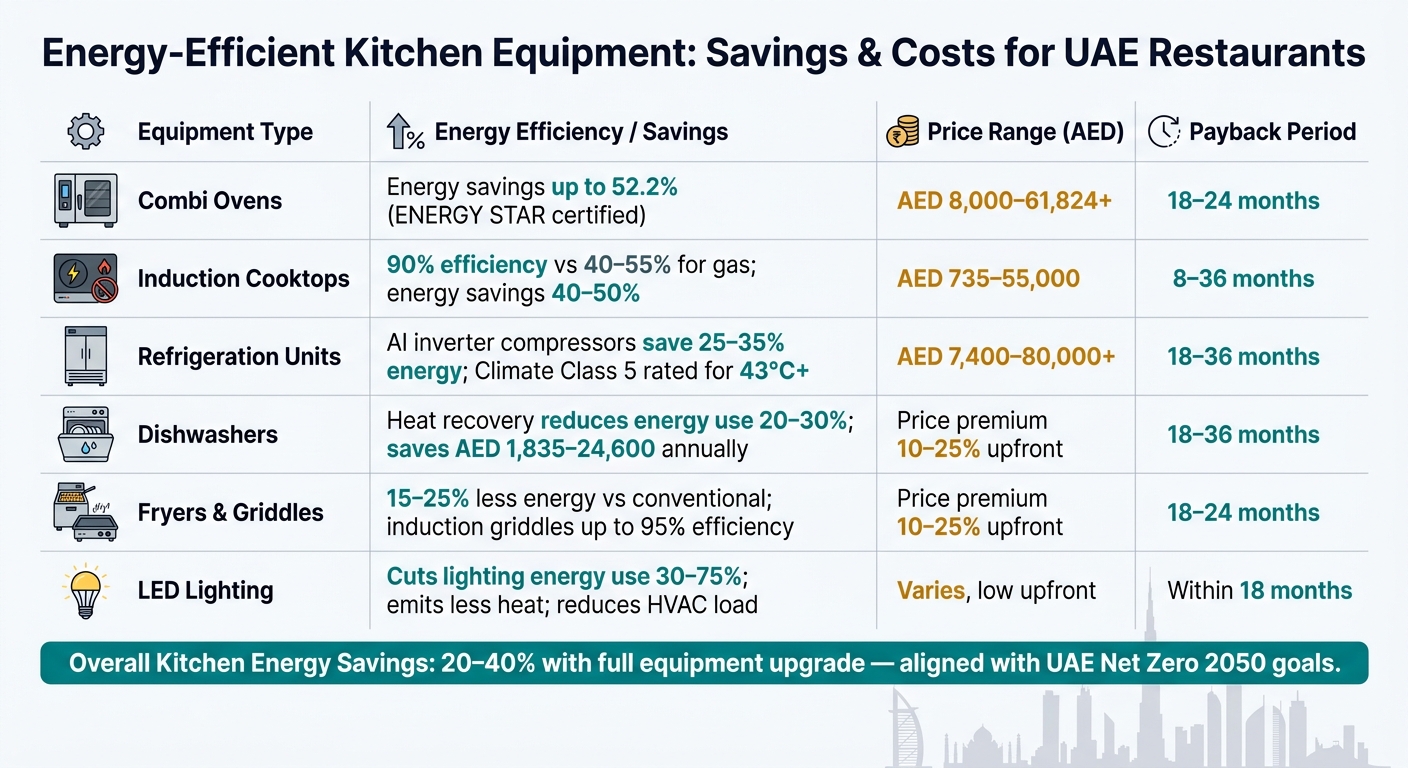
Energy-Efficient Kitchen Equipment: Savings & Costs for UAE Restaurants
Kitchen equipment expenses go beyond just the upfront price tag. In the UAE, where electricity tariffs are tiered and summer temperatures often exceed 40°C, operational costs can add up quickly. Below, we break down key equipment comparisons to help you make informed investment decisions.
When it comes to combi ovens, the Rational iCombi Pro Electric (10-tray, GN 1/1) is priced at AED 50,025, while the Unox CHEFTOP-X (XEDA-0621-GXRS) comes in at AED 92,012. The Unox model is noted for consuming 113.6 kWh/day and includes advanced features like AI-driven feedback and automatic standby mode. Both models deliver 20–35% energy savings compared to conventional deck ovens, making them a game-changer for energy-conscious kitchens. In UAE conditions, the higher upfront cost is typically offset within 18–24 months due to reduced energy usage. Other options like the Hobart COMBI 101 and Unox CHEFTOP XEVC-1011-EPRM also offer efficient heating and consistent heat distribution.
For induction cooktops, the energy efficiency is a standout benefit. Induction operates at 80–90% efficiency, far surpassing the 40–55% efficiency of gas burners. In UAE kitchens that switch from LPG, the return on investment can be achieved in as little as 8–14 months. Additionally, induction cooktops generate less waste heat, which can significantly reduce air conditioning loads and DEWA bills.
"Induction units are unaffected by altitude and are faster than gas or coil, making them the standard for energy-conscious, fast-response commercial kitchens." - Commercial Kitchen Project
On the refrigeration front, the Coldline Smart 700 (A70/1NE) is a strong contender, consuming just 0.896 kWh per 24 hours and using R290 refrigerant with a Global Warming Potential (GWP) of only 3. By comparison, the Al Tareeq URD1S-758-EL (700L, R134a) is priced at AED 7,400 but consumes 1.25 kW continuously. For larger setups, the Friulinox double-door unit (1,400L) offers impressive efficiency, operating at only 432W, with a price of AED 18,000. For UAE kitchens, selecting units rated for Climate Class 5 ensures reliable performance during the peak summer months.
These comparisons underscore the importance of balancing upfront costs with long-term savings. Calculating the Total Cost of Ownership (TCO) over 5–7 years is a practical way to assess value. This includes the purchase price, energy costs based on DEWA tariffs, and maintenance expenses. Often, equipment with a higher initial cost ends up being the most economical choice per year of operation. To make the most of your investment, consider consulting Silverline Kitchens to evaluate your current setup and identify upgrades that deliver the best returns while meeting UAE energy efficiency and compliance standards.
Conclusion
After examining ovens, cooktops, refrigeration, and other essential systems, one thing is clear: energy-efficient kitchen equipment offers immediate savings on operating costs.
But it’s not just about saving money. These systems also make compliance easier. For instance, a well-planned commercial kitchen can slash energy costs by 20–40% and cut water usage by 25–35%. Plus, electric and induction-based setups often get faster approvals from Dubai Municipality and Civil Defence compared to gas installations, which require extra fire safety measures like suppression systems and leak detection. This dual benefit of regulatory ease and energy savings ensures your kitchen runs smoothly and efficiently.
By aligning with the UAE’s Net Zero 2050 and Zero Waste to Landfill 2030 initiatives, you can avoid expensive retrofits down the line. Additionally, sustainability is becoming a key factor for diners, who increasingly favour restaurants with eco-friendly practices.
For maximum returns, upgrade in stages based on ROI. Start with LED lighting, then move to energy-efficient cooking equipment and refrigeration as outlined earlier.
When planning or upgrading your kitchen, focus on equipment that meets both energy efficiency and UAE regulatory standards. This approach prevents costly reworks later. Silverline Kitchens specialises in designing and installing setups that optimise energy use while ensuring full compliance, helping your kitchen run at its best from day one.
FAQs
Which upgrade gives the fastest payback in a UAE kitchen?
Installing LED lighting is a smart and efficient way to upgrade your UAE kitchen. It offers a quick return on investment, with costs usually recovered within 1–2 years. Another cost-effective improvement is installing waste heat recovery systems, which can often pay for themselves in less than a year. These initial upgrades not only reduce energy expenses but can also free up savings to invest in larger projects, like upgrading refrigeration or cooking equipment.
How do I check if a unit is rated for 43°C+ UAE conditions?
To ensure kitchen equipment is compatible with UAE conditions, start by reviewing the product's data sheet for regional certifications such as G-mark or SASO. These certifications indicate compliance with local standards. Additionally, check the manufacturer's specifications to confirm the appliance can operate effectively at temperatures exceeding 43°C. Finally, look for certificates of conformity that validate the equipment's performance in high-temperature commercial settings, which are common in the UAE.
What approvals do I need when switching from gas to electric or induction?
Switching to electric or induction cooking isn’t as simple as swapping out equipment - it involves getting approvals from local authorities like the municipality and Civil Defence. You’ll need to submit updated MEP (mechanical, electrical, and plumbing) drawings that show the changes in equipment and power requirements.
Make sure to check your facility’s electrical load capacity with DEWA (Dubai Electricity and Water Authority) or ADDC (Abu Dhabi Distribution Company). Additionally, all equipment must have ESMA (Emirates Authority for Standardisation and Metrology) product registration to meet regulatory standards.
Regardless of whether you’re using electric, induction, or another power source, proper ventilation systems and HACCP-based zoning are essential to ensure safety and compliance.
