


Starting a food business in Dubai? The right commercial kitchen supplier can make or break your success. Here's what you need to know:
- Compliance is Key: Dubai Municipality and Civil Defence enforce strict regulations. Your supplier must understand HACCP standards, food safety codes, and UAE-specific requirements like anti-slip flooring, proper drainage, and T3-rated refrigeration for high temperatures.
- Tailored Solutions: Your kitchen type (restaurant, bakery, cloud kitchen) and capacity needs dictate equipment choices and layout. Suppliers should design for unidirectional food flow and provide MEP drawings for approvals.
- Supplier Experience: Look for a proven track record in the UAE. Review portfolios, visit showrooms, and confirm their projects pass inspections on the first attempt.
- Equipment Quality: Opt for durable materials like Grade 304 or 316 stainless steel. Ensure equipment meets local certifications, supports energy efficiency, and includes easily available spare parts.
- After-Sales Support: Choose suppliers offering installation, preventive maintenance, 24/7 emergency services, and local spare part inventory to avoid downtime.
Selecting a reliable supplier isn't just about buying equipment - it's about ensuring your kitchen operates smoothly, meets regulations, and avoids costly delays. Companies like Silverline Kitchens offer end-to-end services, from design to compliance, making them a strong contender for businesses in the UAE.
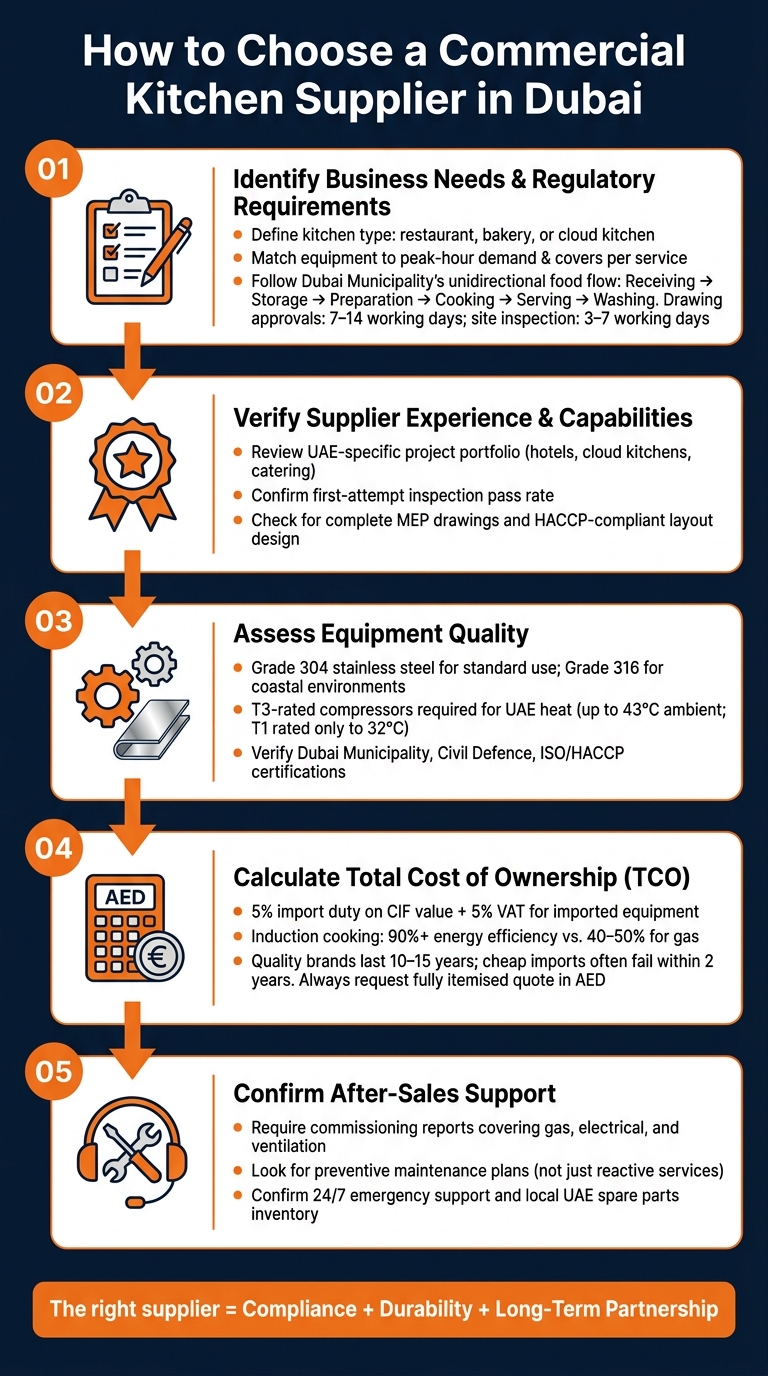
How to Choose a Commercial Kitchen Supplier in Dubai: Step-by-Step Guide
Identify Your Business Needs and Regulatory Requirements
Understanding your kitchen’s specific type and capacity can save you from making costly adjustments down the line.
Define Your Kitchen Type and Capacity
The nature of your business determines what equipment, layout, and capacity you’ll need. For example, high-volume catering businesses require industrial refrigeration and expansive cooking suites. Bakeries, on the other hand, depend on efficient deck ovens and proofing chambers, while cloud kitchens must ensure proper separation between brands. It’s also essential to evaluate your peak-hour demand - how many covers you serve per service or orders you process per hour - and select equipment that can reliably handle this workload. When designing your layout, prioritise optimised staff workflow while adhering to Dubai Municipality’s strict unidirectional food flow guidelines: Receiving → Storage → Preparation → Cooking → Serving → Washing.
Once your kitchen’s operational needs are clear, the next step is ensuring compliance with UAE’s stringent standards.
Know the UAE Compliance Standards
In Dubai, compliance is overseen by authorities like Dubai Municipality and UAE Civil Defence. Dubai Municipality enforces the UAE Food Code and HACCP principles. The process involves drawing approvals, which typically take 7–14 working days, followed by a site inspection that requires an additional 3–7 working days. Meanwhile, UAE Civil Defence ensures that systems like gas, fire suppression, and ventilation meet safety requirements.
Kitchens must also adhere to specific physical standards, such as having anti-slip flooring, smooth and washable walls, light-coloured ceilings free of exposed wiring, dedicated hand wash stations, and proper drainage slopes for grease traps.
"Dubai Municipality approval isn't just paperwork - it's a business safeguard." - Kitchen Works
"Working with experienced suppliers minimises the risk of failed inspections." - ANKE
Partnering with suppliers who understand these regulations can help you avoid unnecessary delays and failed inspections during the approval process.
sbb-itb-19c3c9a
Check Supplier Experience and Capabilities
Once you’ve nailed down your compliance requirements, the next step is finding a supplier who can actually meet them. A supplier's experience can make all the difference when it comes to ensuring your project passes inspection on the first go.
Review Past Projects in the UAE
A supplier's portfolio is like a window into their expertise. Focus on projects they’ve completed in the UAE that align with your business type. Whether it’s a hotel kitchen, a cloud kitchen, or a high-volume catering facility, each setup comes with its own unique demands. A supplier with prior experience in your specific area will already understand the workflow challenges and nuances involved.
When going through their portfolio, don’t just look at the pictures. Ask about their inspection track record. Did their projects pass inspections the first time? This tells you whether they truly understand local regulations in practice, not just in theory.
"A professional supplier helps you avoid breakdowns, delays, municipality violations, and unnecessary expenses." - Alrazana
If possible, visit their showroom. This gives you a chance to assess the quality of their work firsthand. Look at details like welding quality, surface finishing, and the materials they use. For instance, Grade 304 stainless steel is the UAE standard, while Grade 316 is better suited for coastal environments. A portfolio that demonstrates attention to detail and quality design is a good sign they can handle complex compliance requirements.
Equally important, ensure their design process reflects their experience.
Check Design and Coordination Skills
A proven track record is great, but it’s equally important to evaluate how well they can design and coordinate a compliant kitchen layout. The design isn’t just about aesthetics; it’s a critical factor in meeting regulatory requirements.
"A poorly planned kitchen design is the number one reason approvals get rejected." - Kitchen Works
Check if the supplier can provide complete MEP drawings, which Dubai Municipality requires. Their design process should seamlessly integrate critical systems right from the start to ensure compliance. Companies like Silverline Kitchens, for example, take care of everything from HACCP-compliant layouts to authority documentation, saving you the hassle of back-and-forth changes that can delay your project.
Ask pointed questions about their design approach. How do they manage unidirectional food flow? How do they separate zones for raw and cooked food? A supplier who can back their answers with specific examples - rather than vague promises - demonstrates a solid understanding of Dubai’s regulatory landscape.
Compare Equipment Quality and Cost
Once you've confirmed a supplier's experience and design capabilities, the next step is to evaluate the quality of their equipment and its long-term costs.
Assess Equipment Brands and Specifications
Start by examining the material quality. In the UAE, Grade 304 stainless steel is the standard for most commercial kitchen equipment like workbenches, sinks, and fabricated items. For coastal areas, opt for Grade 316 stainless steel, which offers better resistance to salt corrosion.
Ensure the equipment meets high standards for gauge thickness, smooth finishes, and flawless welds. Additionally, verify that it complies with all relevant local certifications, such as Dubai Municipality health and hygiene requirements, Civil Defence fire safety codes, and ISO or HACCP documentation. Don’t just take verbal assurances - request the actual paperwork.
Pay close attention to details like welds, edges, and material thickness, as these factors directly impact durability and ease of cleaning, especially in the UAE's humid climate.
Another critical factor is the availability of spare parts. If a piece of equipment breaks down, waiting weeks for imported parts can disrupt your operations. Look for suppliers who have local service teams and maintain spare parts within the UAE.
"Well-fabricated stainless steel products may cost more initially but save money in durability and hygiene." - ANKE
Calculate the Total Cost of Ownership
Once you've confirmed the quality, shift your focus to the Total Cost of Ownership (TCO). This means looking beyond the initial price to include factors like import duties, installation, energy use, and ongoing maintenance.
For imported equipment, keep in mind that commercial kitchen items typically fall under HS Chapter 84, which incurs a 5% import duty on the CIF (cost, insurance, and freight) value, plus an additional 5% VAT. These charges can add up quickly, so always request a fully itemised quote in AED. Make sure the quote breaks down costs for equipment, delivery, installation, and finishing, so you can avoid unexpected expenses later.
Energy efficiency is another key consideration. For instance, induction cooking transfers over 90% of its energy directly to cookware, compared to just 40–50% for gas. It also reduces the ambient heat in kitchens, which can lower air conditioning costs significantly.
"Induction is incredibly efficient, transferring over 90% of its energy directly to the cookware, compared to just 40–50% for gas. It slashes energy costs and drastically reduces ambient heat, lowering the burden on your air conditioning." - Lestov
Refrigeration is another area where quality matters. In the UAE, refrigeration units must use T3-rated compressors, which are designed to handle ambient temperatures up to 43°C. Standard T1 compressors, rated for only 32°C, often fail prematurely in the UAE's summer heat. Always confirm that refrigeration units come equipped with T3-rated compressors.
Finally, ask suppliers for a detailed written quote in AED that includes everything: equipment, custom fabrication if required, installation, and a maintenance plan. This will make it easier to compare true costs across suppliers and avoid any hidden charges later on.
Check After-Sales Support and Project Management
Even top-quality equipment will eventually need servicing. What sets a dependable supplier apart is how they handle this aspect - turning a one-time purchase into a lasting partnership.
"A good supplier becomes a long-term partner - not a one-time seller." - Alrazana Kitchen Equipment
Confirm Installation and Maintenance Services
Once you're satisfied with the equipment's quality and pricing, it's time to assess the supplier's post-delivery services. Before committing, make sure to clarify what their post-delivery support includes. For instance, commissioning is a must. This involves the supplier’s team handling installation, calibration, and providing written testing and commissioning reports. These reports should confirm that all systems - gas, electrical, and ventilation - are functioning correctly.
But support shouldn't stop at installation. Check if the supplier offers preventive maintenance plans instead of just reactive services. Preventive plans schedule regular inspections for high-use equipment like ovens, chillers, fryers, and extraction hoods. This proactive approach can help you avoid sudden breakdowns during busy periods.
Additionally, two critical factors to look for are 24/7 emergency support and a local inventory of spare parts. A supplier with a UAE-based service team and readily available spare parts ensures minimal downtime, eliminating delays caused by waiting for imported components.
Review Project Management Scope
Top-tier suppliers don't just provide equipment - they manage the entire project lifecycle. This includes everything from initial consultations and layout planning to the final handover. A comprehensive service also covers all the necessary documentation and site coordination for approvals from Dubai Municipality and Civil Defence. Missing details - like hand wash stations, proper drainage slopes, or adequate ventilation - can lead to inspection failures, causing expensive delays. Effective project management keeps construction on track and ensures compliance with UAE food safety and kitchen design standards.
For example, Silverline Kitchens offers an all-inclusive solution. Their services cover equipment consultation, custom fabrication, compliance with UAE regulations (such as HACCP and Dubai Municipality requirements), grease trap and drainage planning, professional installation, and after-sales support. With one company handling every stage, the risk of miscommunication drops significantly, ensuring your project stays on schedule.
"Reliable after-sales support reduces downtime and ensures smooth kitchen operations." - ANKE
When assessing a supplier’s project management capabilities, ask for a detailed timeline that outlines delivery, installation, commissioning, and inspection stages. A supplier who can stick to these milestones and provide clear documentation is worth your trust. This level of support ensures your kitchen remains efficient and compliant throughout its operation.
Conclusion
Choosing the right supplier means prioritising operational clarity, adhering to regulations, investing in durable equipment, and ensuring dependable after-sales support. Each of these factors plays a vital role in avoiding expensive mistakes and delays.
Skipping any of these critical steps can result in fines, project hold-ups, or the need for costly redesigns. For instance, poor kitchen design is a major reason why municipality approvals often get rejected. Additionally, while reputable commercial equipment brands can last 10–15 years, cheaper, unbranded imports frequently fail within just two years. This guide has outlined how following each step can help secure the success of your project.
"Selecting the right supplier is not just about purchasing appliances. It's about finding a long-term partner who understands your cuisine, your workflow, your safety requirements, and your budget." - Alrazana
Silverline Kitchens provides comprehensive services that cover everything from HACCP-compliant designs and Dubai Municipality approvals to custom fabrication, installation, and maintenance. Their all-in-one approach helps minimise risks and ensures smooth operations. Whether you're setting up a restaurant, café, or cloud kitchen, having a single team manage the entire process can significantly cut down on errors and delays.
The right supplier doesn’t just help you open on time - they ensure your operations remain compliant and efficient for years to come.
FAQs
What documents do I need for Dubai Municipality approval?
To get Dubai Municipality (DM) approval, you’ll need to prepare and submit a few key documents. Start with detailed kitchen layout plans and MEP (mechanical, electrical, and plumbing) drawings. These must highlight essential systems like ventilation, grease traps, and exhaust setups.
You'll also need to provide proof that your equipment meets safety and hygiene standards. This can include CE certificates, manufacturer data sheets, or GCC/DCL conformity documents. Don’t forget to include any relevant ISO certifications and documentation for Civil Defence approvals, especially for gas systems and fire suppression measures.
How do I confirm equipment is T3-rated for UAE heat?
To ensure equipment is rated T3 for the UAE’s intense heat, always request formal documentation and certifications from the manufacturer or supplier. Ask for technical test reports and evidence showing compliance with local safety standards. These certifications should confirm that the cooling systems and electrical components are designed to perform reliably in high-ambient temperatures. Without this, standard equipment might not withstand the extreme summer heat common in the UAE.
What after-sales support should a supplier include?
A reliable commercial kitchen supplier isn’t just about providing top-notch equipment - it’s about the support they offer after the sale. To keep your kitchen running smoothly and avoid costly disruptions, look for suppliers that provide regular maintenance services, preventive maintenance plans, and 24/7 emergency support.
It’s also essential that they handle warranty claims efficiently, have spare parts readily available, and offer hands-on staff training to ensure your team can use the equipment correctly. For quicker response times and dependable service, prioritise suppliers with service teams based locally in the UAE.
