


When setting up a restaurant in the UAE, choosing between imported and locally manufactured kitchen equipment is a key decision. This choice affects your startup costs, operational efficiency, and compliance with UAE regulations. Here's what you need to know:
- Imported equipment offers advanced features and durability but comes with higher costs and longer lead times (60–90 days). It may also require modifications to meet UAE-specific power and climate conditions.
- Locally manufactured equipment is designed for the UAE’s environment, offering cost savings, faster delivery (7–14 days), and easier access to spare parts. However, it may lack the advanced features of imported brands.
Key considerations include:
- Cost: Imported options are pricier upfront; local options save on shipping and duties.
- Performance: Imported brands excel in heavy use, while local products are tailored to UAE conditions.
- Compliance: Both must meet UAE regulatory standards like ESMA certification.
- Lead Times: Local equipment is faster to deliver, ideal for tight project deadlines.
Quick Comparison:
| Factor | Imported Equipment | Locally Manufactured Equipment |
|---|---|---|
| Upfront Cost | Higher due to shipping and duties | Lower, no import fees |
| Technology | Advanced features | Functional, region-specific designs |
| Maintenance | Expensive, delays for parts | Affordable, parts readily available |
| Climate Suitability | May struggle in UAE heat | Built for UAE’s 43°C+ conditions |
| Lead Times | 60–90 days | 7–14 days |
| Compliance | Requires certifications | Aligned with UAE standards |
For specialty cafés and fine dining, imported equipment may be ideal. For cloud kitchens or high-volume outlets, local options offer better value and reliability. Many UAE restaurants use a hybrid approach, combining both to balance quality and cost.
Pro Tip: Ensure all equipment complies with UAE regulations to avoid costly delays. Prioritize long-term performance over just upfront costs.
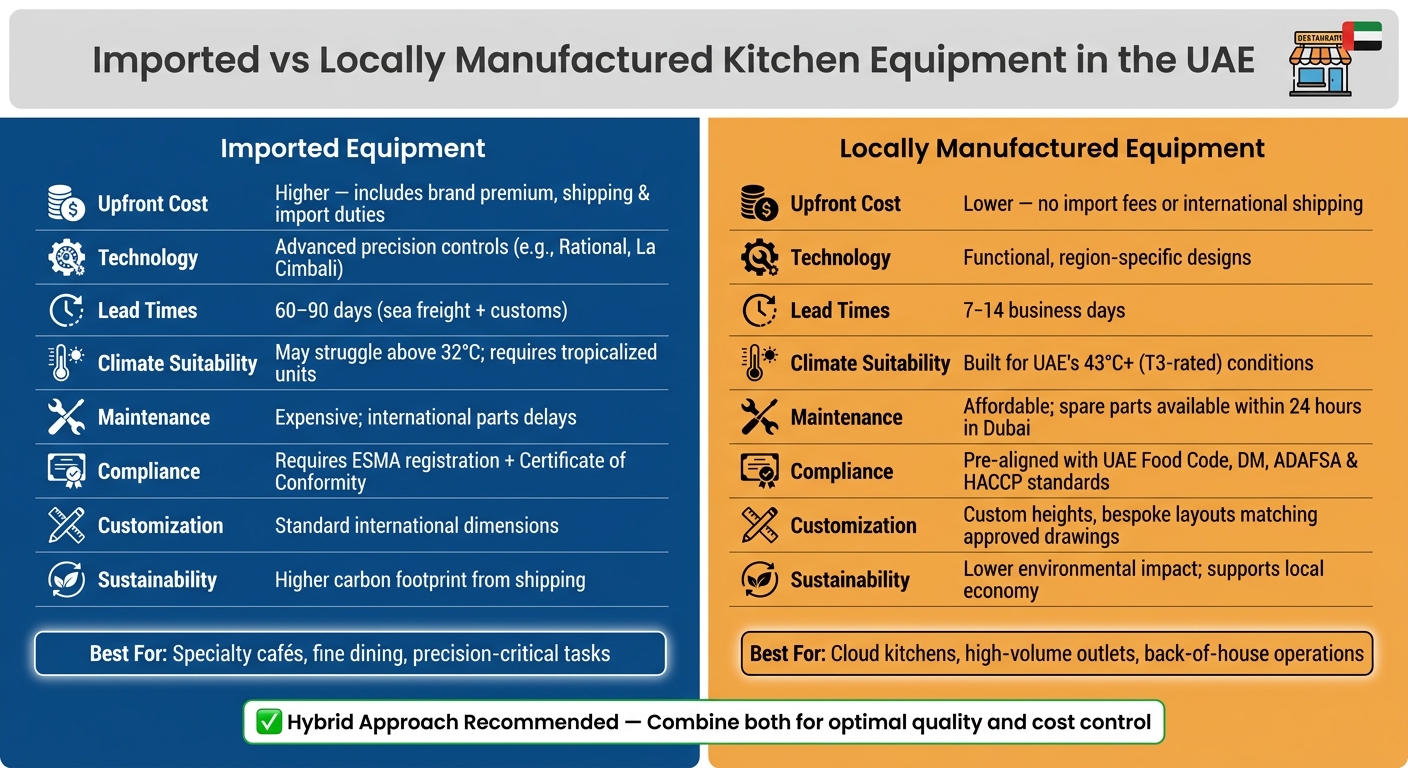
Imported vs Local Kitchen Equipment: UAE Restaurant Comparison
1. Imported Commercial Kitchen Equipment
Cost
Imported commercial kitchen equipment often comes with a hefty upfront cost. For instance, a 10-tray combination oven ranges between USD 4,200 and USD 7,800 (FOB price), excluding shipping, customs duties, and installation fees. In Dubai, gas and electrical installation alone can add another AED 2,500 to AED 8,000 per project.
But the expenses don’t stop there. Hidden costs, like sourcing spare parts internationally or hiring specialised technicians for repairs, can significantly increase the overall cost of ownership. While cost is a key factor, performance is equally vital to ensure smooth operations.
Quality and Performance
Imported equipment is known for its durability and ability to handle long hours of heavy use. Renowned brands such as Rational and Unox (combi ovens), Robot Coupe (food processors), Pitco (gas fryers), and La Cimbali (espresso machines) are designed for up to 18-hour shifts, often using high-grade materials like 304 or 316 stainless steel.
Given the UAE’s hot climate, refrigeration units with tropicalized compressors are a must. High-quality imported units are built to withstand T3 conditions (ambient temperatures up to 43°C), whereas standard European models rated for 32°C often fail in such extreme heat.
"In the UAE's high-ambient heat, a low-quality compressor in a refrigerator will fail twice as fast as a 'tropicalized' commercial unit." - Your Kitchen Center
Regulatory Compliance
Imported equipment must adhere to UAE-specific regulatory standards. Key product categories like refrigerators, ovens, and dishwashers require ESMA product registration and a Certificate of Conformity before installation.
"Certain product categories - refrigerators, ovens, and dishwashers - require mandatory ESMA product registration before they can be legally sold or installed in the UAE." - Grace Kitchen Equipment
Additionally, equipment must meet local electrical standards of 220–240V/50Hz (single-phase) or 380–415V/50Hz (three-phase). Importing 208V equipment designed for North America is a common error that can lead to costly modifications. Suppliers are expected to provide CB Scheme test reports from IECEE-accredited labs to facilitate the ESMA registration process.
Availability and Lead Times
Delivery timelines are another key factor to consider. Shipping by sea from manufacturing hubs like China to Jebel Ali Port usually takes 14 to 18 days, followed by 3 to 7 days for customs clearance. Including manufacturing lead times, the entire process from order confirmation to delivery can take 42 to 75 days. This delay can disrupt restaurant opening schedules.
For larger orders exceeding USD 50,000, consolidating shipments into full container loads can help lower freight costs and simplify customs procedures.
sbb-itb-19c3c9a
2. Locally Manufactured Kitchen Equipment
Cost
Choosing locally manufactured kitchen equipment means avoiding import duties, international shipping fees, and distributor markups, offering upfront pricing clarity from day one.
Beyond the initial purchase, ongoing costs are also lower. Spare parts are readily available within 24 hours in Dubai, minimising downtime and repair expenses. As noted by Your Kitchen Center:
"The 'cheapest' equipment on the market often delivers the highest long-term cost through energy waste, food shrinkage, and downtime." - Your Kitchen Center
Additionally, equipment designed for the UAE’s high temperatures can ease the strain on your kitchen's HVAC system, helping to lower monthly DEWA bills. These cost advantages are tailored to the unique needs of UAE kitchens.
Quality and Performance
The financial benefits are matched by operational improvements. Local manufacturers design equipment specifically for the UAE’s conditions, including the 220–240V/50Hz power supply, hard water, and temperatures exceeding 40°C. This targeted engineering reduces the likelihood of early failures that can occur with standard imported models.
Another key advantage is customisation. UAE hotel and restaurant kitchens often deviate from standard international dimensions. Local fabricators can create custom-height counters, bespoke pass tables, and non-standard worktop depths using 304 or 316-grade stainless steel with rounded edges and seamless finishes, all in line with HACCP hygiene standards. This ensures precise alignment with approved designs.
Regulatory Compliance
Locally produced equipment is typically aligned with UAE regulations, meeting standards from DM Food Safety, ADAFSA, and UAE Civil Defence.
One standout benefit is the ability to match layouts precisely. Local manufacturers can fabricate equipment to fit approved drawings, minimising the risk of mismatches during final site inspections. This is crucial, especially considering Dubai Municipality conducted over 65,000 inspections in 2023, with penalties for violations reaching AED 100,000.
However, it’s important to note that electrical appliances like refrigerators, ovens, and dishwashers - even when locally made - still require ESMA product registration before installation. Ensuring compliance from the start avoids costly delays.
Availability and Lead Times
Local manufacturing offers significantly shorter lead times. Facilities in areas like Ajman and Al Jurf can often deliver and install within 7 to 14 business days. This is a major advantage for restaurants working under tight deadlines, especially compared to the 42 to 75-day timelines typical of international orders.
For operators managing fast-track fit-outs, this level of production control removes a major hurdle in meeting project deadlines efficiently.
Pros and Cons of Each Option
Choosing between imported and locally manufactured equipment involves weighing various factors like cost, technology, and suitability. Your decision will likely depend on your specific needs, budget, and operational goals. Here's a detailed comparison to help you evaluate both options.
Imported Equipment
Premium imported brands are known for their precision engineering, making them ideal for specialty cafés or fine-dining kitchens in the UAE where performance and advanced features are crucial. However, these benefits come with higher upfront costs, and the equipment may not always align with the UAE's power specifications or withstand the region's extreme climate.
Locally Manufactured Equipment
Locally produced equipment is tailored to the UAE's unique conditions, offering a more budget-friendly option with quicker delivery and easier maintenance. However, these models might not include the advanced features often found in imported brands.
| Factor | Imported Equipment | Locally Manufactured Equipment |
|---|---|---|
| Upfront Cost | Higher due to brand premium and shipping | Lower, making it more affordable |
| Technology | Advanced features and precision controls | Practical and functional, though less specialised |
| Maintenance | More expensive, with potential delays for parts | Cost-effective with readily available parts |
| Climate Suitability | May struggle with high temperatures and humidity | Designed for UAE's T3-rated conditions (43°C) |
| Lead Times | 60–90 days through international distributors | 25–45 days via local fabricators |
| Compliance | Often requires additional certifications | Built to meet UAE Food Code and HACCP standards |
| Sustainability | Higher carbon footprint due to shipping | Lower environmental impact, supporting local economy |
Another key factor to think about is the total cost of ownership. As ANKE highlights:
"Well-fabricated stainless steel products may cost more initially but save money in durability and hygiene."
This reinforces the idea that upfront costs aren’t the only consideration - long-term performance and maintenance also play a big role in your decision.
Conclusion
Choosing between imported and locally manufactured equipment isn't a one-size-fits-all decision - it depends entirely on your kitchen's specific needs and priorities.
Based on the comparisons above, the best choice often depends on your restaurant type. For specialty cafés and fine-dining establishments, imported equipment from brands like La Marzocco or Rational is a must. These brands deliver the precision and performance needed to maintain top-tier service quality. On the other hand, cloud kitchens, high-volume outlets, and standard back-of-house operations may benefit more from locally manufactured or regionally sourced equipment. These options are better suited to the UAE's challenging heat and humidity, cost less upfront, and are generally easier to maintain.
Many operators in the UAE adopt a hybrid approach: using imported equipment for tasks where precision and guest experience are paramount, while relying on locally fabricated items like stainless steel worktables, sinks, exhaust systems, and refrigeration for durability and cost control. This method strikes a balance between managing expenses and maintaining quality.
It's also crucial to ensure that all equipment complies with UAE regulatory standards. Non-compliance can lead to expensive delays, so this step is essential.
Silverline Kitchens recommends a balanced strategy. By aligning your equipment choices with your budget and operational needs, you can create a kitchen that performs efficiently without overspending. At Silverline Kitchens, we offer tailored solutions, sourcing and fabricating equipment that meets your requirements while adhering to UAE regulations. Our comprehensive project management and after-sales support ensure your kitchen operates smoothly from day one.
FAQs
Which kitchen items should I import, and which should I buy locally?
Choosing between imported and locally manufactured equipment often comes down to your specific needs and budget. Locally manufactured items like stainless steel worktables, shelving, sinks, and extraction hoods are a smart choice. They can be customised to fit your layout perfectly and are designed to comply with UAE regulations, including those from Dubai Municipality and HACCP.
On the other hand, importing equipment makes sense for high-end specialty appliances. Advanced coffee machines or unique cooking technologies that aren’t available locally can offer features and innovations to enhance your operations.
What certifications do I need before installing equipment in the UAE?
To set up commercial kitchen equipment in the UAE, you need to follow federal and local safety regulations closely. Start by obtaining operational clearance from the local municipality. This requires submitting approved kitchen layouts along with MEP (Mechanical, Electrical, and Plumbing) drawings.
Key certifications to keep in mind include ECAS or EQM issued by the Ministry of Industry and Advanced Technology (MoIAT). Additionally, recognised international safety marks like CE or NSF/ANSI 4 are essential. Make sure your equipment also complies with standards set by Civil Defence and utility authorities such as DEWA (Dubai Electricity and Water Authority) or ADDC (Abu Dhabi Distribution Company).
How do I choose equipment that won’t fail in UAE summer heat?
To maintain dependable performance during the UAE's intense summer heat, focus on the following:
- Durable materials: Opt for Grade 304 or 316 stainless steel, which are resistant to corrosion and capable of enduring high temperatures.
- Energy-saving technology: Use well-insulated refrigeration units and induction cooking systems to minimise heat-related strain.
- Accessible local support: Ensure availability of spare parts, professional installation services, and adherence to UAE-specific regulations.
