


Want to pass your Dubai Municipality kitchen inspection without delays? Here's what you need to know:
Failing this inspection can lead to costly changes, fines, and delays in starting your business. To succeed on your first attempt, focus on these key areas:
- Kitchen Design: Ensure a unidirectional food flow (receiving → washing → preparation → cooking → serving → washing) with clear separation of raw and ready-to-eat zones.
- Structural Standards: Use anti-slip flooring, washable walls, and food-grade stainless steel surfaces.
- Temperature Control: Maintain raw meat at 0–5°C, dairy at 0–4°C, and hot food at 63°C or above.
- Hygiene Facilities: Install handwash basins with non-manual taps (1 per 5 staff).
- Fire Safety: Comply with Dubai Civil Defence (DCD) fire safety regulations, including suppression systems and gas safety measures.
- Waste Management: Use DM-approved contractors for waste disposal, grease trap cleaning, and pest control.
- Staff Training: All staff must complete DM-regulated food hygiene training and register on the FoodWatch platform.
Pro Tip: Partner with a DM-registered engineering firm to streamline approvals and avoid costly mistakes. First-time approval rates with experts are 98%.
Planning and Designing a Compliant Kitchen
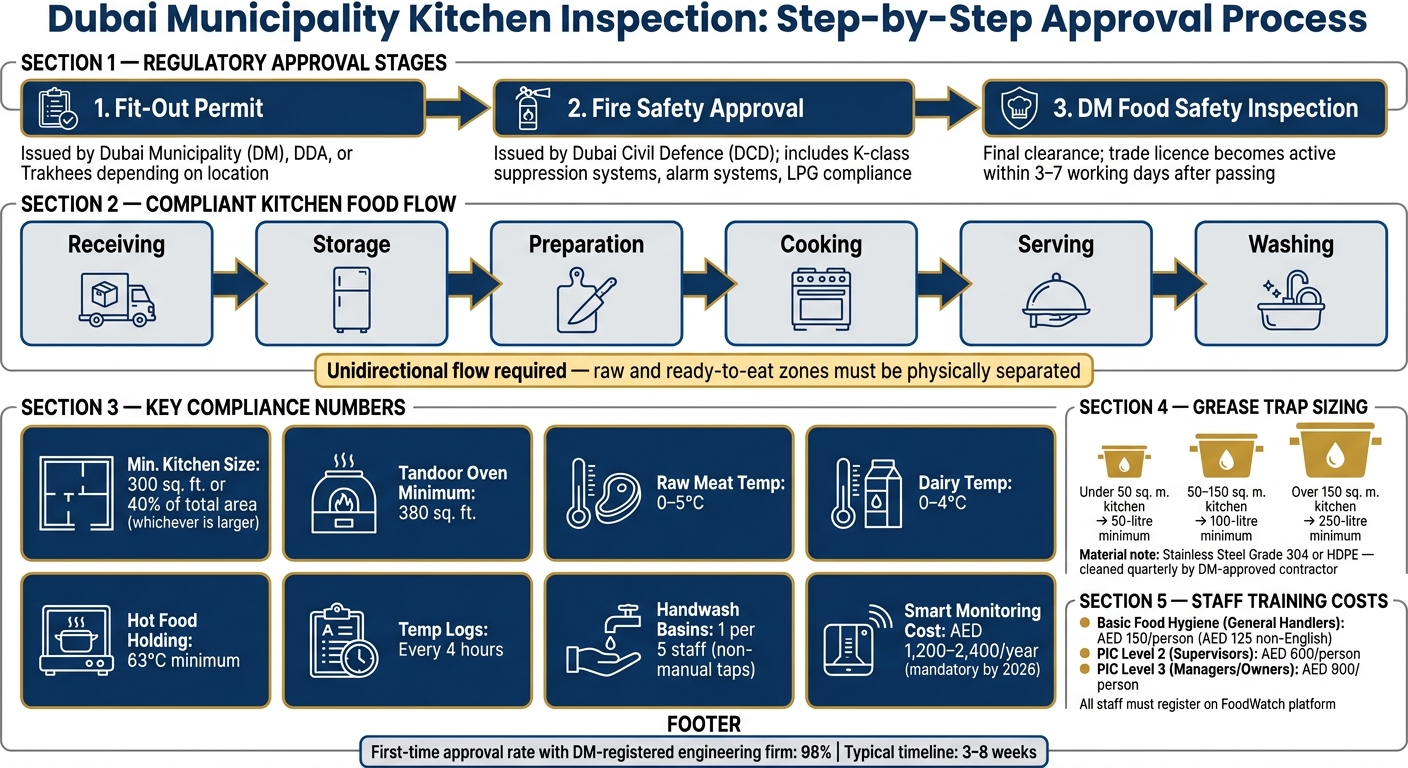
Dubai Municipality Kitchen Inspection: Step-by-Step Approval Process
Designing a commercial kitchen in Dubai requires meticulous planning to avoid delays and unexpected costs, which can extend beyond the typical timeline of 3–8 weeks.
Understanding Approval and Licensing Stages
The approval process involves several regulatory steps, with different authorities reviewing your plans in sequence. First, your kitchen drawings must secure a fit-out permit from Dubai Municipality (DM) or the relevant authority, such as DDA or Trakhees, depending on your location. After that, Dubai Civil Defence (DCD) must approve fire safety systems. Finally, a DM Food Safety inspection is necessary before your trade licence becomes active. The costs for fit-out permits and DCD approvals depend on the size and scope of your project.
To minimise rejections and costly revisions, it’s wise to engage a DM-registered engineering firm early in the process. Companies like Silverline Kitchens specialise in managing these steps, ensuring compliance with DM and DCD requirements, planning drainage systems and grease traps, and sourcing equipment. This approach helps operators avoid discovering compliance issues after construction begins.
Once approvals are in place, the focus shifts to designing a kitchen layout that adheres to strict regulations for food flow and zoning.
Designing for Food Flow and Zoning
A compliant kitchen layout must follow a logical, unidirectional sequence to prevent cross-contamination:
- Receiving → Storage → Preparation → Cooking → Serving → Washing
It’s also essential to separate raw and ready-to-eat food zones using physical barriers or clearly designated counters.
"The most common inspection failure is a kitchen layout where raw meat storage, raw preparation area, and cooked food serving area are not clearly separated by physical barriers, separate counters, or documented operational procedures." - Dar Al Naseeb
Additionally, refrigeration zones must be clearly defined. For example, raw meat should be stored in a fridge maintained at 0–5°C, dairy at 0–4°C, and frozen items in a separate freezer. Cleaning chemicals must have their own storage area, completely isolated from food zones. Staff facilities like restrooms and changing areas should not open directly into food preparation spaces.
The kitchen size must meet minimum requirements: at least 300 sq. ft. or 40% of the restaurant’s total area, whichever is larger. If you plan to install a tandoor oven, the minimum space requirement increases to 380 sq. ft..
After zoning and layout are finalised, attention must turn to the structural and material standards required for approval.
Structural and Material Standards
To pass inspections, your kitchen’s structural elements must meet stringent hygiene and durability criteria. Floors should be anti-slip, smooth, and washable, with proper slopes to ensure water drains efficiently. Walls need smooth, crack-free, and washable finishes to prevent bacterial growth, while ceilings must be light-coloured and free of exposed wiring or cracks.
Drainage systems are another critical factor. Install a grease trap made from stainless steel (minimum grade 304) or high-density polyethylene, ensuring it meets the capacity requirements for your kitchen size. Place grease traps in accessible locations to allow for quarterly cleaning by DM-approved services. Retrofitting access later can disrupt operations and lead to higher costs.
sbb-itb-19c3c9a
Meeting Food Safety and Hygiene Requirements
Once your kitchen layout is finalised, the next step is ensuring compliance with food safety and hygiene standards. This is a critical focus for Dubai Municipality (DM) inspectors and an area where many kitchens fall short. These measures are integral to your kitchen's design, creating a comprehensive compliance framework.
Implementing HACCP and Food Safety Management
A Hazard Analysis and Critical Control Points (HACCP) plan is a non-negotiable requirement for DM approval. This plan must outline every stage in your kitchen where contamination risks could arise, from receiving raw ingredients to serving finished dishes, and detail how each risk is mitigated.
For example, hot food must be kept at a minimum of 63°C, with digital temperature readings logged every four hours. By 2026, all kitchens will need to connect to a 24/7 smart monitoring system, which comes with an annual cost of AED 1,200–AED 2,400.
If you're operating a multi-brand cloud kitchen, DM requires a separate food handling protocol for each brand’s menu categories. This ensures clear procedures are in place to prevent cross-contamination between brands.
Staff Hygiene and Training Requirements
Every member of your kitchen staff must hold a valid DM-regulated food hygiene certification, which must be registered on the FoodWatch platform.
"FoodWatch registration will be a must for all trainees." - Bobby Krishna Thulasi, Food Safety Specialist, Dubai Municipality
Training is divided into levels based on job roles. General food handlers must complete Basic Food Hygiene training, which costs AED 150 per person (or AED 125 for sessions in non-English languages). Supervisory staff are required to complete Person In Charge (PIC) Level 2 training at AED 600, while managers and owners must take PIC Level 3 training, costing AED 900. These prices are fixed, and no provider is allowed to charge more or less than the set amounts.
Additionally, your kitchen must have at least one dedicated handwashing basin for every five food handlers. These basins, equipped with elbow- or foot-operated taps, must be located within food preparation areas. Improper placement of these basins is a common reason for inspection failures, so double-check their locations before the inspection.
Cleaning, Disinfection, and Pest Control
A documented cleaning and disinfection schedule is essential for inspector review. This includes cleaning surfaces, sanitising equipment, and managing waste. Waste bins must be covered and separated into specific streams - food waste, packaging, recyclables, and used cooking oil each require their own container.
For pest control, you must hire a DM-approved contractor and maintain a valid service contract on file. The same rule applies to used cooking oil disposal - you’ll need a separate DM-approved disposal contract. Even if an unapproved contractor does excellent work, it won’t meet compliance standards on paper.
Grease traps must be cleaned quarterly by a DM-approved service provider. Keep detailed records of these cleanings on-site, as inspectors will request to see them. Staying organised and up to date with these records is key to passing inspections.
Equipment, Fire Safety, and Utilities Compliance
Once food safety and hygiene measures are in place, it’s time to focus on your kitchen’s physical infrastructure. This includes equipment, fire safety systems, and utilities, which must meet the standards set by Dubai Municipality (DM) and Dubai Civil Defence (DCD). These technical elements work alongside design and safety requirements to ensure a smooth DM inspection.
Food-Grade Equipment Standards
All kitchen equipment must be made from smooth, non-absorbent materials to allow for easy cleaning and maintenance. Proper clearance from walls and neighbouring units is essential to ensure hygiene and accessibility. Refrigeration equipment must adhere to the previously mentioned guidelines. With these basics in place, the focus shifts to fire safety compliance, a critical step in meeting final approval.
Fire Safety and Civil Defence Standards
DM and DCD approvals are distinct processes. While DM oversees food safety, DCD ensures fire safety compliance. For commercial kitchens, K-class wet chemical suppression systems are mandatory above cooking equipment. The amount of extinguishing agent is calculated using the 2026 formulas based on the hood’s coverage area. Suppression nozzles must fully cover deep-fat fryers, and a written post-discharge cleanup protocol is required before obtaining a permit.
Manual fire alarm pull stations should be installed within 5 metres of cooking equipment. The alarm system must produce at least 70 dB and connect to a DCD-approved 24/7 smart monitoring station. Annual monitoring costs typically range between AED 1,200 and AED 2,400. For kitchens using LPG, additional DCD approval is needed. This includes installing gas detection sensors (one for every 25 sq. m.), automatic solenoid shut-off valves, LPG manifolds placed at least 3 metres from heat sources in ventilated enclosures, and flexible gas hoses no longer than 1.5 metres, which must not be concealed.
Fire suppression is just one part of the equation. Ensuring your mechanical, electrical, and plumbing systems meet standards is equally critical.
Mechanical, Electrical, and Plumbing (MEP) Requirements
Kitchen hoods must fully cover all cooking equipment and include grease filters and ducting that expels air outside the building. MEP drawings must match the actual exhaust and ventilation system installed - discrepancies can lead to inspection failures. Grease trap size is determined by kitchen area:
- Kitchens under 50 sq. m.: Minimum 50-litre capacity
- Kitchens between 50–150 sq. m.: At least 100 litres
- Kitchens over 150 sq. m.: 250 litres or more
Grease traps must be made from stainless steel (Grade 304 or higher) or HDPE, with drainage pipes sloped to avoid backflow and accessible for cleaning. Water tanks must be cleaned twice a year as per DM regulations.
Electrical systems must be installed by DEWA-approved technicians. All wiring must be concealed, and panels must be free from overheating or corrosion. Emergency lighting and manual call points are required at each exit. Non-compliance with life-safety systems can result in fines ranging from AED 5,000 to AED 50,000.
Preparing for Inspection Day and Avoiding Common Failures
With your MEP systems and utilities ready, the final task is ensuring your kitchen setup matches the approved plans exactly.
Pre-Inspection Self-Audit Checklist
Before inspection day, carefully compare your kitchen layout to the approved Dubai Municipality (DM) drawings. Any discrepancies between the actual setup and the plans can lead to inspection failure, as layout mismatches are one of the most common issues cited by inspectors. Beyond ensuring the layout is correct, check that all hand wash stations are fully stocked with soap and sanitiser, and confirm that non-manual taps are functioning properly. Ventilation systems should be tested, drainage verified, and all surfaces inspected to ensure they are intact, washable, and free of defects.
Make sure all necessary documentation is organised and easily accessible. This includes contracts, logs, and records - missing paperwork can delay approval just as much as physical issues.
Once your self-audit is complete, familiarise yourself with the inspection process to understand what inspectors will focus on during their visit.
How a Typical Dubai Municipality Inspection Works
A DM inspection is a methodical process. The inspector will first check that your kitchen’s physical layout matches the approved drawings exactly. They will then assess key systems, such as hand wash stations, ventilation hoods, drainage, and grease traps, to ensure they are fully operational. Inspectors also evaluate whether your kitchen maintains a clear and logical food flow: Receiving → Storage → Preparation → Cooking → Serving → Washing. There should be no cross-movement between raw and cooked food zones.
Structural surfaces and hygiene infrastructure, such as dedicated sinks and soap dispensers with non-manual taps, are also reviewed. After the walkthrough, the inspector will examine your documentation to confirm that all records and layouts align with earlier approvals. If everything is in order, you can expect operational clearance within 3 to 7 working days after the inspection.
Understanding this process helps pinpoint the common reasons inspections fail.
Common Reasons Inspections Fail
The majority of inspection failures stem from a few recurring issues, with the most critical being the lack of proper separation between raw and cooked food zones. Other frequent problems include missing or incorrectly placed hand wash stations, inadequate drainage slopes, and ventilation systems that fail to cover cooking equipment effectively. Inspectors also pay close attention to refrigeration temperatures - raw meat should be stored at 0–5°C, dairy at 0–4°C, and digital logs must be updated at least every 4 hours. Hot food holding below 63°C is another common failure point.
If your kitchen operates as a cloud kitchen, be prepared for additional scrutiny. These setups often face stricter reviews, particularly around brand separation and shared storage areas. Addressing these potential issues before the inspection can save you from costly delays and re-inspections.
Key Takeaways for Passing Your Dubai Municipality Kitchen Inspection
The key to passing your Dubai Municipality kitchen inspection on the first try is simple: plan before you build. Many approvals are rejected due to poorly thought-out kitchen designs. Making changes after your drawings are approved can also lead to inspection failures. To avoid this, focus on critical aspects like maintaining a strict unidirectional food flow, proper temperature controls, and fire safety compliance.
Ensure you keep updated temperature logs, have valid waste disposal contracts, and make sure all documentation matches your approved plans. When paired with professional expertise, these steps can make the approval process much smoother.
Working with DM-registered engineering firms can significantly increase your chances of first-time approval. These experts manage multiple permits - such as DM Food Safety, Civil Defence, and fit-out permits - at the same time. This streamlined approach can reduce the entire process to just 3–8 weeks. Companies like Silverline Kitchens handle every detail, from compliance-focused designs and MEP drawings to grease trap planning and equipment installation, ensuring you’re set up for inspection success.
FAQs
What documents should I have ready for the Dubai Municipality inspection?
To meet the requirements of a Dubai Municipality inspection, ensure you have the following documents ready:
- Trade Licence and Food Establishment Permit: These confirm your business is officially registered and authorised to operate.
- Food Safety Management System Documentation: Includes records that demonstrate your compliance with HACCP guidelines.
- Kitchen Layout and Equipment Plans: Approved designs that align with hygiene and safety regulations.
- Fire Safety Certificates: Proof of fire safety compliance, approved by Civil Defence authorities.
- Staff Training Records: Documentation showing that your team has undergone food safety and hygiene training.
- Maintenance Logs: Detailed records of equipment maintenance, cleaning schedules, and inspections.
How do I fix a kitchen layout mismatch with the approved DM drawings?
To resolve a mismatch with the approved Dubai Municipality (DM) kitchen layout, start by carefully reviewing the approved drawings to pinpoint any inconsistencies. Once identified, adjust your kitchen layout accordingly to match the approved design. This might involve repositioning equipment or rearranging specific zones to align with DM standards.
It's a good idea to consult a designer or compliance expert to ensure that any changes you make adhere to the required regulations. If modifications are significant, update all necessary documentation and submit it for approval. This step is crucial to ensure compliance and successfully pass inspections.
What should I do if my kitchen fails the DM inspection?
If your kitchen doesn't pass the Dubai Municipality inspection, the first step is to carefully review the inspection report. This will help you pinpoint the areas of non-compliance, whether it's related to hygiene, equipment, or safety standards.
Take immediate action to address these issues. This could involve deep cleaning, repairing faulty equipment, or updating safety practices. Once you've resolved everything, schedule a re-inspection to ensure your kitchen meets the required standards and gains approval to operate. Make sure all your corrective measures strictly follow the relevant guidelines to avoid any further setbacks and get back to business without unnecessary delays.
