


Setting up a commercial kitchen in the UAE is no small task. The process must align with stringent regulations from Dubai Municipality, Civil Defence, and other authorities. From layout to equipment, every element must meet specific standards to ensure food safety, hygiene, and fire safety compliance. Here's what you need to know:
- Space Requirements: Kitchens must occupy at least 40% of the restaurant area or a minimum of 28 m².
- Workflow Design: A "Raw to Cooked" uni-directional flow is mandatory to avoid cross-contamination.
- Material Standards: Surfaces must use SS 304 stainless steel, and flooring must be seamless and non-absorbent.
- Fire Safety: Fire suppression systems and fire-rated ventilation are essential.
- HVAC Systems: Kitchens need specialised ventilation due to the UAE's hot climate.
Key Takeaway: Proper planning and expert guidance are critical to avoid costly retrofits and ensure compliance from the start. Specialists can help design efficient, regulation-compliant kitchens tailored to your needs.
UAE Kitchen Design Standards and Compliance Requirements
Running a commercial kitchen in the UAE comes with a host of regulations enforced by Dubai Municipality (covering food safety, hygiene, and drainage), Dubai Civil Defence (focusing on fire safety and suppression systems), and DEWA (addressing utility loads and MEP capacity). These rules revolve around three key areas: HACCP compliance and hygiene standards, space and workflow regulations, and fire safety and ventilation requirements. Together, these standards ensure that kitchens operate safely and efficiently right from the start.
HACCP Compliance and Hygiene Standards
Dubai Municipality mandates that all commercial kitchens implement HACCP (Hazard Analysis and Critical Control Points) principles. This involves identifying and managing contamination risks at every step - from receiving raw ingredients to serving finished dishes.
Physical separation of work zones is a must. Kitchens need distinct areas for raw meat preparation, vegetable handling, and ready-to-eat food processing. Handwash stations must be located away from food prep sinks and equipped with non-hand-operated faucets, such as elbow, foot, or sensor-activated types. To minimise moisture and bacteria build-up, floor-to-wall joints must be coved, not angled.
Material choices are also tightly regulated. All food contact surfaces must use SS 304 grade stainless steel, as lower grades like SS 201 are prone to rust in the UAE's humid conditions. Flooring must be seamless and non-absorbent, with polyurethane or epoxy finishes preferred over traditional tiles. Kitchen walls in food handling areas must be tiled or clad with stainless steel to at least 2 metres in height.
Dubai Municipality Space and Workflow Regulations
Dubai Municipality enforces specific spatial guidelines for commercial kitchens. According to the "40% rule", your kitchen must occupy at least 40% of the total restaurant area or a minimum of 300 sq. ft (approximately 28 m²), whichever is greater. Failing to meet these requirements can result in permit rejections. As NMT Services highlights:
Retrofitting a finished kitchen costs 3x more than building it right the first time.
Workflow design must adhere to a uni-directional "Raw to Cooked" layout as outlined in Dubai Municipality guidelines. Equipment placement should also allow for easy access and cleaning, following the municipality's standards.
Once spatial and workflow requirements are addressed, fire safety becomes the next critical consideration.
Civil Defence Fire Safety and Ventilation Standards
Fire safety and ventilation systems are vital for ensuring kitchen safety. Dubai Civil Defence requires fire suppression systems for all cooking areas, particularly those using open flames or grease-heavy equipment. These systems must be incorporated into the initial kitchen design and clearly shown in MEP plans.
Ventilation systems are equally important for both hygiene and fire safety. Exhaust ducts must extend at least 2 metres above the nearest structure to manage odours, and all ductwork must be fire-rated for at least 120 minutes. Kitchens must maintain negative pressure to contain cooking odours, while a Fresh Air Handling Unit (FAHU) ensures a steady supply of fresh air for staff safety.
Additionally, grease traps are mandatory for all wastewater from cooking areas before it enters the main sewage system. These traps should be sized appropriately for the kitchen's capacity and installed for easy maintenance. Depending on the kitchen's layout and size, fire-rated walls or partitions may also be required to separate cooking areas from storage or dining spaces.
All fire safety and ventilation systems must gain approval from Dubai Civil Defence through detailed design submissions, followed by a final on-site inspection before the kitchen can begin operations.
sbb-itb-19c3c9a
What Food Service Kitchen Design Specialists Do
In the UAE, where strict HACCP and fire safety standards are the norm, food service kitchen design specialists play a vital role in aligning your business vision with regulatory demands. They take your menu, service volumes, and operational workflows and convert them into layouts that meet the requirements set by Dubai Municipality, Civil Defence, and the emirate-level Food Control Department. But their work doesn’t stop at blueprints - they also manage equipment procurement, coordinate with Mechanical, Electrical, and Plumbing (MEP) teams, and ensure everything complies with local regulations. Their expertise bridges the gap between efficient design and adherence to safety and compliance standards.
Custom Layouts and Workflow Optimisation
Specialists carefully study your menu and service model to design layouts that minimise cross-contamination while boosting efficiency. For instance, the layout for a café will differ significantly from that of a full-service restaurant to ensure smooth operations. They also incorporate hygiene-focused measures, such as colour-coded cutting boards - green for vegetables and red for meat - to maintain strict food safety standards. In coastal locations like Jumeirah or Corniche, they often recommend using Grade 316 stainless steel instead of Grade 304, as it offers better resistance to salt corrosion.
Equipment Sourcing and Compliance Verification
Designing an efficient layout is only part of the job; sourcing the right equipment that meets local certification standards is equally crucial. In Abu Dhabi, for example, specialists look for equipment certified with the QCC Trustmark to guarantee both safety and performance. They ensure refrigeration units are properly sealed and maintain the required temperatures, which is essential in the UAE’s hot climate to comply with HACCP cold chain standards. Cooking equipment is also checked to ensure it meets DEWA power consumption limits, avoiding costly upgrades. With risk-based inspections becoming the focus for UAE authorities in the coming years - especially for high-risk operations handling perishables or ready-to-eat foods - equipment must be robust and ready to meet these heightened standards.
Grease Traps, Drainage, and MEP Systems Integration
Specialists also handle the technical side, ensuring grease traps and MEP integrations meet local regulations. They work closely with MEP teams to incorporate fire suppression systems into exhaust hoods, aligning with fire safety requirements. As the Abu Dhabi Quality and Conformity Council highlights:
Ventilation shall be sufficient to reduce food contamination from air and to control ambient temperature, odours, and humidity.
This collaborative approach ensures that electrical systems, water supply lines, drainage, and ventilation all work seamlessly - not only during installation but also during future inspections. By addressing these critical details, specialists help create kitchens that are functional, safe, and fully compliant.
Silverline Kitchens: Commercial Kitchen Design Services
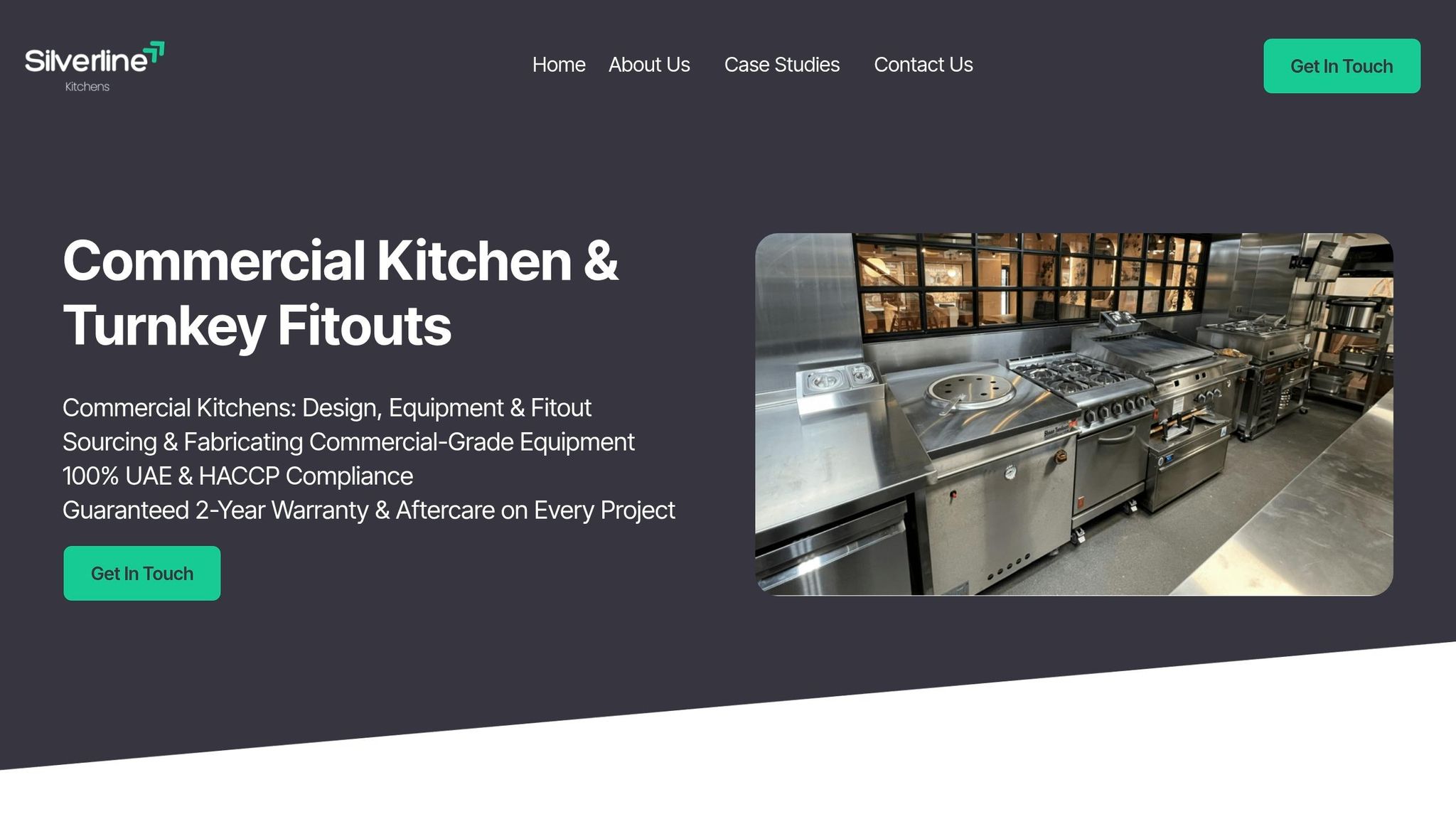
With 30 years of UK expertise brought to the UAE, Silverline Kitchens specialises in creating commercial kitchen solutions that comply with local regulations, from the first consultation to the final handover. Their services cater to a wide range of clients, including restaurants, cafés, hotels, bakeries, catering facilities, cloud kitchens, and large-scale food production units. Notable names like Tesco, HMP Prisons, Choithrams, and Filli Cafe have trusted Silverline Kitchens to design kitchens tailored to their specific menus and operational needs. Below is a closer look at their key service offerings.
Custom Kitchen Design and Installation
Silverline Kitchens begins every project with a detailed consultation, evaluating your menu and service volumes to craft layouts that adhere to UAE regulations. By ensuring compliance with the UAE Food Code and Dubai Municipality standards, they guarantee smooth inspections and approvals, providing kitchens that are both safe and efficient.
Their service doesn’t stop at design. It includes sourcing and fabricating equipment, installing systems like extraction, fire suppression, mechanical ventilation, and grease traps, and integrating everything seamlessly. They even specialise in creating commercial-grade "Chef's kitchens" for large villas, staying registered with major UAE developers. Every project comes with a 2-year warranty and aftercare support, ensuring reliability and peace of mind.
Renovation, Maintenance, and After-Sales Support
For those looking to modernise existing kitchens, Silverline Kitchens offers renovation services to improve layout efficiency, safety, and compliance with current regulations. Whether you’re starting fresh or upgrading an older space, they focus on optimising workflow, enhancing safety, and boosting overall productivity.
Post-installation, their dedicated maintenance and repair team ensures your kitchen stays operational and compliant for years to come. This ongoing support minimises downtime and extends the life of your equipment, making sure your kitchen remains a well-oiled machine long after the handover.
How to Achieve a UAE-Compliant Kitchen: Step-by-Step

4-Step Process to Achieve UAE-Compliant Commercial Kitchen Design
If you're aiming to set up a kitchen that meets UAE regulations, it's not just about ticking boxes - it's about creating a space that operates smoothly and legally from the start. Here's how you can achieve that, step by step.
Step 1: Site Assessment and Menu Analysis
Start with your menu. List every dish you plan to serve and identify the equipment you'll need - whether it's a tandoor, a pizza oven, or a pastry station. Your menu isn't just a list of offerings; it drives the design and layout of your kitchen.
Next, confirm your property's zoning and identify the governing authority, such as Dubai Municipality or ADAFSA. If you're in a development managed by Emaar, Nakheel, or Miral, you’ll need their additional approvals. Also, secure utility approvals from DEWA or ADDC early on to ensure your kitchen's electrical load matches commercial requirements.
Assemble your team of experts: a main contractor, an MEP consultant, and an interior fit-out company. Make sure they're experienced with government approval processes to avoid costly delays.
Step 2: Regulatory Checklist and Floor Plan Development
Design your kitchen with a clear, linear workflow: Receiving/Storage → Preparation → Cooking → Assembly → Washing. This setup minimizes cross-contamination and keeps staff movements efficient. Pay special attention to dedicated zones for meat, poultry, and fish preparation, as these are a key focus for HACCP compliance checks.
Choose materials that meet hygiene standards. Floors must slope toward drains to prevent water pooling - something inspectors will flag immediately. Ensure your architectural and MEP drawings are submitted to Civil Defence for fire safety approval. You'll need to install a wet-chemical fire suppression system (like ANSUL) in your kitchen hood, sized correctly based on your equipment's BTU output. Don't forget to include handwash stations with non-manual faucets, placed separately from food prep sinks.
Step 3: Equipment Sourcing and Installation
Pick equipment that aligns with your menu and meets UAE compliance standards. For wet areas, all electrical outlets must be IP66-rated waterproof. Equipment should be raised at least 150 mm off the ground, either on legs or wheels, to make cleaning easier - inspectors will check this detail specifically.
Install a fire suppression system with automatic shut-offs. Ensure all drainage from cooking areas passes through a grease trap before entering the main sewage line. If your menu involves heavy grease cooking, like burgers or steaks, additional filtration systems such as electrostatic precipitators (ESP) and carbon filters are required. Exhaust ducts must extend at least 2 metres higher than the nearest building to avoid odour complaints.
"Retrofitting a finished kitchen costs 3x more than building it right the first time." - NMT Services
Getting the equipment placement and MEP integration right during installation can save you time and money later. Expert guidance at this stage ensures everything is set up according to operational and regulatory standards.
Step 4: Final Inspections and Handover
Begin with your Civil Defence inspection to confirm that fire suppression systems, ventilation, and emergency exits are in order. Once cleared, schedule your Municipality health inspection. Inspectors will focus on HACCP compliance, equipment standards, drainage slopes, and the placement of hygiene stations.
After passing all inspections, you'll receive your Food Trade Licence, allowing you to operate legally. Post-approval, set up mandatory testing schedules: drinking water quality every 3–6 months, ice quality monthly, and surface hygiene checks weekly to bi-weekly. Ensure you have at least one certified Person In-Charge (PIC) on staff, as required by UAE Federal Law No. 10 of 2015. This PIC should have clearly defined responsibilities to maintain compliance.
Common Kitchen Design Mistakes and How to Avoid Them
Following UAE kitchen design standards is crucial. Overlooking common design mistakes can lead to inspection failures, operational hiccups, and expensive retrofits. With commercial kitchens accounting for over 30% of a project's total investment, getting the design right from the start is non-negotiable.
Choosing the Right Flooring Material
Flooring often gets overlooked but plays a key role in passing inspections. Many operators prioritise aesthetics, choosing materials that don’t align with Dubai Municipality standards. The flooring must be non-slip, chemical-resistant, and seamless to prevent bacterial growth and ensure easy cleaning.
- Epoxy flooring is a top choice due to its seamless finish and durability. However, an anti-slip treatment is essential when wet.
- Polyurethane flooring offers flexibility and thermal insulation but falls short in chemical resistance.
- Quarry tiles can work if properly sealed to prevent bacterial growth. Unsealed grout lines are a breeding ground for bacteria, making sealing a must.
For full compliance, epoxy flooring remains the most reliable option.
Proper Workflow and Space Utilisation
Beyond flooring, optimising workflow is vital for both efficiency and compliance. Poorly designed workflows can increase cross-contamination risks and slow down staff movement, potentially cutting efficiency by up to 30%. Inspectors often check for layouts that separate raw, prep, cooking, and plating zones in line with HACCP requirements.
Start by designing your kitchen layout based on the menu. Aim for a linear, uni-directional workflow that separates key zones logically. Maintain aisle widths of 1.2–1.5 metres to allow smooth, one-way traffic. It’s also important to:
- Clearly mark clean and dirty zones.
- Avoid placing handwash stations near food prep sinks.
For irregularly shaped spaces, common in Dubai developments, consider custom fabrication and vertical storage solutions to maximise space while ensuring compliance.
Meeting Equipment Compliance Standards
Choosing non-compliant equipment can derail your project. Operators often prioritise cost or availability, only to find the equipment doesn’t meet Civil Defence fire safety standards or Dubai Municipality approvals.
To avoid such pitfalls, ensure the following:
- All equipment has the required UAE approvals.
- Wet-area equipment is rated IP66.
- Grease traps are correctly sized and easily accessible for maintenance.
Grease traps, in particular, are a frequent failure point. Undersized or poorly placed traps can cause blockages and regulatory issues. Size your grease trap based on the grease load from your menu and ensure regular access for maintenance.
Conclusion: Working with Kitchen Design Specialists for Long-Term Success
Designing a commercial kitchen in the UAE involves much more than just picking the right equipment - it’s about creating a workspace that’s efficient, compliant, and built to last. With commercial kitchens often accounting for over 30% of a project’s total investment, getting the design right from the start is critical.
Teaming up with experienced kitchen design specialists can help you avoid costly mistakes like installing non-compliant flooring, undersized grease traps, or inefficient layouts. These professionals manage every stage of the process, from site assessments and menu analysis to regulatory compliance, equipment selection, and final handover. With a deep understanding of local requirements - such as Dubai Municipality standards, Civil Defence fire safety rules, and HACCP compliance - they ensure your kitchen is not only ready to operate but also built to perform reliably over time.
Specialists don’t just stop at installation; their expertise extends to ongoing maintenance, helping to protect your investment. Regular upkeep ensures your equipment stays functional and can handle the intense demands of daily operations.
"Our focus is to deliver durable, efficient and reliable kitchen environments that help businesses grow." - Silverline Kitchens
Whether you’re opening a new restaurant, upgrading a cloud kitchen, or renovating your current space, working with specialists who have proven expertise in the region offers tailored, compliant, and scalable solutions. By addressing both design and regulatory challenges from the very beginning, these experts ensure your kitchen remains efficient and ready to meet evolving standards.
FAQs
Which approvals do I need for a commercial kitchen in the UAE?
For operating a commercial kitchen in the UAE, obtaining approvals from Dubai Municipality is essential. You'll need a trade licence, a food establishment permit, and adherence to HACCP guidelines, along with fire safety and health standards. These measures ensure your kitchen aligns with local regulations, promoting safe and efficient operations.
How long does it take to get Dubai Municipality and Civil Defence approvals?
Approval usually takes 3 to 10 working days, depending on the complexity of the case. In some situations, the process might extend up to 40 days if further inspections or revisions are required. For simpler cases, approvals are often finalised within just 3 working days.
What documents and drawings will inspectors ask for during final inspection?
During the final inspection, inspectors often ask for several key documents. These include permits, approval certificates, detailed layout drawings, equipment specifications, and compliance documentation. It's crucial to ensure that all these documents are current and align with UAE regulatory standards. This includes adhering to HACCP guidelines for food safety and meeting fire safety regulations. Double-checking these requirements in advance can help avoid unnecessary delays or complications.
