


Starting a restaurant kitchen in the UAE requires careful planning to meet strict local regulations, including the UAE Food Code, Dubai Municipality guidelines, and Civil Defence standards. Non-compliance can lead to costly delays and fines. Here's what you need to know:
- Compliance: Kitchens must adhere to layout rules like the 40% rule (40% of the total area or minimum 28 sqm) and use food-grade materials like SS 304 stainless steel.
- Costs: Setting up a cloud kitchen in Dubai costs around AED 50,000–100,000, while a full restaurant kitchen setup can range from AED 45,000 to AED 250,000.
- Key Features: Proper ventilation, grease traps, and separate work zones for raw and ready-to-eat foods are mandatory.
- Equipment: Durable, regulation-compliant tools like tropicalised refrigeration units and intelligent combi-ovens are essential.
- Installation: Professional installation ensures safety, compliance, and smooth operation, with proper utility integration for gas, water, and electricity.
- Maintenance: Regular upkeep, including cleaning and inspections, is critical to extend equipment lifespan and maintain food safety.
Silverline Kitchens provides end-to-end solutions, from design and equipment supply to installation and after-sales support, ensuring kitchens meet UAE standards and operate efficiently. Investing in quality equipment and expert installation is key to avoiding setbacks and achieving long-term success.
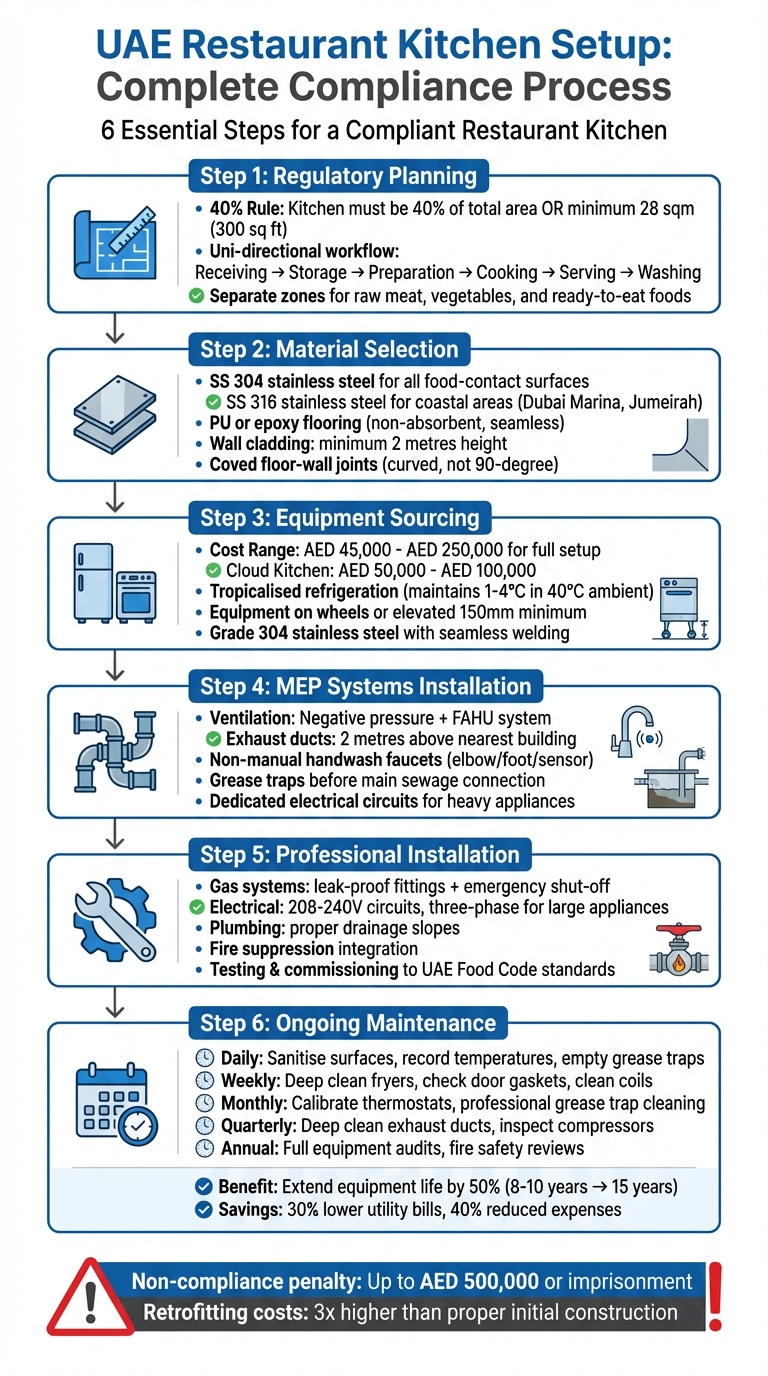
UAE Restaurant Kitchen Setup: 6-Step Compliance Process from Planning to Operation
UAE Kitchen Design and Equipment Standards
Understanding UAE regulations is the first step in planning your kitchen design. These rules guide your equipment choices, layout, and overall functionality, ensuring compliance and efficiency. Ignoring these standards can lead to costly adjustments later.
Regulatory Requirements for Kitchen Layouts
Dubai Municipality enforces the 40% rule, which means your kitchen must take up at least 40% of your restaurant's total area or a minimum of 300 sq. ft (28 sqm), whichever is larger. The kitchen layout must follow a uni-directional workflow: Receiving, Storage, Preparation, Cooking, Serving, and Washing. Additionally, raw meat preparation, vegetable preparation, and ready-to-eat areas must be physically separated.
Equipment placement is tightly regulated. Items like fridges, ovens, and prep tables need to be either on wheels or elevated on legs at least 150mm off the ground. This design ensures thorough cleaning and reduces pest risks. Non-compliance during the initial setup can result in retrofitting costs that are up to three times higher than proper construction.
Material and Structural Requirements
Material selection plays a crucial role in compliance. All food-contact surfaces must be made from SS 304 food-grade stainless steel, as lower grades like SS 201 are prone to rust and will not pass inspections. In coastal areas like Dubai Marina or Jumeirah, SS 316 stainless steel is recommended due to its higher resistance to corrosion.
Flooring must be non-absorbent, with options like Polyurethane (PU) or epoxy flooring being ideal for their seamless, easy-to-clean surfaces that meet Dubai Municipality standards. The joint between the floor and wall should be curved (coved) instead of forming a sharp 90-degree angle to prevent bacterial buildup. Wall cladding or tiling must extend to at least 2 metres in height in all food preparation areas. Avoid using prohibited materials like wood or non-food-grade metals, and ensure your Mechanical, Electrical, and Plumbing (MEP) systems meet these specifications.
Ventilation, Plumbing, and Hygiene Systems
Proper ventilation is essential for both safety and comfort. Kitchens must maintain negative pressure to contain odours, while a Fresh Air Handling Unit (FAHU) ensures adequate air circulation for staff. Exhaust ducts should extend at least 2 metres above the nearest building to reduce odour issues. For establishments with heavy-grease cooking, such as steakhouses, electrostatic precipitators (ESP) and carbon filters are mandatory.
Hand hygiene is another critical area. Handwash sinks must be separate from food preparation sinks and equipped with non-manual faucets, such as elbow-operated, foot-operated, or sensor-based models, as standard twist taps do not comply. Separate double-bowl stainless steel sinks are also required for washing vegetables and thawing meat or fish to avoid cross-contamination.
Drainage systems must include grease traps before connecting to the main sewage line, with a proper slope to prevent backflow. UV insect killers are recommended near entry points but should be installed away from food preparation areas. Coordinating these MEP elements during the design phase is essential, as retrofitting later can be significantly more expensive.
sbb-itb-19c3c9a
Core Restaurant Kitchen Equipment
Choosing the right equipment is a cornerstone of a well-functioning kitchen. In the UAE's fast-paced and competitive environment, it’s essential to prioritise tools that are both durable and compliant. As Complete Kitchen Solutions FZE puts it: "Your kitchen is your engine room, and in the harsh climate and fast-paced market of the Emirates, your equipment needs to be both resilient and compliant."
For durability and hygiene, Grade 304 stainless steel is the go-to material in the UAE's restaurant industry. Look for equipment with seamless welding and rounded edges to minimise bacteria build-up and make cleaning easier. Also, consider your kitchen’s power load requirements based on your menu - this helps prevent electrical overloads during busy hours. The cost of fully equipping a professional kitchen in the UAE typically ranges from AED 45,000 to AED 250,000, covering refrigeration, cooking, food prep, and sanitation essentials. [10, 11]
Refrigeration and Cold Storage
Refrigeration systems in the UAE need to handle extreme conditions. Tropicalised refrigeration units are a must - they maintain internal temperatures of 1°C to 4°C even when the kitchen’s ambient temperature exceeds 40°C. These units are equipped with high-density insulation, ensuring consistent performance during scorching summers while also helping to lower energy bills. Depending on your menu, your setup could include walk-in coolers, freezers, prep fridges, and blast chillers. For reliability, choose models with compressors specifically designed for high ambient temperatures. [10, 11]
Cooking Line Equipment
Cooking equipment in commercial kitchens must endure long hours of intense heat. Many modern kitchens now use intelligent combi-ovens, which combine steam and convection to cut cooking times by up to 30%, all while improving food consistency. In the UAE, kitchens often feature both gas and induction hobs - induction for precise temperature control and reduced heat emissions, and gas for high-heat cooking like searing. Essential items for your cooking line include ranges, deep fryers, grills, and salamanders, all designed with energy efficiency in mind. [10, 11]
Food Preparation and Sanitation Tools
Food preparation equipment covers everything from meat slicers and mixers to food processors and stainless steel worktables. Custom-fabricated worktables are especially useful in the UAE, where optimising limited kitchen space and ensuring smooth workflows are critical. Gastronorm (GN) containers are another key addition, helping to streamline storage and prep.
Sanitation is equally important. Your setup should include commercial dishwashers, grease traps, exhaust hoods, and designated sinks, all of which must comply with HACCP guidelines and local regulations. To maintain food safety, use HACCP-approved tools like colour-coded cutting boards and thermometers. [10, 11]
Sourcing Equipment Through Silverline Kitchens
Evaluating Supplier Quality and Compliance
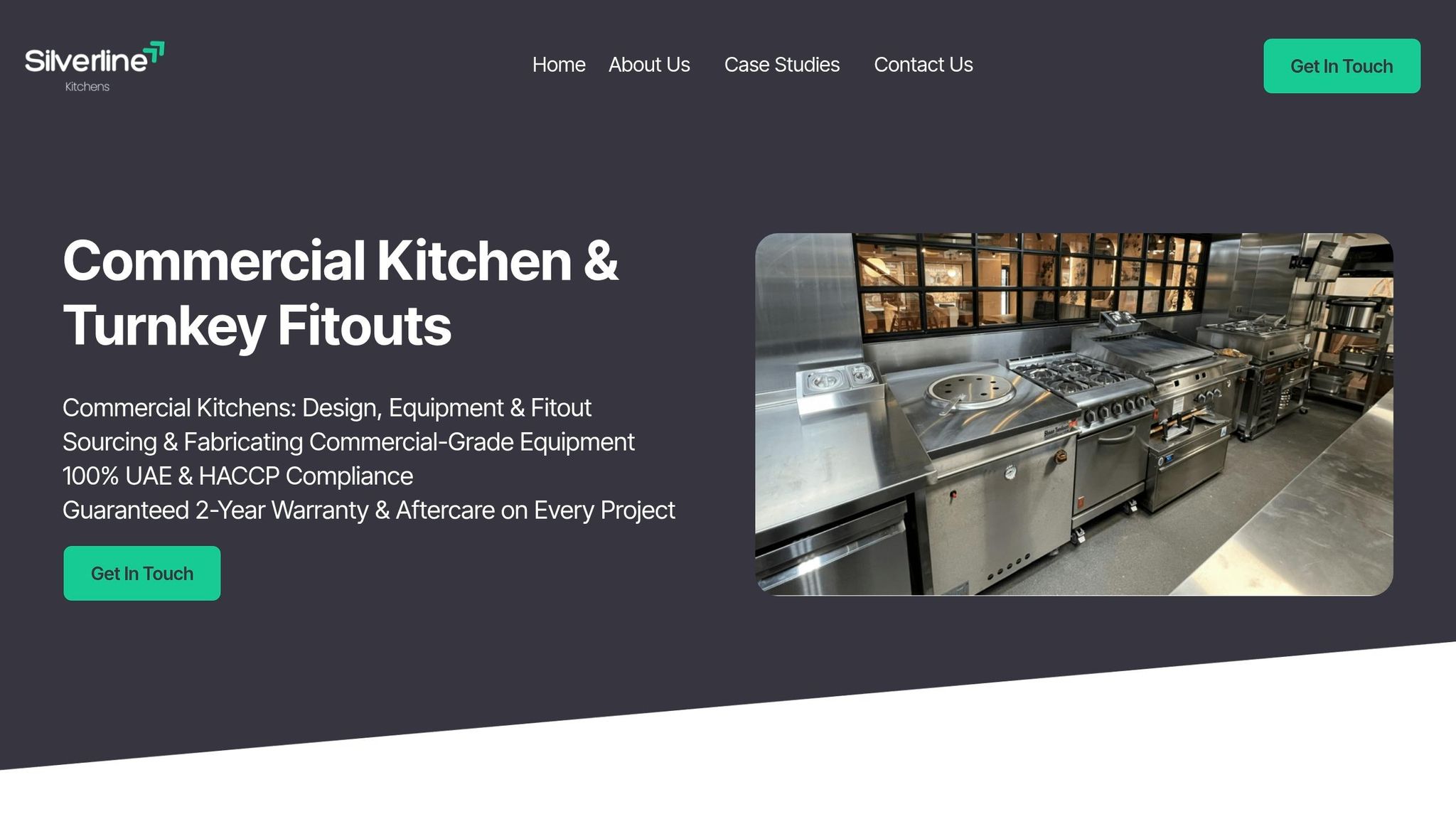
In the UAE, ensuring compliance is a cornerstone of any successful kitchen operation. Silverline Kitchens takes this responsibility seriously, meticulously evaluating every piece of equipment against stringent criteria. These evaluations cover hygiene, safety, regulatory standards, and durability, aligning with the UAE Food Code and Dubai Municipality requirements. This ensures that inspections and approvals proceed without a hitch from the outset.
Additionally, all equipment must meet Civil Defence and Fire Life Safety standards, particularly for critical systems like extraction, fire suppression, and mechanical ventilation. Materials and finishes are carefully selected based on internationally recognised HACCP guidelines, promoting optimal hygiene, efficient layouts, and seamless operational workflows. With every project, clients benefit from a guaranteed 2-year warranty and a robust aftercare programme, ensuring long-term reliability. This thorough assessment process naturally supports the development of tailored designs that address each client’s unique needs.
Silverline Kitchens' Custom Design and Supply Process
Silverline Kitchens builds its designs on a foundation of strict compliance, crafting solutions to meet the specific demands of kitchen operations in the UAE. The company oversees the entire sourcing process through a well-structured approach. It all starts with an initial consultation and needs assessment, where the team delves into your workflow, menu offerings, spatial limitations, and budgetary considerations.
From there, a custom layout is developed to maximise space efficiency while enhancing safety, productivity, and operational flow. The designs are tailored to match the unique requirements of your kitchen. Once the design is finalised, Silverline Kitchens handles the sourcing and in-house stainless steel fabrication of bespoke components. Technical planning for key elements like ventilation, extraction systems, grease traps, and drainage slopes ensures full compliance with Dubai Municipality standards.
The process culminates in professional installation, where trained teams integrate the equipment seamlessly with existing utilities. A final phase of testing and commissioning ensures the kitchen is ready for immediate operation. Renowned names such as Tesco, Choithrams, Filli Cafe, and HMP Prisons have trusted Silverline Kitchens to deliver on the demanding needs of high-capacity corporate and institutional kitchens.
As Mr Farid, Operations Manager at LA VITA Caffee, remarked:
"They understood what we needed and advised us on equipment and tools. We are very satisfied with their work ethics."
Professional Installation Process
Pre-Installation Planning and Site Preparation
Getting a site ready for installation is key to keeping operations smooth and reducing the risk of breakdowns. This step starts with a carefully designed layout that promotes efficiency, reduces unnecessary staff movement between prep, cooking, and cleaning areas, and ensures clear separation zones to minimise cross-contamination risks.
Utility infrastructure is a critical focus. Heavy-duty appliances like ovens and refrigerators need dedicated electrical circuits equipped with moisture-resistant fittings to prevent overloading and potential fire hazards. Gas lines require precise mapping, while plumbing systems must include proper drainage slopes and well-placed grease traps to avoid standing water and meet UAE sanitation regulations.
Ventilation systems, extraction hoods, and fire suppression equipment should be coordinated to comply with Civil Defence and Fire Life Safety standards. Materials and finishes must adhere to international HACCP guidelines for hygiene and operational efficiency. Additionally, leaving enough maintenance space around equipment is essential. Crowding units together can make routine cleaning and repairs unnecessarily challenging.
Equipment Installation and Utility Integration
With the site prepared, skilled technicians install the equipment and connect it to gas, water, and electrical systems. For commercial kitchens, electrical integration often involves 208–240 volt circuits, with larger appliances like combination ovens requiring three-phase wiring. Proper grounding and overload protection are mandatory to prevent electrical issues.
Gas systems are installed with leak-proof fittings, flame failure protection, and emergency shut-off valves. As NMT Services highlights:
"Incorrect installation of gas ranges, exhaust hoods, or electrical appliances can lead to fire hazards, gas leaks, or accidents".
Certified technicians handle these connections to ensure safety compliance while preserving manufacturer warranties.
Plumbing systems are fitted with grease traps in designated spots, and drainage slopes are built to meet Dubai Municipality standards. Extraction systems use stainless steel ducts and high-efficiency filters, integrated with fire suppression systems to handle grease and smoke in high-volume kitchens. Throughout the process, technicians ensure all utility connections comply with ESMA technical standards and the UAE Food Code. This guarantees the kitchen meets both UAE Food Code and Civil Defence requirements. A thorough testing phase follows installation to confirm everything is in proper working order.
Testing, Commissioning, and Handover
Before the kitchen becomes operational, technicians rigorously test all systems. Ovens are fired up, refrigerator cooling is monitored, and exhaust airflow is checked to ensure everything functions as expected. Gas, water, and electrical connections are double-checked to rule out leaks, power issues, or overloads.
Fire suppression systems and extraction units are commissioned to meet Fire Life Safety and Civil Defence standards. Grease trap placements and drainage slopes undergo a final review to confirm they align with plumbing and sanitation regulations. As Silverline Kitchens explains:
"Every kitchen we deliver is built to meet UAE Food Code and Dubai Municipality standards, ensuring smooth inspections and approvals".
During the handover, staff are trained on how to use the equipment properly, follow cleaning protocols, and implement safety precautions. This training not only helps extend the lifespan of the equipment but also reduces the likelihood of accidents. Keeping detailed records of testing, calibration, and maintenance ensures compliance with regulations and supports warranty claims. Manufacturers often require professional installation and commissioning to validate equipment warranties.
Post-Installation Maintenance and Support
Routine Maintenance and Inspections
Once the installation is complete, keeping equipment in top shape requires consistent maintenance. This not only ensures compliance with regulations but also keeps operations running smoothly while avoiding costly breakdowns. For instance, regular upkeep can extend a refrigerator's lifespan from 8–10 years to up to 15 years, reduce utility bills by 30%, and lower overall expenses by as much as 40%.
A structured maintenance schedule based on frequency is key. Daily tasks often include sanitising surfaces, recording temperatures, and emptying grease traps. Weekly responsibilities might involve deep cleaning fryers, wiping down condenser coils, and checking the door gaskets on cold storage units [19, 20]. Monthly routines typically cover thermostat calibration and arranging professional grease trap cleaning. Quarterly efforts focus on more intensive tasks like deep cleaning exhaust ducts and inspecting compressors to align with Civil Defence fire safety standards [19, 21]. Lastly, annual audits ensure comprehensive equipment checks and fire safety system reviews, which are crucial for licence renewals [19, 21]. These practices align with Dubai Municipality and UAE Food Code requirements.
Authorities like Dubai Municipality mandate physical proof of maintenance, including temperature logs, cleaning schedules, and service records [19, 21]. The UAE's harsh climate makes regular filter and coil cleaning essential, along with proper care for stainless steel surfaces. For instance, wiping stainless steel with the grain using pH-neutral cleaners and avoiding abrasive sponges can prevent pitting caused by humidity. Failing to comply with food safety and hygiene regulations can lead to severe penalties, reaching up to AED 500,000 or even imprisonment.
In addition to routine inspections, strong after-sales support plays a crucial role in maintaining operational efficiency.
Silverline Kitchens' After-Sales Support
Silverline Kitchens goes beyond basic maintenance by offering robust after-sales support to protect your investment. Their 2-year warranty includes comprehensive aftercare, covering parts replacement and servicing to ensure compliance with UAE Food Code and Dubai Municipality standards. Their team also manages critical systems like mechanical ventilation, fire suppression, and extraction to meet Fire Life Safety and Civil Defence regulations.
Emergency repair services are available to tackle sudden equipment failures promptly, while preventive service schedules help identify and resolve potential issues before they disrupt operations. To maintain the integrity and performance of your equipment, they exclusively use original manufacturer spare parts for repairs. As the company explains:
"Our support team ensures your kitchen runs smoothly and minimises downtime".
Their proactive approach includes immediate assistance and regular kitchen audits to ensure facilities remain up-to-date with evolving regulations. Highlighting their reliability, Mr. Rami, General Manager of The Stuffed Burger Co., shared:
"The services they have provided throughout the complete scope of work was amazing. Their responsiveness towards changes is very high".
Silverline Kitchens’ commitment to after-sales care ensures your kitchen operates efficiently while staying compliant with local requirements.
Conclusion
Creating a compliant and efficient restaurant kitchen in the UAE involves more than just purchasing quality equipment. It requires strict adherence to regulatory standards, expert installation, and consistent maintenance. Following Dubai Municipality's 2026 Food Code and HACCP guidelines, along with maintaining precise temperature controls, is essential for ensuring both operational approval and food safety.
Using high-grade, regulation-compliant equipment not only helps avoid costly breakdowns but also ensures food safety in the UAE's demanding climate. Costs for professional setups can vary depending on the scope, while integrated solutions like combi ovens save space, streamline workflows, and minimise risks of cross-contamination - all of which enhance productivity.
Careful planning is the foundation for seamless installation and ongoing operational efficiency. Collaborating with experienced providers ensures compliance with safety and utility standards from the outset. Beyond the initial setup, regular maintenance - such as weekly seal inspections, calibrations, and deep cleaning - keeps equipment performing at its best and prevents temperature inconsistencies that could jeopardise food safety. With all components working together, your kitchen is set up for success.
Silverline Kitchens offers a complete solution tailored to UAE standards, covering everything from initial consultation and HACCP-compliant designs to equipment supply, professional installation, and after-sales support. With over 30 years of experience in bringing European standards to the UAE market and a guaranteed 2-year warranty, they help ensure your kitchen operates efficiently, safely, and in full compliance with local regulations.
To build trust in your brand and succeed in the competitive GCC market, investing in quality equipment, expert installation, and ongoing support is key. Contact Silverline Kitchens to ensure your kitchen setup meets all requirements and supports your long-term growth.
FAQs
What documents do I need for Dubai Municipality and Civil Defence approval?
To secure Dubai Municipality and Civil Defence approval, you’ll need to prepare the following:
- Food safety and hygiene permits: These include certificates that confirm your operations meet food safety and hygiene regulations.
- Compliance documents: These should demonstrate adherence to layout, space, and health standards, such as HACCP certification.
- Fire safety certificates: Issued by Civil Defence, these include proof of fire-resistant materials, proper signage, and other fire safety measures.
Make sure all your documents align with UAE regulations for kitchen design and safety.
How do I size my kitchen and equipment for my menu and peak hours?
To determine the right size for your kitchen and equipment, start by focusing on your menu, expected customer volume, and peak-hour demands. Break down your menu to identify the specific equipment you'll need and ensure it can handle the busiest times of the day without strain.
When designing your layout, prioritise an efficient workflow while adhering to UAE regulations and standards. This ensures smooth operations and compliance. It's also wise to factor in potential future growth to avoid costly and disruptive redesigns later on.
If you're unsure how to proceed, consulting with experts can be a smart move. They can help customise your kitchen setup to align with both operational requirements and local regulatory guidelines.
What maintenance logs should I keep to pass inspections in the UAE?
To ensure your kitchen passes inspections in the UAE, it's crucial to keep well-organised and detailed records for all equipment. Here's what you need to focus on:
- Daily temperature logs: Record refrigeration and freezer temperatures consistently every day.
- Maintenance and inspection records: Document service dates and technician details for equipment like grease traps and exhaust hoods.
- Cleaning and service proof: Keep photographic evidence and certificates for all cleaning and servicing activities.
- Standard operating procedures (SOPs): Maintain schedules and guidelines for routine cleaning and safety checks.
These records can be stored digitally or in print - just make sure they're easily accessible to meet compliance standards.
