


Kitchen equipment can take up 45% to 55% of your setup budget, so one bad buying call can tie up a lot of cash. If I want to keep spend under control in the UAE, I need to do five things: build the list from the menu, size each item to peak-hour demand, check full ownership cost, compare quotes on the same scope, and phase purchases by opening priority.
Here’s the short version:
- Start with the menu, not a catalogue
- Buy for peak-hour covers, then add about 20% headroom
- Check UAE rules before ordering anything
- Look past the sticker price
- Put core items first and delay low-use extras
A few numbers make the point fast:
- Commercial kitchen equipment can reach AED 200,000.00 to AED 500,000.00
- Energy and maintenance can add 30% to 60% of purchase cost over 5 to 7 years
- Extraction changes can add AED 10,000.00 to AED 50,000.00
- Accessories can add 5% to 10%
- Late approval or install issues can add 10% to 15%
What do I cut first when budgets get tight? Anything that does not support output, compliance, or uptime.
Quick comparison
| Check | What I focus on | What I avoid |
|---|---|---|
| Equipment list | Menu, stations, workflow | Buying from supplier wish lists |
| Sizing | Peak-hour demand + 20% margin | Buying for rare max-volume days |
| Cost review | Price + power + service + downtime | Looking only at invoice price |
| Quote review | Same model, same scope, same warranty | Comparing uneven quotes |
| Purchase timing | Tier 1 first, extras later | Buying all items at once |
If I keep those five checks in place, I can spend where it counts and avoid paying twice later.
New vs Refurbished vs Leased Kitchen Equipment: Full Cost Comparison
1. Build your equipment list from your menu and workflow
Start with what you cook, how you serve it, and how many covers you handle during peak hours. Don’t start with a supplier catalogue. That’s the easiest way to end up with kit you don’t need.
Map every menu item to the station that needs it
Go through your menu one dish at a time and track where it moves in the kitchen. Split the workflow into receiving, storage, prep, cooking, holding, service, and dishwashing. Every menu item should link back to equipment in one of those stations.
This step also helps you spot HACCP critical control points. In plain terms, it shows which items need temperature control and helps you size refrigeration and ovens based on peak-hour covers, not total daily volume.
Remove duplicate functions before requesting quotes
Once you’ve built a station-by-station list, check it for overlap. Before you ask for even one quote, put each item under a bit of pressure: does another piece of equipment already do this job?
If the answer is yes, cut it.
That one check can save space, money, and a lot of clutter in the kitchen.
Check your equipment list against UAE compliance requirements
Before quotes go out, do one last compliance review of the full list. Each cooking appliance must sit under a DCD-approved wet-chemical hood suppression system with automatic shut-off. Prep and dishwashing stations need handwash basins, drainage, and grease traps in the correct positions. Miss these at the planning stage and you may end up paying for retrofits or dealing with failed inspections later.
Keep this review tight and practical:
- Match each item to the rule it must meet
- Remove anything that duplicates another function
- Cut any item that doesn’t meet compliance
Once the list is clean, size each item to peak-hour demand.
sbb-itb-19c3c9a
2. Size equipment to real demand, not peak-demand assumptions
Oversizing equipment locks up cash in capacity you may hardly use. It also adds to day-to-day energy and maintenance bills. The better approach is to size each station around actual demand, starting with the busiest hour.
Calculate covers, peak hour output, and batch requirements
Use your actual covers, peak-hour output, and batch counts to size each station. Let peak-hour output set oven, line, and prep capacity, not some maximum theoretical volume.
A handy rule of thumb is to size equipment to handle 20% above your projected peak load. That gives you enough headroom for growth and demand spikes, without pushing you into larger units that cost more to run and service.
Apply practical sizing rules to ovens, refrigeration, and prep equipment
For ovens, start with your peak tray load per hour and work backwards. Figure out the tray capacity and cycle time needed to hit that output, then match the oven spec to that number. It’s a simple way to avoid paying for a larger model than your menu and service pattern call for.
For refrigeration, size around stock turnover and delivery cadence, not static volume. In the UAE, summer heat can reduce equipment performance, so refrigeration and cooking units should be sized for hot-weather conditions, not mild-weather assumptions.
Use layout planning to reduce the need for extra equipment
Layout matters more than many teams expect. Poor zoning creates workarounds, and those workarounds often lead to extra equipment purchases that weren’t needed in the first place. Better zoning can cut duplicate stations and stop you from buying spare equipment just to patch flow issues. Mobile modular units can also give you more flexibility as menu mix or volume shifts.
3. Calculate total cost of ownership and avoid common cost traps
Once your equipment is right-sized, compare the full cost of owning each option, not just the supplier quote. The invoice price is almost never the full story.
Total cost of ownership (TCO) includes:
- purchase
- installation
- utilities
- servicing
- energy
- downtime
- replacement value
Over a typical 5–7-year lifespan, energy and maintenance alone can match or exceed 30–60% of the original purchase price. So a cheaper unit at the start can still end up costing more if it uses more power and needs more servicing.
List every cost line before approving a purchase
Before approval, map out every cost line: equipment, delivery, installation, utility upgrades, extraction changes, commissioning, staff training, energy, water, servicing, spares, and contingency.
Extraction is one of the most common hidden costs. High-heat equipment like ovens, grills, and fryers can trigger hood, ductwork, and suppression upgrades under UAE municipality and Civil Defence rules. Depending on the scope and building limits, these works can add AED 10,000.00 to AED 50,000.00 to a project. It also makes sense to allow a 10–15% contingency for extraction and fit-out changes.
Identify the most common overspending mistakes early
In UAE commercial kitchens, four mistakes tend to drive avoidable overspending.
- Overcapacity - buying equipment far beyond peak-hour demand increases purchase cost, extraction work, and energy bills without adding revenue.
- Overlapping functions - duplicate equipment adds cost, takes up space, and increases maintenance without improving output.
- Low-cost units with poor components - frequent call-outs, imported spare parts, and downtime can wipe out any saving from the lower purchase price.
- Non-compliant equipment - this can lead to retrofit work or full replacement after inspection.
You can spot many of these risks before signing a purchase order. Ask vendors for typical annual maintenance costs, common failure points, and whether spare parts are stocked locally in the UAE. That one conversation can save a lot of trouble later.
Compare purchase price against lifecycle value using a simple table
Use the table below to compare shortlisted options on five-year cost, not just invoice price.
| Combi oven – Option A | Combi oven – Option B | |
|---|---|---|
| Purchase price (AED) | 25,000.00 | 20,000.00 |
| Monthly running cost (AED) | 1,300.00 | 1,700.00 |
| Annual maintenance (AED) | 2,000.00 | 3,500.00 |
| Warranty (years) | 2 | 1 |
| Expected useful life (years) | 7 | 5 |
| Local parts stock | Yes | Limited |
| 5-year total cost (AED) | ~113,000.00 | ~139,500.00 |
Option A costs more upfront, but over five years it costs less.
4. Compare quotes properly and choose the right buying route
After you’ve worked out total cost of ownership, compare every supplier quote against the same scope, warranty, and compliance checklist.
Compare supplier quotes line by line
Split each quote into matching cost and scope items before you compare prices. On the surface, two quotes for the same equipment can seem close. But once you break them down, the gap often shows up fast.
One supplier may include delivery and installation. Another may include delivery only, then bill mechanical, electrical, and plumbing connections as separate items. Those gaps often don’t show in the headline price. This helps operators avoid paying twice for installation, approvals, or accessories that should have been included from the start.
Before making a decision, check each quote against the same points:
- Model specification - Does the steel grade, energy rating, and capacity match peak-hour demand?
- Accessories - Are trays, racks, or specialist hoses included, or priced separately? Accessories can add 5–10% to the base price.
- Installation scope - Does the quote include mechanical, electrical, and plumbing connections and commissioning, or is it delivery only?
- Warranty terms - Is it a local UAE warranty with on-site service, or does it depend on overseas claims support?
- Spare parts and local support - Are parts stocked in the UAE, and what response time is guaranteed for repairs?
- Compliance documentation - Reject quotes that don’t include the approvals paperwork needed for inspection.
- Lead time - Is the unit in local stock, or is it 8–12 weeks away? A delay here can push back your opening and add holding costs.
Once the quotes are lined up properly, the next step is choosing the buying route that suits the asset’s risk level and expected life.
Choose between new, refurbished, and leased equipment
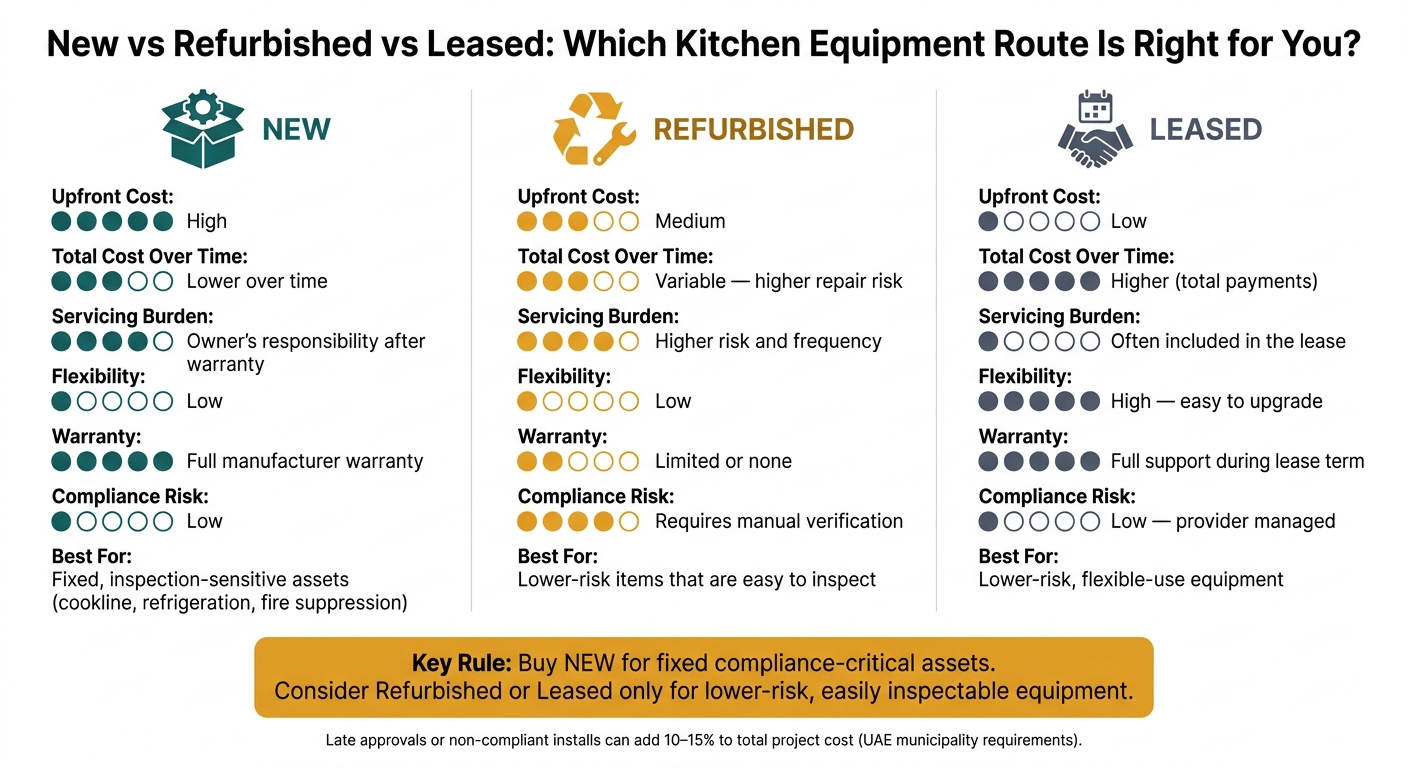
The buying route should protect cash flow without putting key equipment at risk. In simple terms, buy new for fixed assets that must meet compliance checks. Lease or buy refurbished only when the item is lower risk and easy to inspect.
Use new equipment for fixed, inspection-sensitive assets. For lower-risk items, a more flexible route can make sense.
| Feature | New | Refurbished | Leased |
|---|---|---|---|
| Upfront cost | High | Medium | Low |
| Total cost | Lower over time | Variable - higher repair risk | Higher (total payments) |
| Servicing burden | Owner's responsibility after warranty | Higher risk and frequency | Often included in the lease |
| Flexibility | Low | Low | High (easy to upgrade) |
| Warranty | Full manufacturer warranty | Limited or none | Full support during term |
| Compliance risk | Low | Requires manual verification | Low - provider managed |
Reduce risk with local support and project coordination
In the UAE, local support can make or break a project. If repairs are delayed, service can stop. That often leads to costly backup purchases. On top of that, late approvals or non-compliant installs can add 10–15% to project cost.
That’s why coordinated delivery matters. A partner that handles design, sourcing, and installation helps cut the risk of delays and keeps purchases in line with UAE approval requirements.
Use suppliers with UAE-based service teams and spare parts stock to cut downtime. Then rank purchases by operational need and phase them in the right order.
5. Rank purchases and phase spending without disrupting operations
Once your quotes are lined up on the same basis, the next step is simple: buy in the order your kitchen depends on each item. Don’t treat every purchase as equal. Some pieces let you open the doors. Others can wait a bit.
After comparing quotes, rank each item by day-to-day operational need and split purchases into stages. That way, you protect cash while keeping the kitchen ready to run.
Build a priority list from critical to optional equipment
Score each item based on a few plain questions. Is it needed to open? Is it required by regulation? Does it protect sales directly? Or can the team manage without it for a short period?
- Tier 1: Items needed to open and pass inspection - primary refrigeration, the main cookline, warewashing, ventilation, and fire suppression.
- Tier 2: Equipment that strongly supports consistency but has a short-term workaround - a dedicated fryer for high-volume items or backup refrigeration on the cookline.
- Tier 3: Additional prep tables, secondary ovens, or specialty mixers - useful but not required on day one.
- Tier 4: Items tied to a single dish or promotion - purchase only once demand is proven.
This kind of ranking keeps the team from spending AED on “nice to have” gear while core systems still need funding.
Plan phased purchasing by opening stage and budget
Kitchen equipment can often reach AED 200,000 to AED 500,000. That’s a big outlay, so phasing spend helps protect cash for core fit-out work.
Use the same tiers to split spending across the opening period, the first few months of service, and later upgrades.
| Timeframe | Equipment Category | Priority | Budget Share |
|---|---|---|---|
| Pre-opening (Month 0–1) | Primary refrigeration, main cookline, warewashing, ventilation, fire suppression | Critical | Largest share of the equipment budget |
| Early-stage (Month 2–6) | Additional prep equipment, backup refrigeration, extra capacity at proven high-demand stations | High / Medium | Smaller share for proven needs only |
| Later-stage upgrades (Month 7–12) | Specialty units, display equipment, niche production add-ons | Medium / Low | Funded from operating cash after demand is validated |
For later purchases, use live service data instead of opening-day guesses. Look at POS data and production logs from the first months, then upgrade only the stations that keep hitting capacity. If one section is constantly under pressure and another is sitting idle, the numbers will tell you where the next dirham should go.
Conclusion: Spend only where it improves output, compliance, and reliability
Start with the menu. Size each unit around actual peak-hour demand. Work out the full cost of ownership, not just the ticket price. Then compare quotes against the same scope before making a call.
From there, phase purchases so compliance-critical and revenue-critical assets come first. Optional upgrades should wait until the numbers support them. Buy only what improves output, compliance, and reliability.
FAQs
How do I know what equipment is essential for opening?
Start with your menu. That tells you what your kitchen actually needs to prep and cook, so you buy equipment for a clear job instead of filling the space with items you may barely use.
Next, match capacity to your daily output, peak demand, and available space so you don’t overbuy. Where it makes sense, prioritise multi-functional equipment to get more use from each unit. And before you sign off on anything, make sure it meets UAE requirements, including ESMA registration, refrigeration rated for high ambient temperatures, and local Municipality and Civil Defence compliance.
When is it better to lease instead of buy?
Leasing kitchen equipment often makes more sense when you need to keep cash on hand for other day-to-day needs, like marketing or staffing. It can also be a smart move if you're testing a new food concept and there’s more financial uncertainty in the early stages.
Another plus is flexibility. Leasing can make it easier to scale up or swap equipment as your menu changes or production volume grows. Instead of paying a large amount upfront, you spread the cost into more predictable monthly payments.
What hidden kitchen equipment costs should I budget for?
Beyond the purchase price, set aside money for installation too. That often means exhaust hoods, Civil Defence-approved fire suppression systems, and, in some cases, electrical panel upgrades.
Then there are the running costs. Utilities add up fast, and inefficient equipment can put extra strain on your HVAC system, which pushes bills higher. Routine upkeep matters as well, including Annual Maintenance Contracts, filter cleaning, and calibration.
You’ll also want to account for compliance-related costs, such as municipal inspections, along with site-specific parts like grease traps.
