


Running a bakery or catering kitchen in Dubai requires careful planning to meet strict regulations and ensure efficiency. Here's what you need to know:
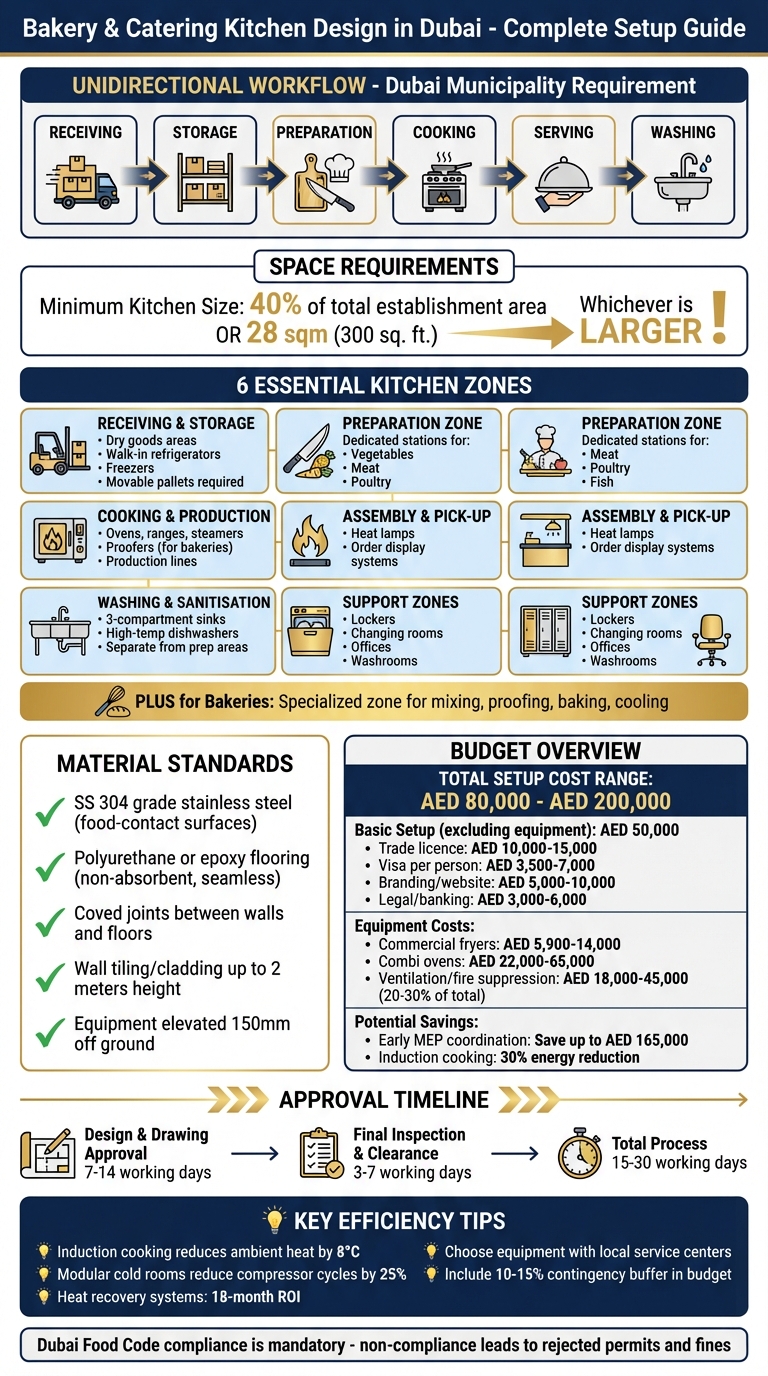
- Compliance is Key: Dubai Municipality mandates a unidirectional workflow (Receiving → Storage → Preparation → Cooking → Serving → Washing) to prevent cross-contamination. Kitchens must also adhere to Civil Defence fire safety standards.
- Space Requirements: Kitchens should occupy at least 40% of the establishment or a minimum of 28 sqm (300 sq. ft.), whichever is larger.
- Material Standards: Use SS 304 grade stainless steel for food-contact surfaces and non-absorbent, seamless flooring like polyurethane or epoxy.
- Essential Kitchen Zones: Include Receiving & Storage, Preparation, Cooking, Assembly, Washing, and Support areas. Bakeries need additional zones for mixing, proofing, and cooling.
- Equipment Selection: Choose items like combi ovens, blast chillers, and HACCP-compliant tools. Ensure all equipment aligns with approved layouts to avoid inspection failures.
- Budget Planning: Setting up a compliant kitchen ranges from AED 80,000 to AED 200,000. Early MEP coordination can save up to AED 165,000 in rework costs.
- Efficiency Tips: Opt for induction cooking to reduce energy costs and heat. Modular cold rooms and locally serviced equipment can lower maintenance expenses.
Dubai Bakery Kitchen Setup: Workflow, Zones & Compliance Requirements
Required Kitchen Zones for Bakery and Catering Operations
Main Kitchen Zones and Their Functions
For bakery and catering kitchens in Dubai, six key zones are essential to meet Municipality standards and ensure smooth operations. The Receiving & Storage Zone is where all deliveries are handled. This area must include separate spaces for dry goods, walk-in refrigerators, and freezers. Movable pallets are a must here, keeping items off the floor and making cleaning easier.
Next is the Preparation Zone, where raw ingredients are processed before cooking. To avoid cross-contamination, this zone needs dedicated stations for handling vegetables, meat, poultry, and fish. The Cooking & Production Zone is where the magic happens, with equipment like ovens, ranges, steamers, and proofers (especially crucial for bakeries) arranged in efficient production lines.
"Your menu is the DNA of your entire kitchen design. A high-volume burger joint, a delicate patisserie, a fine-dining seafood restaurant, and a massive wedding hall kitchen have wildly different equipment and workflow needs." - Tina, Project Consultant, Lestov
The Assembly & Pick-Up Zone bridges the kitchen and service staff. This area needs heat lamps and order display systems to keep food warm and ensure order accuracy. The Washing & Sanitisation Zone is where cleaning happens, with separate areas for washing pots and plates. This zone must include three-compartment sinks and high-temperature dishwashers. Lastly, Support Zones provide essential staff facilities such as lockers, changing rooms, offices, and washrooms.
Bakeries also require an additional specialised zone for mixing, proofing, baking, and cooling. This separation is vital to maintaining consistent product quality by preventing temperature fluctuations that could affect dough development. The design of these zones must adapt to the available space.
How Kitchen Size Affects Zone Planning
The size of a kitchen plays a big role in how these zones are laid out. For smaller bakeries operating in spaces as small as 320 sq. ft. (around 30 sqm), multi-functional zones and vertical storage are essential for making the most of limited space. A great example is a modular bakery kitchen delivered by ContekPro in December 2021. With a compact 40'x8' footprint (approximately 30 sqm), it optimised mixing, baking, and cooling zones using custom prep tables and built-in storage - perfect for boutique operations in urban settings.
For mid-sized kitchens (90–140 sqm), having physically separated production lines helps meet compliance standards and reduces the risk of cross-contamination. These setups often include distinct areas for meat preparation, vegetable processing, and assembling ready-to-eat items.
Large facilities, spanning over 200 sqm, need fully independent zones with their own ventilation systems, drainage, and access points. Many of these kitchens use induction cooking equipment, which transfers over 90% of its energy directly to cookware, compared to just 40-50% for traditional gas. This is particularly beneficial in Dubai's climate, as it reduces ambient heat, cutting air conditioning costs and creating a more comfortable work environment for staff.
sbb-itb-19c3c9a
Equipment Selection for Bakery and Catering Kitchens
Core Equipment for Bakery and Catering Operations
Choosing the right equipment is crucial for meeting your kitchen's production needs. For bakeries, key items include planetary mixers for dough preparation, deck ovens with steam injection for perfect crusts, proofing racks to manage fermentation, and blast chillers to quickly cool baked goods.
Catering kitchens, on the other hand, have different requirements. Essential equipment includes combi ovens for steaming, roasting, and baking in one unit, tilting and boiling pans for large-scale cooking, walk-in cold rooms for ingredient storage, and insulated transport boxes to ensure food stays at the right temperature during delivery. It’s also important to prioritise equipment with certifications like NSF, UL, or equivalent, and ensure food-contact surfaces are made from approved materials such as Stainless Steel 304/316, food-grade polypropylene, or heat-resistant silicone.
For kitchens with fryers or grills, fire suppression systems like Ansul are mandatory under Civil Defence regulations. Additionally, HACCP compliance requires equipment that supports strict temperature control and prevents contamination - features like digital temperature logs and colour-coded preparation tools are highly recommended. Adhering to Dubai Municipality standards ensures your kitchen remains compliant and operates safely.
"Choose commercial-grade equipment known for its quality and durability, especially considering the UAE's specific conditions." - Your Kitchen Center
In terms of costs, UAE market prices (2025/2026) range from AED 5,900–14,000 for commercial fryers to AED 22,000–65,000 for combi ovens. Ventilation and fire suppression systems can add another AED 18,000–45,000, typically accounting for 20–30% of the total investment.
Matching Equipment to Business Scale
Once you’ve identified your core equipment needs, it’s important to scale your choices based on your business size. For small-scale setups like boutique bakeries or cafés, compact equipment such as reach-in or undercounter fridges, small deck or convection ovens, tabletop mixers, and undercounter dishwashers work well. These options save space while maintaining compliance with food safety standards.
For medium to large catering operations, the demands are significantly higher. Equipment like walk-in cold rooms with blast chillers, high-capacity combi ovens or rotary rack ovens, floor-standing planetary mixers, and conveyor-style or hood-type dishwashers becomes essential. These choices are designed to handle higher production volumes and improve workflow efficiency, which could reduce labour costs by up to 15%.
When sourcing equipment in Dubai, favour brands with local service centres, such as La Marzocco, Pitco, or Hobart, to avoid downtime caused by the UAE’s extreme climate. Additionally, consider the local water hardness, especially for dishwashers and other appliances that rely on water, to minimise scale buildup. It’s also critical to wait for Dubai Municipality approval of your kitchen layout before buying expensive equipment to avoid costly modifications or inspection failures.
For instance, Rational combi ovens are a great choice for their ability to steam, roast, and bake, all while optimising space and increasing output. To meet storage regulations, ensure shelving provides at least 6 inches of clearance from walls and floors for easy cleaning, in line with local food codes. Professional kitchen design services in Dubai, which include MEP drawings for municipality approval, typically start at around AED 5,000. Thoughtful equipment selection not only boosts efficiency but also ensures regulatory compliance and smooth operations.
Layout and Workflow Planning for Maximum Efficiency
Creating a Logical Production Flow
A functional kitchen layout is more than just good design - it’s a necessity, especially in Dubai, where regulations like those from Dubai Municipality enforce strict unidirectional food flow to prevent cross-contamination. The workflow must follow this sequence: Receiving → Storage → Preparation → Cooking → Serving → Washing. This approach not only safeguards hygiene but also boosts staff productivity by cutting down on unnecessary movement and reducing errors during busy hours.
"A poorly planned kitchen design is the number one reason approvals get rejected." - Kitchen Works
To streamline operations, place receiving and storage areas near the entrance, so heavy goods don’t have to be transported far. Preparation zones should be centrally located, with clear divisions between raw and dry areas. Cooking or baking stations should connect seamlessly to preparation zones, and serving areas should be positioned near the exit for fast handovers. Washing stations must be entirely separate from prep and cooking areas to handle waste efficiently.
Hygiene plays a critical role in the workflow. Install hand wash stations with non-manual taps in preparation zones to maintain cleanliness without disrupting operations. Also, ensure that all equipment aligns with approved technical drawings to avoid setbacks during inspections.
Once the workflow is optimised, the next challenge is making the most of limited kitchen space, a common issue in Dubai.
Maximising Space in Smaller Kitchens
Space is a premium in Dubai’s commercial kitchens, making efficient design essential. Start by prioritising compliance with regulations over squeezing in equipment, as non-compliance often leads to approval delays or rejections. Engage professionals to create 2D and 3D layouts that incorporate MEP (Mechanical, Electrical, and Plumbing) plans early on. This ensures your design meets regulatory standards while avoiding costly adjustments later.
Even in compact kitchens, zoning is non-negotiable. For cloud kitchens or shared bakery spaces, dedicate separate zones for each brand and storage area. This prevents bottlenecks and ensures smooth operations while adhering to Dubai Municipality’s standards.
Proper planning for drainage and ventilation is equally important. Address these elements early, including floor slopes and accessible grease traps, to avoid expensive redesigns down the line. Keep in mind that design and drawing approvals from Dubai Municipality generally take 7–14 working days, while final inspections and operational clearance require an additional 3–7 working days after construction. Getting the layout right from the start saves both time and money in the long run.
Meeting UAE Standards and HACCP Requirements
HACCP-Compliant Kitchen Design
In Dubai, achieving HACCP compliance is a must for bakery and catering kitchens. A well-thought-out kitchen design should follow a unidirectional workflow: Receiving → Storage → Preparation → Cooking → Serving → Washing. This setup helps prevent cross-contamination by keeping raw and cooked food areas clearly separated.
To ensure safety, work zones need to be physically segregated. For example, raw meat handling, vegetable preparation, and ready-to-eat food areas should each have dedicated workstations, cutting boards, and storage. This separation is particularly important for bakeries that handle both raw ingredients and finished products.
Material choices are equally important. Food-contact surfaces must be made from SS 304 grade stainless steel, which resists rust and meets inspection standards. Using SS 201, which is prone to rusting, can lead to compliance issues. Floors should have seamless, non-absorbent finishes like polyurethane or epoxy, with coved joints (curved edges) between walls and floors to minimise bacterial growth. Walls in food handling areas should be tiled or clad in stainless steel up to a height of 2 metres, ensuring a smooth, easy-to-clean surface.
For hygiene, appliances and workstations should be elevated at least 150 mm off the ground, making cleaning more manageable. Hand wash stations must operate without manual taps and should be kept separate from food preparation sinks.
"The Dubai Food Code is one of the strictest regulatory frameworks globally. A single violation in your layout, ventilation, or waste management can lead to rejected permits, delayed openings, or immediate fines." - NMT Services
Once your kitchen meets HACCP layout standards, the next step is obtaining approvals from Dubai Municipality and Civil Defence.
Dubai Municipality and Civil Defence Approvals
After ensuring your kitchen design aligns with HACCP standards, you’ll need to secure official approvals. This process includes design reviews and final inspections, typically taking 15–30 working days.
Space allocation is a key requirement. Your kitchen must occupy at least 40% of the total establishment area or a minimum of 300 sq. ft. (approximately 28 sqm), whichever is larger. Ventilation systems are another critical focus. Exhaust ducts must extend at least 2 metres above the nearest building, both to manage odours and to comply with Civil Defence fire safety standards for gas connections and ductwork.
Drainage planning is also essential. Grease traps are mandatory for all drainage in cooking areas to catch grease-laden water and allow for regular cleaning. Kitchens with higher grease output may need additional solutions like electrostatic precipitators and carbon filters to meet hygiene and fire safety requirements.
The approval process involves submitting detailed MEP (Mechanical, Electrical, and Plumbing) drawings, architectural plans, equipment lists, and ventilation layouts through the Dubai Municipality and Dubai Economy & Tourism portals. During the final site inspection, officials will verify that the kitchen matches the approved designs. Any deviations could result in rejection. It’s crucial to finalise designs before purchasing equipment - retrofitting a non-compliant kitchen can cost up to three times more than getting it right the first time.
Budget Planning and Cost Management
Kitchen Setup Costs by Size
Setting up a bakery or catering kitchen in Dubai comes with a price tag ranging from AED 80,000 to AED 200,000, covering licensing, equipment, and other essentials. Breaking these costs into categories helps you allocate your budget wisely.
The basic setup costs - excluding equipment - start at around AED 50,000. These include:
- Trade licence and registration: AED 10,000–15,000
- Visa and Emirates ID per person: AED 3,500–7,000
- Initial branding and website development: AED 5,000–10,000
- Legal and banking fees: AED 3,000–6,000
For bakery and catering businesses, which are operationally intensive, specialised kitchen equipment will significantly raise this base cost.
Your choice of jurisdiction also plays a big role in expenses. Free zones like IFZA, SPC Free Zone, or SHAMS offer a more budget-friendly setup. However, opting for a mainland licence, which allows direct local retail, comes with higher costs. Additionally, UAE banks often require a minimum deposit between AED 50,000 and AED 500,000, so this should be included in your financial planning.
The average cost for kitchen construction is AED 918 per sq ft, with smaller kitchens ranging from AED 55,000 to AED 367,000, depending on menu requirements and equipment needs.
Once you have a clear picture of setup costs, the next step is to focus on design choices that can help you control operating expenses.
Reducing Operating Costs Through Design
The way you design your kitchen can have a huge impact on your running costs. For instance, coordinating your Bill of Quantities (BoQ) with MEP (Mechanical, Electrical, and Plumbing) drawings from the start can save you up to AED 165,000 by avoiding costly rework. Early MEP coordination reduces change orders by 70%, which can significantly streamline the construction process.
Switching from gas to induction-ready units is another smart move. This change can lower ambient temperatures by 8°C and cut energy consumption by 30%. Pairing this with smart control panels and heat recovery systems often pays for itself within 18 months. Heat recovery modules can even pre-heat dishwashing water, reducing energy bills by 18%.
Choosing the right equipment is equally important. Opting for models with locally available spare parts prevents downtime caused by delays in importing replacements, which can take 2–4 weeks. Equipment sourced from Turkey, for example, offers 18–22% lower initial costs and 20% lower annual energy costs compared to premium European brands, while still meeting CE certification standards. Over five years, this can result in a 25% lower total ownership cost.
"No hidden cost, no waiting for spare parts. That changed the entire project timeline." - Procurement Manager, Dubai Hospitality Project
Investing in modular cold rooms with 80 mm polyurethane panels can reduce compressor cycles by 25%. With proper staff training, maintenance calls can also drop by 35%. In Dubai's high-rent market, an efficient layout that minimises unnecessary staff movement can improve productivity and service speed.
Finally, always include a 10–15% contingency buffer in your budget. This safety net can cover unexpected expenses like waste removal, rewiring, or structural adjustments.
Conclusion
Setting up a bakery or catering kitchen in Dubai is about much more than just picking ovens and mixers - it’s about creating a design that prioritises compliance. Following the Dubai Food Code is not optional; it’s a must for any successful operation.
To get it right, focus on integrating zone planning, equipment choices, and workflow design. A layout with a unidirectional workflow (moving from raw to cooked) is crucial to avoid cross-contamination. Use only approved materials and ensure equipment is elevated as required by the regulations. Addressing MEP (Mechanical, Electrical, and Plumbing) needs early can save you from expensive changes later on.
Budget planning is equally important. Choosing energy-efficient equipment not only aligns with sustainability goals but also helps cut long-term costs. These financial considerations go hand-in-hand with the technical aspects of kitchen design.
"Every layout is designed around how the kitchen will actually operate day to day, not just how it looks." - Silverline Kitchens
FAQs
What documents do I need for Dubai Municipality and Civil Defence approval?
To get approval from Dubai Municipality and Civil Defence for a commercial kitchen, you'll need to gather some essential documents, such as:
- Dubai Municipality permits: These include layout plans and certificates confirming hygiene and safety compliance.
- Civil Defence certification: This ensures fire safety compliance, proper emergency exits, and the use of fire-resistant materials.
- HACCP certification: This demonstrates that your kitchen follows food safety management systems.
You might also need additional permits from other authorities, like the Food Control Department or Department of Economic Development (DED), depending on your business type.
How do I design a compliant workflow in a small bakery kitchen?
Designing an efficient and compliant workflow in a small bakery kitchen starts with a smart layout. Divide the space into clear zones: storage, preparation, baking, and cleaning. This separation helps maintain order and reduces the risk of cross-contamination.
To keep things running smoothly, implement a one-way traffic flow. This means staff move through the kitchen in a single direction, avoiding unnecessary backtracking and minimising the chances of contamination.
Since space is often limited, make the most of it by using vertical storage solutions and multi-functional equipment. For example, shelves that extend upwards can store ingredients without taking up floor space, and appliances with multiple uses can save both room and money.
Don’t overlook the basics: ventilation, lighting, and drainage are essential for both safety and comfort. Use materials that meet UAE regulations, such as stainless steel surfaces for durability and hygiene, and non-slip flooring to avoid accidents.
Finally, maintaining compliance with HACCP standards is crucial. This includes regular temperature checks for food safety and sticking to a strict cleaning schedule to keep everything spotless and in line with health requirements.
Which equipment should I buy first to avoid redesign costs?
To keep redesign costs in check, focus on the essential equipment that guarantees compliance and improves workflow. Begin with stainless steel surfaces, commercial-grade appliances, and ventilation systems - all of which align with UAE regulations and HACCP standards. Additionally, ensure you have proper fire safety systems in place, as they are critical for both legal approval and overall safety. By prioritising these key items from the start, you can create a functional and compliant kitchen layout while avoiding expensive adjustments down the line.
