


If I had to sum it up in one line: I would budget for build cost + approval cost + hidden cost from day one, not just equipment and fit-out.
In the UAE, a small kitchen may start around AED 80,000 to AED 150,000, while a standard restaurant kitchen can move well past AED 220,000, and large production kitchens can cross AED 300,000+. The main issue is simple: if I leave approvals, MEP work, ventilation, and contingency out of the first budget, the final spend can jump by 10–15% or more due to rework, panel upgrades, and re-submissions.
If I were planning a kitchen budget, I would focus on these points first:
- Write the kitchen scope before asking for quotes
- Split the budget into equipment, fit-out, MEP, ventilation, compliance, and contingency
- Keep approvals and HACCP as separate cost lines
- Check quotes for exclusions, not just total price
- Set aside 10–15% for changes and rework
- Plan for maintenance after opening, not just setup
A few cost facts stand out straight away:
- Equipment often takes 45–55% of the total
- Ventilation can take 15–20%
- Standard MEP items may fall around AED 5,000 to AED 18,000
- Grease traps can range from AED 850 to AED 7,500+
- Retrofitting HACCP into an old kitchen can cost 20–30% more than planning it early
| Kitchen type | Typical starting range | Main budget pressure |
|---|---|---|
| Small cloud kitchen / café | AED 80,000–150,000 | Equipment, ventilation, drainage |
| Standard restaurant kitchen | AED 110,000–220,000+ | Equipment, MEP, approvals |
| Large cloud / production kitchen | AED 300,000+ | Heavy equipment, extraction, power load |
So before I commit to a unit or supplier, I would make sure the budget covers the full setup path: space condition, utility load, food safety layout, authority approvals, and post-install costs. That is what keeps the numbers closer to plan.
Step 1: Define the kitchen scope before requesting any quotes
A written brief is the fastest way to get accurate, comparable supplier quotes. Without one, suppliers price based on guesswork. And guesswork usually leads to gaps in the budget. Your scope should be the benchmark for every quote you collect.
Your brief needs to cover the kitchen concept, workflow zones, daily output, storage, utilities, required approvals, and material specs, including stainless steel, food-safe finishes, and marine-grade sealants. As a budgeting tool, this document pushes every supplier to price the same scope. That makes quote comparisons useful instead of misleading.
Match the layout and equipment list to your kitchen concept
Different kitchen types need very different setups. And the gap can be big in both cost and complexity.
A cloud kitchen or central kitchen will often need dedicated zones for each production function. A smaller delivery-led unit can usually work with simpler drainage and extraction. High-volume kitchens may also need large grease traps, often 500–2,000+ litres, plus a 3-phase electrical connection to support multiple pieces of equipment running at the same time.
The chain is pretty simple: concept shapes equipment, equipment shapes utilities, and utilities shape the budget.
Build a first-pass budget split by category
Before you get into line-by-line costing, map your budget across the main cost buckets:
- equipment
- fit-out
- MEP
- ventilation and fire safety
- licensing and compliance
- contingency
This gives you a working frame to sense-check supplier quotes and spot anything that feels out of proportion.
Always ask for a detailed Bill of Quantities (BOQ). MEP items, which are often AED 5,000–AED 18,000 for standard setups, should be shown separately so hidden costs don't disappear inside lump-sum pricing. That BOQ becomes the base for the cost breakdown in Step 2.
sbb-itb-19c3c9a
Step 2: Break the budget into the main setup cost categories
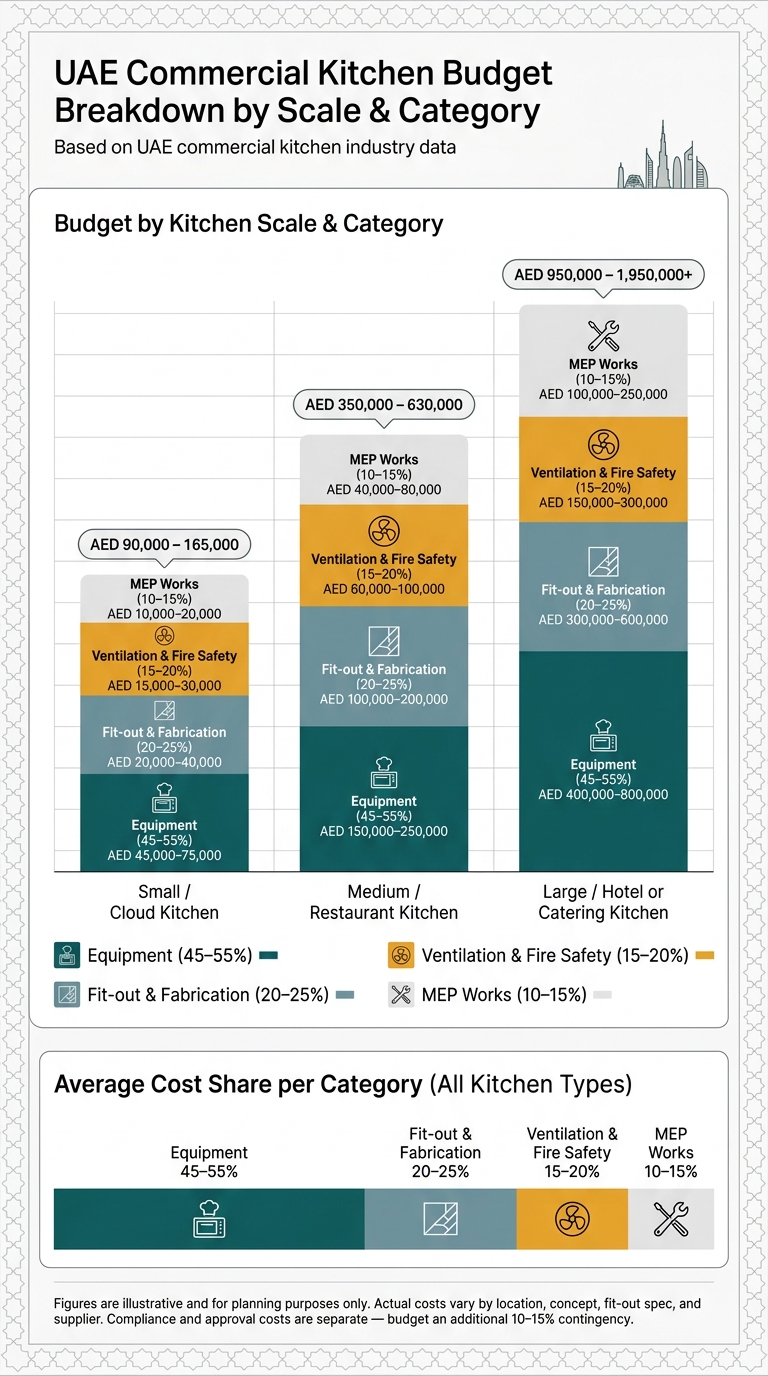
UAE Commercial Kitchen Setup Costs by Type & Category (AED)
Once you've set the scope and checked the BOQ, price each cost category on its own. The goal is simple: map every BOQ line to a budget bucket before you ask suppliers for prices. That makes it much easier to separate build costs from compliance costs when quotes start coming in.
Design, fit-out, equipment, and MEP works
In most kitchen projects, equipment takes the biggest chunk of the budget. That covers cooking equipment, refrigeration like cold rooms, and prep stations. It also needs its own installation allowance of AED 700–AED 2,000 per unit for safe gas or electrical connection.
Fit-out and fabrication usually include stainless steel fabrication, non-absorbent wall and floor finishes, drainage, and grease trap planning. MEP works cover electrical load balancing, 3-phase connections, gas piping, and plumbing points.
There’s one cost that often sneaks up on people: the electrical side. If the current power supply can't carry the full load of your cooking line, refrigeration, and extraction system, you may need to add an electrical distribution board upgrade.
Civil Defence submissions, Dubai Municipality food-safety items, and DEWA electrical works should sit in their own line items. Don’t mix them into the build budget here, because Step 3 deals with those in full.
Ventilation and authority-driven installation costs
After equipment and fit-out, ventilation is usually the next big pressure point in the budget. In many projects, it comes in as the second-largest cost, making up around 15–20% of the total budget.
This section should include:
- Extraction hoods
- Ducting
- Fresh air systems
- Fire suppression
- Gas interlock systems
Site access can push this cost higher than expected. If the kitchen is on an upper floor or inside a mall, longer duct runs, specialist access, and craneage for heavy items like walk-in cold rooms can add a fair amount to the total. Getting detailed layouts submitted early helps keep resubmission risk low.
Sample budget table by kitchen scale
These figures are for planning, not fixed quotations. Actual costs change based on location, concept, fit-out spec, and supplier.
| Category | Small / Cloud Kitchen (AED) | Medium / Restaurant Kitchen (AED) | Large / Hotel or Catering Kitchen (AED) | Avg. % of Total |
|---|---|---|---|---|
| Equipment (cooking, refrigeration, prep) | 45,000 – 75,000 | 150,000 – 250,000 | 400,000 – 800,000 | 45–55% |
| Ventilation and fire safety | 15,000 – 30,000 | 60,000 – 100,000 | 150,000 – 300,000 | 15–20% |
| Fit-out and fabrication | 20,000 – 40,000 | 100,000 – 200,000 | 300,000 – 600,000 | 20–25% |
| MEP works (electrical, gas, plumbing) | 10,000 – 20,000 | 40,000 – 80,000 | 100,000 – 250,000 | 10–15% |
| Estimated total | 90,000 – 165,000 | 350,000 – 630,000 | 950,000 – 1,950,000+ | 100% |
Figures are illustrative; Step 3 covers compliance costs.
Step 3: Budget for UAE compliance, HACCP, and approvals from day one
Once you've priced equipment, fit-out, and MEP, set aside a separate budget block for approvals and HACCP. Do this before you sign the fit-out contract.
Why? Because these costs often get missed in early numbers. Then, halfway through the project, spend starts climbing and cash flow gets squeezed.
Licensing and authority approvals to list as separate line items
The authority will change from one emirate to another, but the way you build the budget stays the same. Keep approval-related costs separate from the contractor's build quote.
That usually includes:
- landlord approvals
- signage permits
- consultant drawings
- resubmission fees
Dubai Municipality usually reviews a standard drainage drawing in 5–10 working days. If the drawing is rejected, the timeline can slip by two weeks or more. That’s why approvals often shape the opening date more than the design itself. Late submissions mean late opening.
Set aside 2–3 weeks for permits and inspections before launch.
If fire and life-safety drawings don’t match the actual ceiling heights or site conditions, Civil Defence may ask for a resubmission. And that’s not a small issue. Mismatched drawings can lead to resubmission and rework costs of 10–15%. Since these approvals affect layout and utility choices, they need to be budgeted before you order equipment.
HACCP-related costs beyond paperwork
HACCP isn’t just forms and checklists. It affects the kitchen layout, finishes, drainage, and even how the team works day to day.
Your kitchen plan should separate raw and cooked food zones from the start. If you try to retrofit compliance into an existing kitchen later, the cost is usually 20–30% higher than fitting out a shell-and-core space.
The main cost drivers usually include dedicated handwash stations, washable high-quality finishes, marine-grade sealants, stainless steel fabrication, and the plumbing points needed to support them.
Drainage is another big one. In Dubai, grease trap sizing is regulated under Dubai Municipality Technical Guideline No. 13. In Abu Dhabi, the reference point is ADAFSA tables. Typical grease trap costs are:
- AED 850–AED 2,200 for under-sink units
- AED 1,500–AED 3,500 for floor-mounted units
- AED 4,500–AED 7,500+ for underground installations
Material choice matters too. Using 304 or 316-grade stainless steel for grease traps costs 30–50% more upfront than mild steel. But mild steel units often fail within 3–5 years in the UAE’s humid climate. So this isn’t just a spec-sheet detail. It’s a direct budget choice.
On the operations side, include staff food safety training, HACCP record-keeping setup, and any third-party consultancy needed for certification. If your concept needs temperature monitoring for HACCP records, list those sensors separately under equipment instead of hiding them inside the fit-out budget.
Compliance cost table for common line items
Use the table below to separate the line items that most often come from compliance demands.
| Compliance Item | Typical Cost Range (AED) | Budget Impact |
|---|---|---|
| Grease trap installation | 850–7,500+ | Required for drainage approval |
| MEP and plumbing coordination | 5,000–18,000 | Ensures electrical load and plumbing meet safety codes |
| Waterproofing and tiling | 1,600–3,200 | Prevents bacterial growth and supports cleaning |
| Stainless steel fabrication | Priced per linear metre | Required for food-contact surfaces and hygiene |
| Dubai Municipality permit and inspection | Bundled or billed separately | Required for legal operation and compliance certificate |
Figures are indicative and should be checked against your final scope, supplier quotes, and local authority rules.
Step 4: Control overspending with quote checks, contingency, and maintenance planning
How to compare supplier quotes by scope, exclusions, and compliance coverage
Once the core build has a price, the last big risk is what suppliers don’t include. The lowest quote often looks good at first glance, but it can end up costing more once the missing items start piling up.
Go through each quote line by line. Check labour, materials, installation, testing, and commissioning. Then look at the gaps. Make sure each quote covers installation scope, gas line testing and certification, and 3-phase electrical connections. Also confirm whether authority revisions, resubmissions, and approval-related adjustments are included. These items can quietly add to the bill later.
It also helps to check the electrical load assumptions and any allowance for panel upgrades. These are common blind spots in kitchen fit-out budgets. If one supplier has priced them in and another hasn’t, the cheaper quote may not be cheaper at all.
Set a contingency and maintenance allowance before final sign-off
Once the exclusions are clear, set your contingency and maintenance allowances before sign-off. Put aside 10–15% for rework, scope changes, and authority-required changes. That buffer can save you from scrambling later if plans shift or approvals trigger extra work.
Maintenance should sit in its own budget line as an operating cost. Budget annual servicing for extraction, grease traps, and fire safety systems separately. If you mix these costs into the fit-out budget, it becomes harder to track what the kitchen will cost to run after opening.
Conclusion: What to prioritise and what to avoid
The final budget check is simple: protect the project from avoidable overruns. Put scope clarity, compliance coverage, and full quote comparison ahead of the lowest headline price.
A well-planned, compliant kitchen usually costs less over its lifetime than one that needs redesign after opening.
FAQs
What usually gets left out of a UAE kitchen budget?
In the UAE, many budgets cover the main equipment but still miss the costs that tend to show up later during fit-out and approvals.
The usual gaps are electrical panel upgrades, permit fees, utility or building management charges, MEP consultant fees, grease trap installation, civil defence re-submissions, and dead rent during approval delays.
It also helps to set aside a 10–15% buffer for delays, permit revisions, design rework, or equipment lead times.
How early should I budget for approvals and HACCP?
Start planning for approvals and HACCP from day one. In many fit-out projects, approvals, not design, shape the timeline. Delays with Dubai Municipality, Civil Defence, and other relevant authorities are common, so it pays to get ahead of them early.
Run approvals in parallel with design. That simple move can help you avoid rework costs of 10 to 15 per cent of your budget. HACCP control measures also need to be built into the initial design before construction starts, not added later when changes cost more and slow everything down.
How can I tell if a supplier quote is missing key costs?
Compare the quote against a full checklist of UAE regulatory and day-to-day setup requirements. A price can look fine at first glance, then fall short when key items are missing. That often happens with civil works, MEP upgrades, ventilation, or permit-related costs tied to Dubai Municipality or Civil Defence.
Look closely at whether the quote covers:
- Civil works such as blockwork, floor levelling, drainage changes, and fit-out prep
- MEP upgrades including power load changes, plumbing, drainage, water points, and AC adjustments
- Ventilation works like kitchen exhaust, fresh air supply, ducting, and discharge changes
- Approvals from Dubai Municipality or Civil Defence, if they apply to the site and use case
Then check for costs that tend to show up later, after the deal is already moving. These can include utility connections, NOC fees, grease traps, and HACCP-related non-absorbent surfacing. Miss one of these, and the budget can shift fast.
A simple way to pressure-test the quote is to ask: What is not included? That one question can save a lot of trouble.
It also makes sense to add a 10–15% contingency for site issues or rule changes. In the UAE, small approval updates or on-site surprises can push costs up without much warning.
