


Designing a commercial kitchen layout in the UAE directly impacts efficiency, food safety, and compliance with strict local regulations. The three main layouts - Island, Zone, and Assembly Line - each serve specific needs:
- Island Layout: Centralised design ideal for fine-dining and luxury kitchens, offering excellent supervision and team coordination but requiring significant space and higher costs.
- Zone Layout: Divides the kitchen into task-specific areas, perfect for large-scale, multi-cuisine operations. It supports food safety and scalability but demands a larger footprint and higher upfront investment.
- Assembly Line Layout: A linear setup tailored for speed and high-volume output, best suited for QSRs, cloud kitchens, and compact spaces. It’s cost-effective but less flexible for diverse menus.
Quick Comparison:
| Layout | Best For | Key Features | Setup Cost (UAE) |
|---|---|---|---|
| Island | Fine dining, luxury hotels | Central hub, 360° supervision | AED 300,000–600,000+ |
| Zone | Large hotels, catering | Task-specific zones, scalable | AED 300,000–600,000+ |
| Assembly Line | QSRs, cloud kitchens, cafés | Linear workflow, compact spaces | AED 80,000–150,000 |
Choosing the right layout depends on your menu, daily order volume, available space, and budget. Hybrid designs often combine features to meet complex operational needs while ensuring compliance with UAE regulations.

UAE Commercial Kitchen Layouts Compared: Island vs Zone vs Assembly Line
Core Design Principles for UAE Commercial Kitchens
Before diving into specific layout comparisons, it's crucial to grasp the essential principles that every UAE commercial kitchen must adhere to.
Workflow and Safety Standards
In UAE kitchens, a strict one-way workflow is mandatory: Receiving → Storage → Preparation → Cooking → Plating → Service → Cleaning. This process is enforced by Dubai Municipality, ADAFSA, and the Food Control Department to ensure raw and cooked foods are kept separate at all times.
"A kitchen should feel like a sequence, not a room. Every step matters: Cold Prep → Cooking Line → Pass / Expo → Dish Drop → Cleaning / Stewarding." - Muhammad Rady, Rady Interior
To ensure food safety, preparation zones must be clearly separated. Surfaces like stainless steel wall cladding and anti-slip floor tiles are standard as they are non-porous and easy to clean. Additionally, hand-washing sinks must be strategically placed throughout the kitchen, and grease traps installed per municipality guidelines. These measures form the backbone of safe and efficient kitchen operations.
Fire Safety and Ventilation
Fire safety and ventilation are non-negotiable in UAE commercial kitchens. According to UAE Civil Defence regulations, every kitchen must have an approved fire suppression system and an exhaust hood installed above all cooking equipment - no exceptions.
Ventilation systems are a major investment, typically accounting for 15–20% of the total kitchen setup budget. The layout of your kitchen directly impacts how these systems are designed. For instance, an Island layout requires a central island hood, which is more complex and costly to install than the wall-mounted units used in Zone or Assembly Line kitchens. Engaging a municipality-approved ventilation contractor early ensures proper hood sizing and compliance. These systems are critical not only for safety but also for maintaining a functional and comfortable workspace.
Space and Capacity Planning
Effective space planning is key to an efficient kitchen. Aisles should be 107–122 cm wide, and workstations set at 85–95 cm high to allow staff to move freely and work comfortably. For safe plating and utensil handling, a minimum counter clearance of 38 cm is required.
The UAE's extreme summer heat, often exceeding 45°C, adds another layer of complexity. Heat-generating equipment must be spaced out to prevent dangerous hot spots in the kitchen. High-capacity ventilation is essential, not only for staff comfort but also for meeting food safety standards. Planning for peak operational capacity, including potential menu expansions, can help avoid costly adjustments in the future.
Island Layout: Features, Pros, and Cons
The Island layout brings a unique approach to kitchen design, with its centralised cooking station surrounded by prep, storage, plating, and washing areas. This setup creates a circular workflow, enabling staff to move efficiently around a central hub. It also fosters better communication and coordination among team members, making it particularly appealing for operations that require precision and teamwork.
Key Features
One of the standout aspects of the Island layout is its enhanced visibility. By placing the executive chef near the central cooking area, they can oversee every surface and team member with ease. This is especially useful for kitchens handling intricate, time-sensitive menus, where seamless coordination is critical.
To function effectively, this layout requires a kitchen width of 5–6 metres, aisle clearances of 1.2 metres, and a central hood that extends 150–300 mm beyond the cooking equipment to handle the heat and vapours generated by the centralised setup.
Advantages and Disadvantages
The Island layout has clear benefits, starting with its ability to streamline chef supervision and improve team communication. However, it does come with challenges, particularly in terms of space and cost. Setting up a fine-dining or large-scale kitchen in the UAE using this layout typically costs between AED 300,000 and AED 600,000 or more. Ventilation systems alone can account for 15–20% of the total budget.
"Efficient layouts can improve staff productivity by up to 50%, reducing fatigue and errors in high-pressure environments." - Dr. Maria Gonzalez, Food Industry Consultant
| Factor | Island Layout |
|---|---|
| Chef supervision | Excellent: full 360° chef supervision |
| Team communication | High - centralised coordination |
| Space requirement | High - minimum 5–6 m kitchen width |
| Ventilation complexity | High - central hood required |
| Menu flexibility | Moderate - suits complex, multi-method menus |
| Setup cost (UAE) | AED 300,000 – 600,000+ |
Best Use Cases in the UAE
This layout aligns well with the needs of fine-dining restaurants, luxury hotels, and high-end table-service venues in Dubai and Abu Dhabi. It’s particularly effective for establishments with spacious floor plans and complex menus, where presentation and precision are paramount. Additionally, the Island layout is a great fit for open or show kitchens, where the central cooking area can double as an engaging visual feature for diners.
That said, it’s not ideal for all scenarios. Smaller spaces, cloud kitchens, or high-volume quick-service restaurants may struggle to accommodate the layout’s spatial requirements. If your kitchen lacks the necessary width or aisle clearances, you might want to explore alternative layouts better suited to your operational needs.
Zone Layout: Features, Pros, and Cons
The Zone layout takes a different approach from the centralised Island layout by dividing the kitchen into specialised areas. These zones are dedicated to tasks like cold prep, hot cooking, pastry, dishwashing, and dry storage. Each zone operates independently, with staff staying within their designated areas. This setup reduces unnecessary movement and keeps operations running efficiently, even during busy periods. It also aligns perfectly with the UAE's requirement for unidirectional food flow in professional kitchens.
Key Features
One of the standout aspects of the Zone layout is how it supports HACCP compliance, which is strictly enforced by UAE food safety authorities, including Dubai Municipality and the Abu Dhabi Agriculture & Food Safety Authority. The separation of zones simplifies inspections and ensures that safety standards are met with ease.
The workflow in this layout is straightforward and follows a logical, unidirectional sequence: receiving → storage → preparation → cooking → serving → washing. This clear flow ensures food safety at every stage of the process.
Advantages and Disadvantages
A major advantage of the Zone layout is its scalability. As operations grow or menus expand, new stations can be added without disrupting the existing setup. Additionally, a well-designed Zone kitchen can lead to a 15–25% reduction in labour costs and up to a 10% decrease in food waste. This is largely because staff become highly skilled in their specific zones, leading to greater efficiency.
On the flip side, the Zone layout requires dedicated equipment for each area, which increases initial setup costs and utility expenses. For example, the gas line capacity and electrical amperage requirements are higher compared to other layouts. In space-limited cities like Dubai, fitting a full Zone kitchen can be a challenge. The setup costs for large-scale Zone kitchens in the UAE typically range from AED 300,000 to AED 600,000 or more.
| Factor | Zone Layout | Island Layout | Assembly Line Layout |
|---|---|---|---|
| Scalability | High – easy to add specialised zones | Moderate – limited by a central hub | Low – designed for specific menus |
| Staff Movement | Minimised within dedicated zones | Circular around a central hub | Linear, step-by-step |
| Food Safety | Superior – physical HACCP separation | Moderate – relies on strict discipline | Good – linear flow prevents back-tracking |
| Space Requirement | High – requires significant floor area | Moderate to high – minimum width of 5–6 m | Low – suitable for compact spaces |
These factors explain why Zone layouts are a popular choice in many UAE foodservice operations.
Best Use Cases in the UAE
Zone layouts are particularly common in large hotel kitchens, central production facilities, and catering operations throughout the UAE. They are ideal for kitchens handling complex and diverse menus at the same time. Beyond Dubai and Abu Dhabi, Zone layouts are frequently seen in Sharjah, Ajman, and Ras Al Khaimah. These setups are especially useful in facilities with dedicated sections for bakery, pastry, and beverages. Even some multi-brand cloud kitchens adopt a zone-based approach to maintain clear separation between different virtual restaurant brands and their storage needs.
sbb-itb-19c3c9a
Assembly Line Layout: Features, Pros, and Cons
The Assembly Line layout is all about speed and efficiency. Unlike the Zone layout, which focuses on versatility, this design simplifies kitchen operations into a straightforward sequence: prep, cooking, plating, and service. Each step flows in one direction, ensuring a smooth, uninterrupted process. For commercial kitchens in the UAE, this setup aligns perfectly with the unidirectional food flow requirements set by Dubai Municipality and ADAFSA.
Key Features
This layout is defined by its linear workflow. Staff are positioned along a single line, each responsible for a specific task before passing the dish to the next station. This eliminates overlapping tasks, reduces errors, and makes supervision easier - a manager can oversee the entire operation from one end.
In high-rent cities like Dubai and Abu Dhabi, this layout's compact design is a major advantage. By utilising undercounter equipment like compact dishwashers, kitchens can save space while maintaining productivity. However, it's essential to follow local regulations, such as the Dubai Universal Design Code, which requires aisles to be at least 1.2 metres wide to ensure safe movement for staff. These features make this layout ideal for high-efficiency operations.
Advantages and Disadvantages
The Assembly Line layout shines in high-volume settings. Its efficiency is unmatched for standardised menus that involve producing the same dishes repeatedly at a fast pace:
"Efficient layouts can improve staff productivity by up to 50%, reducing fatigue and errors in high-pressure environments."
Training staff is simpler since each person focuses on a single task. Plus, the initial setup costs for a small cloud kitchen or café using this layout are relatively affordable, ranging from AED 80,000 to AED 150,000. This makes it an appealing choice for new businesses. However, this cost-effectiveness comes with limitations.
The layout struggles to accommodate diverse or frequently changing menus. If your kitchen handles multiple cuisines or needs flexibility, bottlenecks can occur. Additionally, failing to meet UAE compliance requirements during the design phase can lead to rework costs of 10–15% of the total budget. Submitting detailed layout drawings to authorities like Dubai Municipality or ADAFSA before starting construction is crucial.
Best Use Cases in the UAE
This layout is a go-to for Quick Service Restaurants (QSRs), fast-casual chains, and cloud kitchens in the UAE. With the rise of delivery-only kitchens on platforms like Talabat, Deliveroo, and Careem, it's become increasingly popular in Dubai and Abu Dhabi. These kitchens often handle 200 or more orders per day in compact, high-rent spaces, making the Assembly Line layout a practical choice.
Bakeries and cafés with narrow, galley-style spaces also benefit from this design, as it fits perfectly with the long, straight floor plans common in UAE retail units. This layout ensures that even in tight spaces, operations remain streamlined and efficient.
How to Choose the Right Layout for Your UAE Commercial Kitchen
Factors to Consider
Choosing the right kitchen layout in the UAE comes down to four main factors: your menu, the volume of daily orders, the size of your space, and your budget. For instance, a QSR handling over 200 orders a day will need a completely different setup compared to a fine-dining restaurant catering to just 60 guests.
Space is a premium in cities like Dubai and Abu Dhabi. Commercial kitchens generally take up 25–40% of the total floor area. With high rental costs, every square metre must serve its purpose. Adequate cold and dry storage is essential and should align with the number of daily covers.
Budget is another critical consideration. For example, a small cloud kitchen setup might cost around AED 80,000, while a fine-dining kitchen can exceed AED 300,000. Equipment costs typically make up 45–55% of the total budget, and ventilation accounts for another 15–20%.
Here’s a quick guide to match your kitchen type with the right layout:
| Your Operation | Recommended Layout |
|---|---|
| QSR, cloud kitchen, fast-casual | Assembly Line |
| Fine dining, hotel kitchen | Island |
| Multi-cuisine, catering, large hotel | Zone |
| Small café, narrow retail unit | Assembly Line or Galley |
In many cases, especially with complex operations, hybrid layouts are the best solution.
Combining Layouts for Complex Operations
Large-scale kitchens in the UAE - like those in hotels, catering services, or institutions - often require hybrid layouts to handle operations serving more than 300 covers.
A popular approach combines a Zone layout for bulk preparation - keeping raw meat, vegetables, and pastry areas separate to meet Dubai Municipality and ADAFSA hygiene standards - with an Assembly Line for final plating and service. This setup ensures speed during busy periods while adhering to the unidirectional food flow rule (Receiving → Storage → Prep → Cooking → Service → Washing). It’s an efficient way to manage a diverse menu while maintaining compliance.
One practical tip for future growth: include a 25–30% safety margin when calculating your kitchen’s electrical load. Skipping this step can lead to costly adjustments if new equipment needs to be added later.
Silverline Kitchens' Expertise
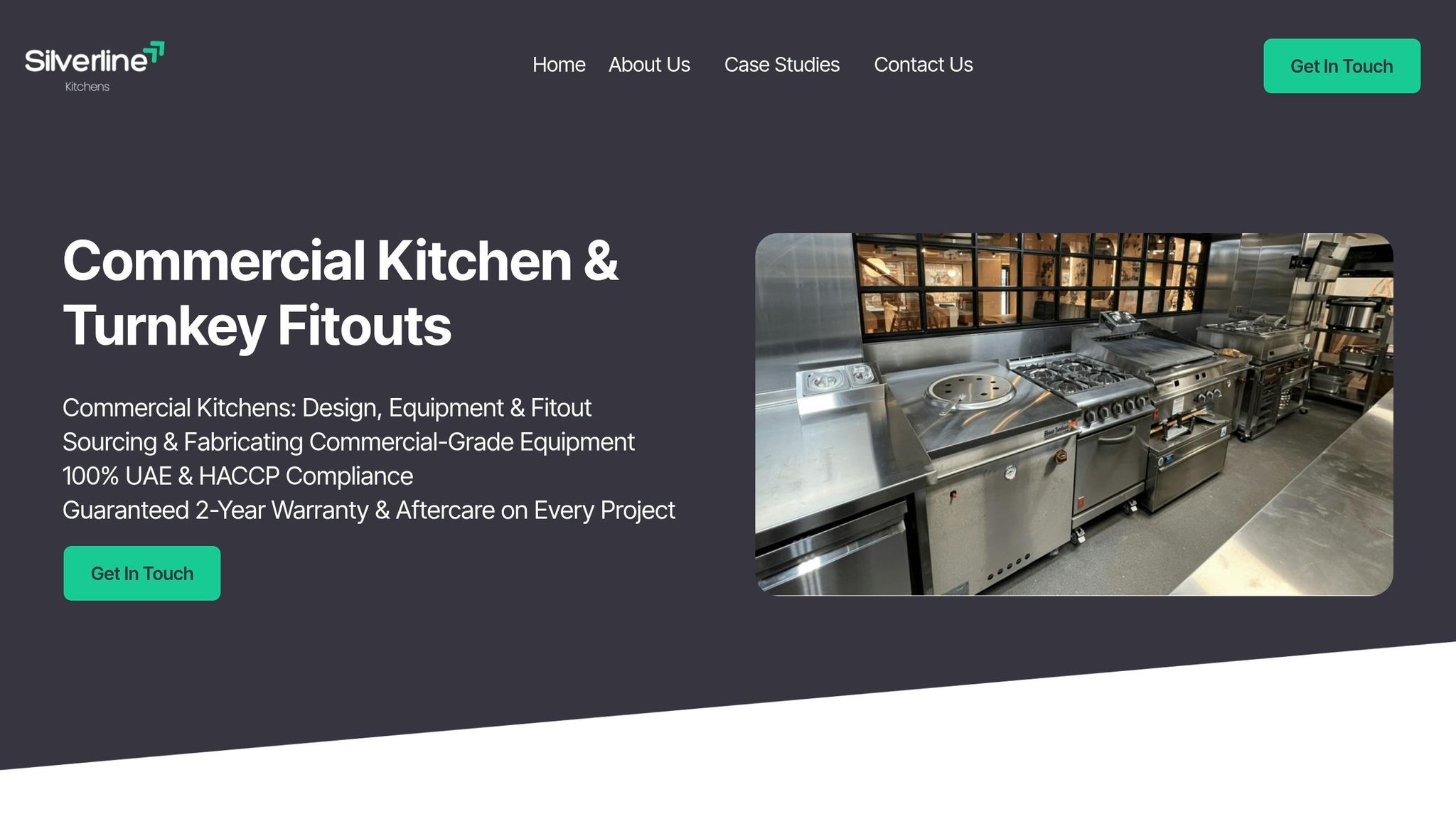
Turning these guidelines into a fully functional, regulation-compliant kitchen requires expert planning. Silverline Kitchens specialises in end-to-end solutions, including custom design, equipment sourcing, installation, as well as grease trap and drainage planning. They ensure compliance with HACCP, Dubai Municipality, and Civil Defence standards.
One of their standout services is managing pre-approval drawing submissions to the relevant authorities before construction begins. This often-overlooked step can save operators from expensive delays. Additionally, their after-sales support ensures that as your business evolves, your kitchen can be updated or reconfigured without needing a complete rebuild.
Conclusion
Every kitchen layout is designed to serve a specific purpose. The Assembly Line layout prioritises speed and repetition, making it a strong contender for quick-service restaurants (QSRs) and cloud kitchens. On the other hand, the Island layout focuses on improving supervision and communication, which works well for fine dining establishments and hotel kitchens. Meanwhile, the Zone layout is perfect for managing complex, multi-cuisine operations by keeping tasks and ingredients organised. These differences also highlight the importance of adhering to the strict safety and hygiene standards in the UAE.
Selecting the right layout has a direct impact on team productivity. A poorly planned layout can cut labour efficiency by as much as 15–20% per shift. Moreover, compliance with UAE regulations is non-negotiable. From aisle widths and surface materials to grease traps and fire suppression systems, every aspect must meet the standards set by Dubai Municipality, ADAFSA, and Civil Defence. Addressing compliance issues during the planning phase is not only easier but also far more cost-effective than fixing them later.
Silverline Kitchens provides comprehensive solutions that combine operational efficiency with regulatory compliance. Their services include custom kitchen design, equipment sourcing, pre-approval drawing submissions, and after-sales support. By aligning layout planning with UAE’s stringent compliance requirements, Silverline Kitchens ensures your kitchen operates both safely and efficiently.
FAQs
How do I choose between Island, Zone, and Assembly Line for my menu?
To make the best choice, consider factors like how complex your menu is, how quickly you need to serve customers, and the size of your kitchen.
- Assembly Line Layout: Perfect for quick-service restaurants with high-volume, straightforward menus that prioritise speed. Think of places where efficiency is key, and dishes follow a predictable preparation process.
- Island Layout: Ideal for fine dining or kitchens where chefs focus on intricate, high-quality dishes. This setup allows for better coordination among the team working on complex plates.
- Zone Layout: Best for kitchens with diverse menus that require specialised stations, such as grills, pastry, or salad prep. This layout ensures flexibility and smooth workflows for handling a variety of tasks efficiently.
What UAE approvals do I need before building my kitchen layout?
Before beginning construction on your commercial kitchen, you’ll need approvals from both Dubai Municipality and Dubai Civil Defence. This requires submitting detailed architectural and MEP (Mechanical, Electrical, and Plumbing) drawings. These should include layouts, equipment placement, ventilation systems, drainage plans, and grease trap specifications.
Make sure the site is properly zoned for F&B operations, and don’t forget to obtain a No Objection Certificate (NOC) from the landlord. A certified consultant can assist with preparing and submitting these documents. The approval process usually takes around 15–30 working days and must meet HACCP standards and fire safety regulations.
Can I mix layouts in one commercial kitchen?
Yes, you can mix and match layouts to fit your specific needs. For instance, open kitchens often combine zone and island layouts to improve workflow and visibility. Larger operations might rely on zones for tasks like preparation and cleaning, while incorporating an island or assembly line for cooking and plating. Just make sure your design supports a logical, one-way food flow and adheres to local hygiene regulations.
