


If I were opening a restaurant kitchen in Dubai today, I’d budget for approvals, MEP, ventilation, fire suppression, stainless steel work, equipment, utility tie-ins, and a few weeks of dead rent - not just cooking gear.
The short version is simple: a small cloud kitchen or QSR may need around AED 80,000–150,000, a casual dining kitchen can start from AED 300,000+, and a high-spec kitchen can hit AED 500,000+. On top of that, design errors or approval issues can add 10–15% in rework, while drainage changes may add 20–30%.
Before I sign off any kitchen budget, I’d make sure it covers:
- Design drawings and authority submissions
- Stainless steel fabrication
- Grease traps and drainage
- Ventilation and exhaust
- Fire suppression and gas interlocks
- Cooking, refrigeration, and dishwashing equipment
- DEWA and utility upgrades
- Permits, inspections, and AMC costs
- 3–4 weeks of dead rent before opening
A lot of owners underprice the kitchen because they focus on the dining area first. But in Dubai, the kitchen often decides both the final cost and the opening date.
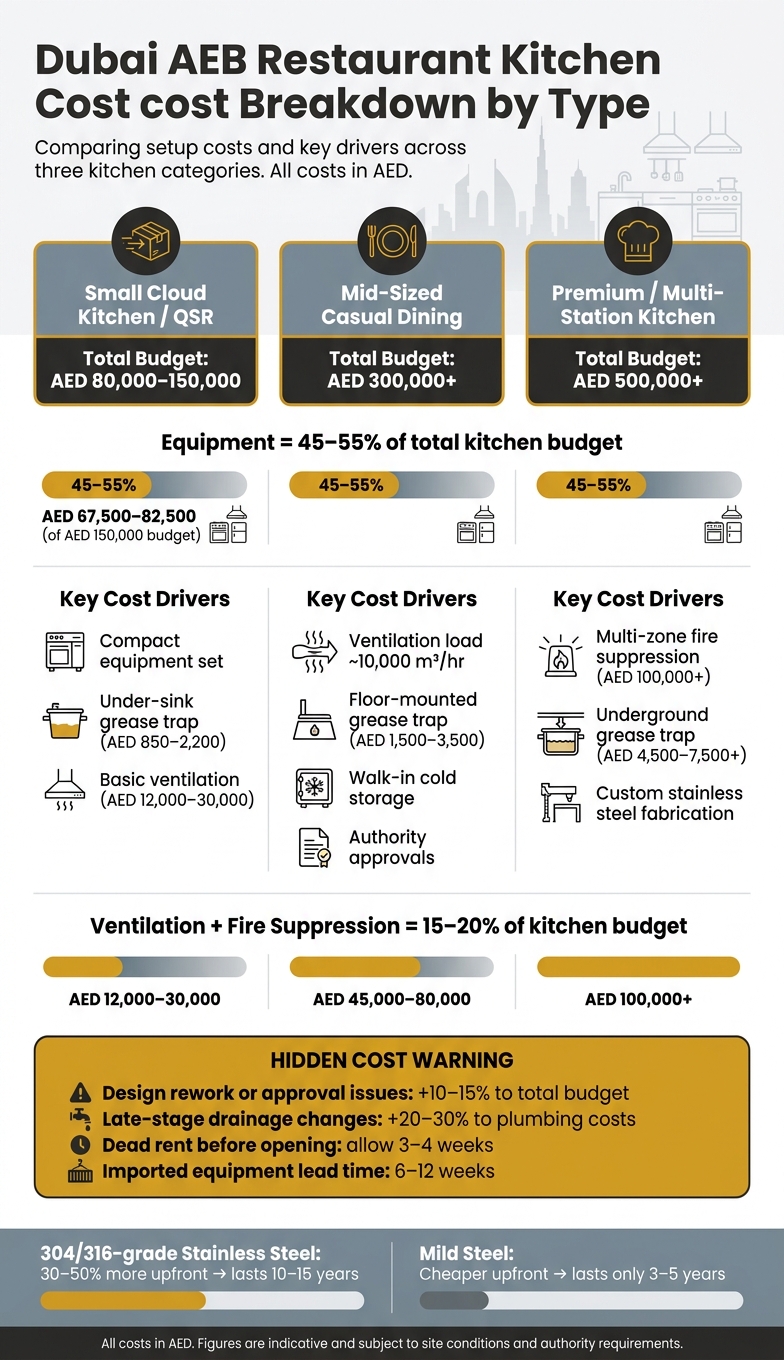
Dubai Restaurant Kitchen Cost Breakdown by Type (2024)
Quick Comparison
| Kitchen Type | Usual Kitchen Budget | Main Cost Pressure |
|---|---|---|
| Small cloud kitchen / QSR | AED 80,000–150,000 | Equipment, grease trap, base ventilation |
| Mid-sized casual dining | AED 300,000+ | Ventilation load, drainage, cold storage, approvals |
| Premium or multi-station kitchen | AED 500,000+ | Multi-line cook setup, suppression, custom fabrication |
The main point: kitchen costs in Dubai are not just about what you cook on. They are also about what the site, landlord, and authorities require before you can open.
sbb-itb-19c3c9a
Design, Fit-out and Compliance Costs
Design and fit-out costs climb fast when compliance shapes the layout, drainage, and material choices. Dubai Municipality’s Food Control Department requires kitchens to be split into zones for preparation, cooking, plating, and storage, with aisles at least 1.2 metres wide. If that’s missed in the drawings, the fix usually comes later - and that kind of rework often adds 10–15% to the total budget.
Kitchen Design Drawings and Stainless Steel Fabrication
These drawings aren’t just for the contractor. They’re approval documents reviewed by DM Food Control, Dubai Civil Defence, and, when needed, the master developer or free zone authority before sign-off. If a drawing gets rejected, opening can be pushed back by at least two weeks, which means extra rent on top of the delay.
Once the drawings are approved, fabrication starts. Stainless steel worktables, wall shelves, splashbacks, pass counters, three-compartment sinks, and handwash basins are all core items, not nice-to-haves.
There’s also a clear material trade-off. 304 or 316-grade stainless steel costs 30–50% more upfront than mild steel. But in Dubai’s humid climate, it usually lasts 10–15 years, while mild steel often lasts only 3–5 years. You pay more at the start, but replacing cheap metal every few years can become a bigger headache.
Grease Traps, Drainage and Utility Connections
Dubai Municipality Technical Guideline No. 13 requires grease traps to be sized based on fixture units. It also makes sense to budget for DEWA load upgrades, water tie-ins, and electrical works as separate line items, because these are often priced only after a site inspection.
Here’s how grease trap costs usually break down:
- A small cloud kitchen may be fine with an under-sink AG1 unit, installed for AED 850–2,200
- A mid-range restaurant will often need a floor-mounted trap at AED 1,500–3,500
- Larger operations need underground B-Type or C-Type traps, which cost AED 4,500 to AED 7,500+ installed
The bigger cost risk tends to come from late-stage changes. If floor penetrations or drainage routes are changed after the slab is complete, or if the existing pipework turns out to be corroded, plumbing and drainage costs can jump by 20–30% compared with a clean shell-and-core unit.
Comparison Table: Basic Fit-out vs Higher-capacity Fit-out
| Fit-out Element | Basic Fit-out (e.g., Cafeteria / Cloud Kitchen) | Higher-capacity Fit-out (e.g., Full-Service / Hotel) |
|---|---|---|
| Kitchen Size | ~50 m² | 100 m²+ |
| Grease Trap | Under-sink AG1 (8–50 L) | Floor-mounted (50–250 L) or underground (500–2,000 L+) |
| Stainless Steel Scope | Standard worktables, single 3-compartment sink | Custom fabrication, pass counters, multi-compartment sinks |
| Drainage Complexity | Single point-of-use connection | Multiple floor drains and recessed pits |
| Main Cost Driver | Grease trap sizing and basic fabrication | Custom stainless steel, drainage routing, and MEP coordination |
Ventilation, ducting, and fire suppression add the next major cost layer.
Ventilation, Fire Suppression and Authority Approval Costs
After drainage and grease traps, ventilation and fire suppression become the next big costs tied to approvals. In Dubai, these are often the most underpriced parts of a kitchen fit-out. The hidden hit usually comes from MEP coordination, especially HVAC, fresh air, and fire systems. This is also the cost block that tends to wreck opening budgets, because you’re paying for equipment, compliance, and installation at the same time.
And the approval side? It’s usually shaped more by consultant hours, submission work, and re-submission delays than by one big fixed fee.
Ventilation and fire safety usually account for 15–20% of the kitchen budget. That works out to AED 12,000–30,000 for an AED 80,000–150,000 cloud kitchen, and AED 105,000–140,000 for an AED 700,000 fit-out.
Exhaust Hoods, Ducting and Air Balance
Ventilation cost mainly comes down to hood size, duct length, and extraction load. Add fryers, chargrills, or tandoor ovens, and the cost climbs fast. These appliances produce more grease-laden air, so they need higher extraction rates.
For example, a mid-sized restaurant may need ventilation that can handle 10,000 m³ of air per hour. That kind of load usually means larger fans, longer duct runs, and make-up air units. Bit by bit, the bill grows.
Fire Suppression Systems and Civil Defence Requirements
Commercial kitchens with gas or high-heat cooking equipment usually need an automatic wet chemical fire suppression system. This setup includes nozzles above each cooking appliance, a manual pull station, and a gas interlock that cuts the gas supply if the extraction fan fails or if the suppression system is triggered.
DCD requires suppression drawings to be submitted by a registered contractor, then reviewed and approved before installation starts. If site conditions later differ from the approved drawings - ceiling height is a common one - the drawings must be submitted again. That can delay the project by two weeks and add rework costs equal to 10–15% of the total budget.
This is why layout and ceiling heights need to be locked before suppression drawings go in. It sounds like a small detail, but it can mean the difference between a clean approval path and a messy delay. It also marks the jump from a simple single-cookline setup to a more complex multi-station kitchen.
Single Cookline vs Multi-Station Kitchen Ventilation
| Kitchen Type | Ventilation Scope | Fire Suppression Scope | Indicative AED Range |
|---|---|---|---|
| Single cookline (small / electric) | Basic canopy hood, short duct run, standard fan | Basic wet chemical system, manual pull station | AED 12,000 – 30,000 |
| Mid-sized restaurant | ~10,000 m³/hr capacity, make-up air units, grease filters | Automatic wet chemical, gas interlocks, DCD-approved drawings | AED 45,000 – 80,000 |
| Multi-station / high-output | Multiple hoods, fire-rated duct treatment, roof discharge, complex air balance | Multi-zone suppression, integrated gas shut-off, full Civil Defence compliance | AED 100,000+ |
Once ventilation and suppression are fixed, equipment selection becomes the next major cost block.
Equipment Costs: Cooking, Refrigeration, Dishwashing and Extras
Once ventilation and fire suppression are sorted, the next big spend is equipment that fits your menu, order volume, and service model. In Dubai, equipment usually accounts for 45–55% of the kitchen budget. So if your cloud kitchen budget is AED 150,000, about AED 67,500–82,500 may go to equipment alone.
Cooking and Refrigeration Equipment
Your menu and daily output shape the equipment list.
A QSR or café with a tight menu can often run well with a compact cookline. A casual dining kitchen with a broader menu, on the other hand, will usually need more cooking stations and a standalone combi oven. That’s where costs can climb fast.
Refrigeration works the same way. A mid-sized restaurant may need storage for around 500 kg of perishables at one time. In practice, that often means a mix of upright chillers, undercounter units, and a small walk-in cold room. Each extra unit also adds to the electrical load, so refrigeration planning affects DEWA connection needs too.
Dishwashing, Prep Stations and Smallwares
Dishwashing systems, stainless steel prep stations, and smallwares often get pushed down the list during budgeting. That’s a mistake. These items are part of the core opening spend, not optional add-ons.
For prep stations and sinks, use 304 or 316-grade stainless steel to lower corrosion risk in Dubai’s humidity. It’s a practical choice, especially in a kitchen that runs hard every day.
Comparison Table: Equipment Budget by Kitchen Scale
It helps to split equipment spend into cookline, refrigeration, and dishwashing. That simple step can stop you from spending too much on items you don’t need. Typical equipment budgets by kitchen scale fall into these ranges:
| Kitchen Type | Typical Equipment Budget (AED) | Essential Equipment Focus |
|---|---|---|
| Small Cloud Kitchen | 80,000–150,000 | Compact prep stations, delivery-led layout |
| Mid-Sized Restaurant | 150,000–300,000 | Combi ovens, walk-in cold rooms, pass-through dishwashers |
| Large Production Kitchen | 300,000+ | Multi-station cooklines, high-volume dishwashing, blast chillers |
Imported kitchen equipment can take 6 to 12 weeks to arrive, so lock in the equipment list early. If not, it’s easy to run into commissioning delays and last-minute buying at the worst time.
How to Plan for Hidden Costs, Maintenance and a Realistic Opening Budget
The biggest budget gaps usually come from approvals, utility upgrades, rework, and dead rent. Those costs almost never show up in equipment quotes. And that’s where many neat-looking fit-out budgets start to fall apart.
Permits, Inspections and Service Contracts
Once the main build cost is clear, these quieter line items often decide if the kitchen opens on time or gets stuck waiting.
Dubai Municipality and Civil Defence approvals have a direct impact on your opening date. If your drawings are rejected more than once, you could end up paying rent on a site that still can’t operate. That’s why it makes sense to allow for 3–4 weeks of dead rent before opening. It also helps to submit Dubai Municipality and Civil Defence drawings during design development, not after it.
Utility upgrades are another cost that tends to appear late. Things like electrical panel upgrades, DEWA load increases, and drainage tie-ins are often priced only after a site inspection. In many cases, they’re not included in the first fit-out quote at all.
Then there’s post-opening maintenance. If you don’t plan for it early, it can put pressure on cash flow fast. Budget for AMC coverage on:
- grease traps
- refrigeration
- exhaust systems
These contracts help you stay compliant after opening, and they’re much easier to handle when they’re part of the budget from day one.
Conclusion: The Main Kitchen Cost Categories to Plan for in Dubai
A realistic Dubai kitchen budget needs to cover compliant design, grease management, ventilation, approvals, and maintenance. Each one plays a part in whether your kitchen passes inspection and opens on schedule.
The practical move is simple: itemise the budget by category before fit-out starts. Once contractors are on site and variation orders begin, cost control gets much harder. Plan for these items early so the final budget reflects what you’ll spend to get the kitchen open.
FAQs
What hidden kitchen costs should I budget for in Dubai?
Set aside a 10–15% contingency for hidden kitchen costs in Dubai. That buffer matters more than most people expect, especially in older buildings where electrical, HVAC, and plumbing upgrades can add AED 183,500–550,500 on top of your base fit-out cost. You may also need MEP coordination for fresh-air and fire suppression systems, which can push costs up further.
Then there are the admin and compliance costs that tend to creep in quietly:
- Permit fees: AED 2,000–15,000
- NOCs: AED 1,000–5,000
- Utility connections: AED 3,000–10,000
- Approval-delay dead rent
- Compliance items such as grease traps and Dubai Municipality-approved materials
If you're working on a retrofit rather than a shell-and-core space, expect to pay 20–30% more. That jump often comes from site constraints, extra remedial work, and the need to bring older systems up to code.
How can I reduce approval delays and rework costs?
Start the regulatory process on day one, at the same time as design development. A lot of rework happens when design and installation don’t line up, or when plans don’t meet code. That extra work can eat up 10–15% of your total budget.
Work with experienced specialists who know how local authorities like submissions to be prepared. Send complete MEP, architectural, and fire safety documents from the start. It also helps to leave a 10–15% buffer in both your timeline and budget for permit revisions or inspection issues.
Which kitchen costs depend most on my menu and concept?
Your menu and concept shape most kitchen costs. They set the direction for your equipment, infrastructure, and day-to-day operating scale.
Take deep-frying as an example. It needs specialised extraction and larger grease traps to meet Dubai Municipality rules. A simple café, on the other hand, may only need basic multi-functional appliances.
Menu complexity also affects your electrical load, ventilation, plumbing, and layout. That’s why it pays to lock this in early. If you change direction later, rework can get expensive fast.
