


If I’m opening a commercial kitchen in Dubai, I need a dedicated kitchen fire suppression system before I can get DCD approval and start trading.
In simple terms, Dubai inspectors expect me to protect three linked areas: the cooking appliances, the hood plenum, and the duct entry. They also check that the system can discharge automatically, be activated manually, shut off gas and electricity, and send signals to the fire alarm panel. A normal building sprinkler system does not replace this, because water is not meant for hot oil fires.
Here’s the short version of what matters:
- Wet chemical suppression must cover grease-producing appliances such as fryers, grills, and woks
- Hood and duct protection must match the cooking line layout
- Manual pull station should be near the exit and easy to reach
- Gas shut-off and electrical isolation must work when the system activates
- Fire alarm tie-in must report discharge and fault status
- Class K extinguishers should be placed near grease-fire risk areas
- Servicing and records must be kept through a DCD-approved company
- Staff training matters, because equipment alone is not enough
A key point many people miss: building sprinklers cover general fire risk, but kitchen hood systems cover grease fire risk. Those are two separate checks in Dubai. For that reason, if I leave suppression design until after fit-out, I can end up with drawing changes, site rework, and inspection delays.
| Item | What Dubai inspectors look for |
|---|---|
| Cooking line | Wet chemical nozzle coverage over grease-producing appliances |
| Hood plenum | Nozzle coverage inside the hood area |
| Duct entry | Protection where fire can move into exhaust |
| Release method | Automatic detection plus manual pull station |
| Utility shut-off | Gas valve trip and electrical isolation |
| Alarm link | Connection to addressable fire alarm panel |
| Portable equipment | Class K, DCP, and CO₂ where needed |
| Service status | AMC, inspection labels, and records |
So if I want a smoother approval process, I need to treat the kitchen hood, duct, appliances, suppression pipework, shut-off controls, and alarm link as one joined system from day one.
Where wet chemical suppression is required in a Dubai commercial kitchen
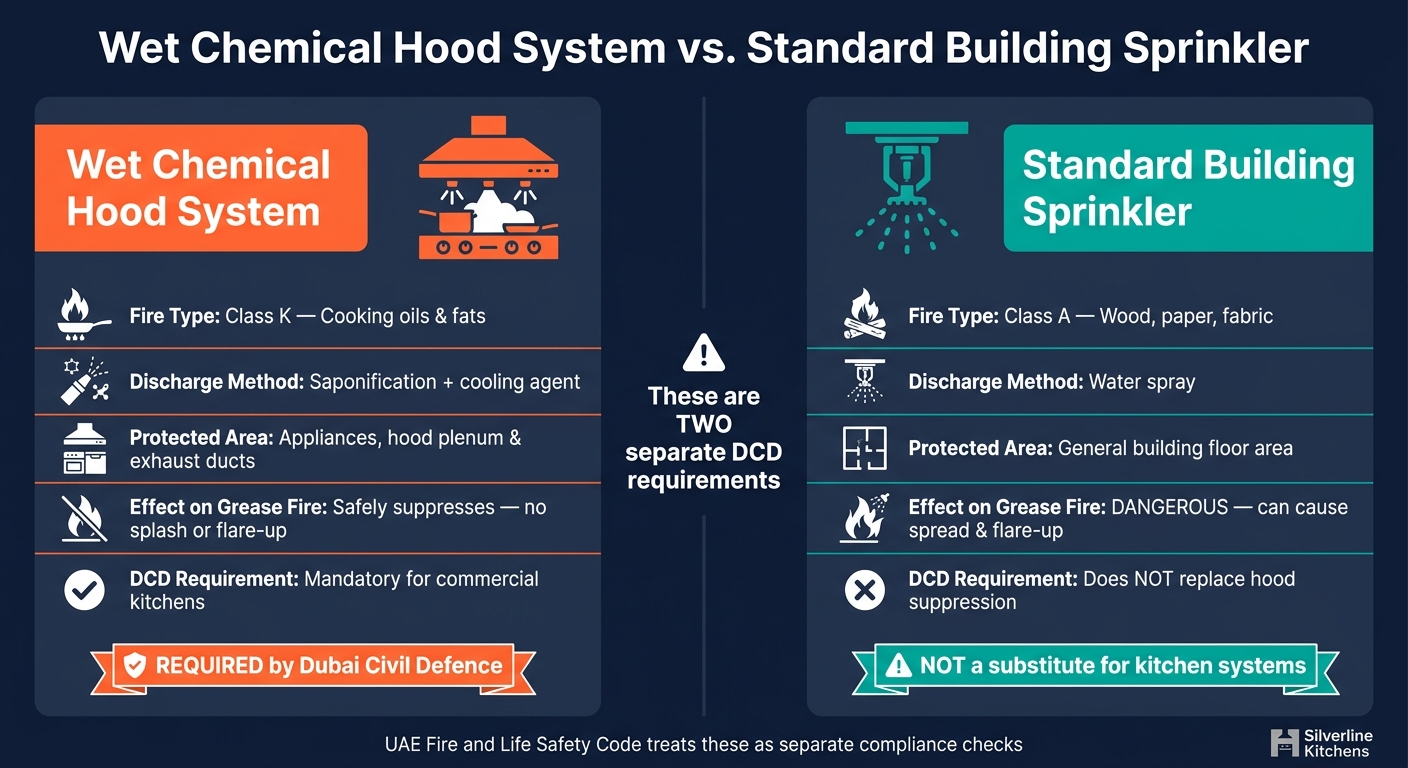
Wet Chemical Hood System vs. Building Sprinkler: Dubai Commercial Kitchen Fire Safety
In Dubai, wet chemical suppression has to protect the spots where grease fire risk is highest: the cooking appliance, hood plenum, and duct entry. In plain terms, the appliance, hood, and duct need to be protected as one connected system.
Cooking equipment and hood areas that must be covered
Any appliance that produces grease-laden vapours needs its own protection under a kitchen hood. That includes:
- Fryers
- Grills
- Woks
The nozzles also need to cover the hood plenum and duct entry point so a fire doesn't move into the ventilation system.
Use a listed wet chemical system approved for DCD requirements.
Why building sprinklers do not replace kitchen hood suppression
A lot of people assume the building sprinkler system already covers the kitchen. It doesn't. And that assumption leaves a clear gap in fire protection.
Here's why. Standard sprinklers discharge water. If water hits cooking oil at a high temperature, it can trigger a violent splatter and push the fire further instead of putting it out. Wet chemical systems work in a different way. They discharge a wet chemical agent that reacts with hot grease and forms a smothering foam layer, which cuts off oxygen. It also cools the oil and helps lower the risk of re-ignition.
The difference is pretty simple: one system is built for grease fires, while the other is built for general building fires.
| Feature | Wet Chemical Hood System | Standard Building Sprinkler |
|---|---|---|
| Fire type suitability | Class K - cooking oils and fats | Class A - wood, paper, fabric |
| Discharge method | Saponification and cooling | Water spray |
| Protected area | Appliances, hood plenum, and exhaust ducts | General building floor area |
| Effect on grease fire | Safely suppresses without splash or flare-up | Can cause dangerous spread and flare-up |
DCD and the UAE Fire and Life Safety Code treat these as separate requirements.
Next, inspectors check the release controls, shut-off, and alarm connections.
sbb-itb-19c3c9a
System components Dubai inspectors check during an inspection
Once the hood and appliance coverage is set, inspectors move through the full control chain. In Dubai, kitchens often fail when the suppression system is missing a linked part. Inspectors want to see one connected setup that protects the same zones throughout: the appliances, the hood plenum, and the ducts.
Wet chemical tank, detection line, and discharge nozzles
At the centre of a compliant kitchen suppression system is the wet chemical agent tank. It connects to a detection line with fusible links. Inspectors check whether the discharge nozzles are placed in the right spots for the appliances and ductwork they protect, and whether grease has blocked them. Misaligned nozzles are a common inspection issue.
Manual pull station, gas shut-off, and electrical isolation
Inspectors expect a manual pull station near an exit. It should be clearly labelled and free from obstruction. That way, staff can activate the system by hand if needed.
They also check what happens when the system goes off. A compliant setup must shut down both fuel and power. That means the system should link to a gas shut-off valve and electrical isolation, so gas and electricity to the cooking appliances are cut during activation. If the gas supply stops but electric equipment stays live, the installation will likely fail inspection.
Fire alarm connection and fault monitoring
The suppression system must connect to the building's addressable fire alarm system. This allows discharge and fault signals to report back to the main panel.
Fixed suppression is only one part of the setup. Kitchens still need portable extinguishers and routine checks.
Portable extinguishers, servicing, and staff readiness
Portable extinguishers and routine servicing help cover the last fire-safety gap that fixed suppression systems don't fully address.
Class K extinguishers and other extinguisher types used in commercial kitchens
Keep Class K wet chemical extinguishers close to fryers, griddles, and other appliances with a grease-fire risk. Never use water on an oil or fat fire. It can cause the burning oil to splash and spread. Use DCP extinguishers in general kitchen areas and CO₂ extinguishers near electrical panels.
Service intervals, inspection records, and staff training
Dubai kitchens need a valid AMC with a DCD-approved company for extinguisher and suppression servicing. Under that AMC, authorised technicians inspect and service wet chemical tanks, detection lines, discharge nozzles, and manual pull stations. Keep service records and certification stickers visible for inspection.
But gear on its own won't save the day. Staff need to know what to do when things go wrong. Kitchen teams should know:
- where the manual pull station is
- where extinguishers are kept
- which evacuation route to use
Train staff through a DCD-approved provider and refresh that readiness as part of routine kitchen safety.
Planning a compliant suppression layout from the start
How coordinated kitchen design avoids approval and installation problems
After confirming hood protection, controls, and the alarm tie-in, the last compliance point is layout coordination. Once the system parts are set, the next job is making them fit the kitchen plan without clashes.
Hood dimensions, duct routing, appliance positions, gas connection points, and suppression pipe runs all affect each other. Shift one item, and something else often has to move too. When these details are planned together from the start, the system can be fabricated to match the kitchen layout. It also gives Dubai Civil Defence a cleaner, more consistent set of approval drawings.
Use listed equipment, manufacturer-approved layouts, and Civil Defence requirements to line up the hood, duct, and suppression design. If this work is left until after fit-out, retrofits usually cost more and cause more disruption.
How Silverline Kitchens supports compliant kitchen fire safety planning

This matters most at the drawing stage, before fabrication and site installation start. For Silverline Kitchens projects, hood size, duct routing, appliance positions, gas shut-off points, suppression pipe runs, and alarm tie-in are fixed in the coordinated drawings before submission.
Coordinate the suppression layout in the initial drawings so the kitchen can be approved and installed without redesign.
FAQs
Do all commercial kitchens in Dubai need wet chemical suppression?
Yes. Automatic wet-chemical fire suppression systems are required for commercial kitchens in Dubai under the UAE Fire and Life Safety Code, especially for kitchen hoods and ductwork where cooking oils and fats are used.
These areas deal with high heat and grease-heavy equipment, so the systems are required to deal with that fire risk. Compliance is enforced by the Directorate General of Civil Defence, and installations must meet UL 300 standards.
What can delay DCD approval for a kitchen fire suppression system?
Delays usually happen because of incomplete documents, project complexity, or failure to meet technical standards.
The most common problems include:
- Missing details on suppression equipment
- Ventilation calculations that are incomplete or unclear
- Emergency exit layouts that don’t meet the required format
- Poor integration or registration with the Hassantuk eSystem
- Designs prepared by a consultancy that isn’t licensed, or drawings that don’t follow the approved guidelines
In short, even a small gap in the file can slow the whole process down.
When should I plan the hood suppression layout in my fit-out?
Plan the hood suppression layout during the initial technical drawing phase. Doing this early helps keep emergency exit routes clear and supports compliance with UAE fire safety rules.
It also makes day-to-day co-ordination much easier. Bring in a licensed engineering consultancy firm from the start to avoid clashes between equipment placement, ventilation needs, and safety standards. That early alignment can also help smooth the path for Dubai Civil Defence approval.
