


Fire safety in UAE commercial kitchens is a legal obligation and critical for protecting lives and property. Here's what you need to know:
- Mandatory Approvals: Secure permits from Dubai Civil Defence (DCD), Dubai Municipality (DM), and others before operations.
- Suppression Systems: Install automatic wet chemical systems like ANSUL R-102 to handle grease fires effectively.
- Ventilation: Approved hood systems and grease management are required to prevent fire risks.
- Gas Safety: Use gas detection sensors, solenoid shut-off valves, and proper LPG setups.
- Staff Training: Conduct fire drills twice a year and train staff in using extinguishers and evacuation protocols.
- Maintenance: Regular servicing of fire systems, extinguishers, and ventilation is non-negotiable.
Starting in 2026, kitchens must connect fire systems to a 24/7 DCD-approved monitoring station for trade licence renewals. Upgrading older kitchens to meet these standards is essential to avoid costly fines, closures, or safety hazards.
Fire safety isn't just about compliance - it's about ensuring your kitchen operates safely every day.
UAE Fire Safety Regulations for Commercial Kitchens: An Overview
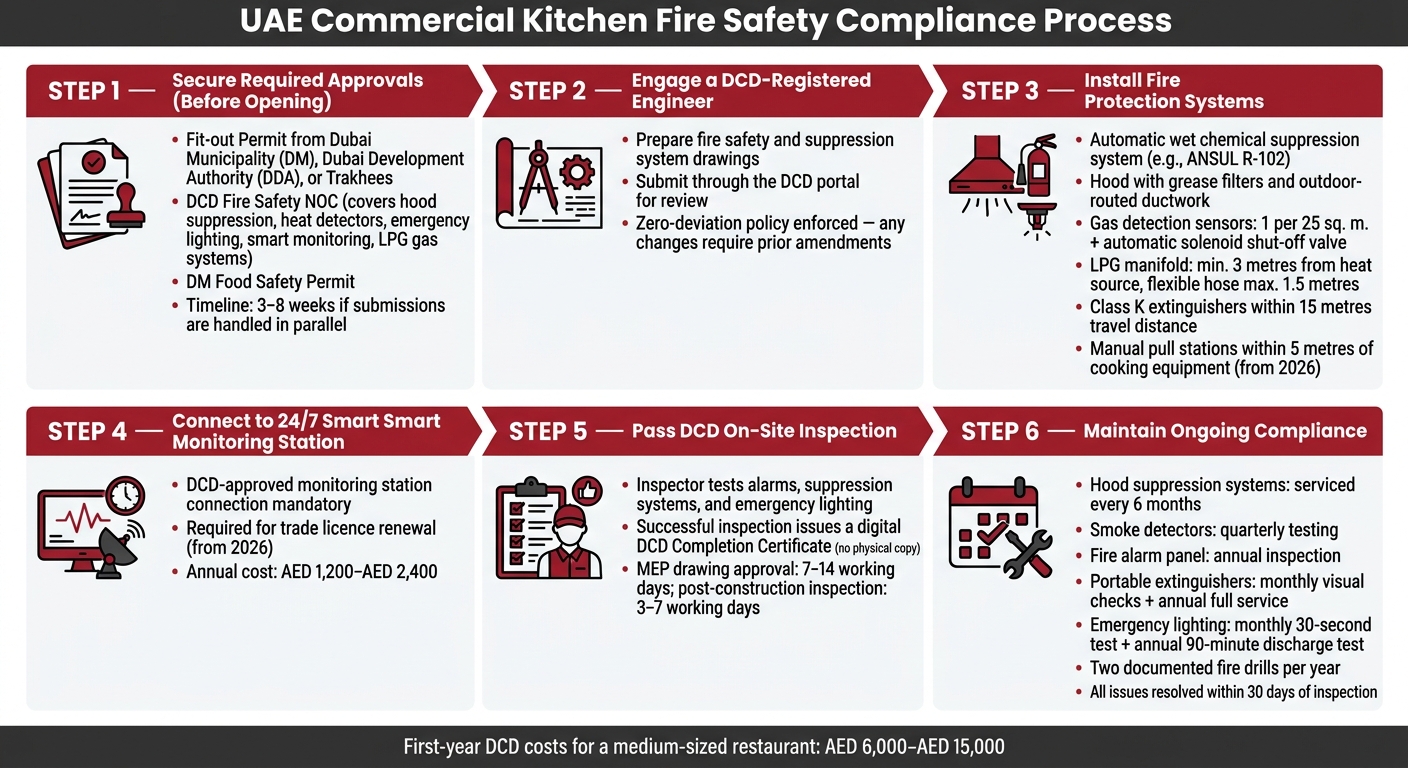
UAE Commercial Kitchen Fire Safety Compliance Process
Fire safety compliance in UAE commercial kitchens involves coordination with several government bodies, each playing a distinct role. Here's a breakdown of the key authorities, the regulations they enforce, and the steps required for compliance.
Key Regulatory Authorities and Standards
The Dubai Civil Defence (DCD) is primarily responsible for enforcing fire safety regulations. They oversee the approval of fire suppression systems, gas lines, and emergency shut-off valves, as well as conducting annual inspections to ensure systems remain fully functional. The Dubai Municipality's Food Safety Department focuses on kitchen layout approvals, grease trap installations, and ensuring food-contact surfaces meet hygiene standards. Additionally, the Emirates Authority for Standardization and Metrology (ESMA) ensures that kitchen equipment complies with GCC conformity certification requirements before being used commercially.
UAE regulations also rely on international standards like NFPA 96, which addresses ventilation and fire protection, and UL 300, which outlines testing standards for fire extinguishing systems. Compliance with these standards generally aligns with what UAE inspectors expect during inspections.
Required Approvals and Certifications
Before opening, every commercial kitchen in Dubai must secure three essential approvals:
- A Fit-out Permit from Dubai Municipality (DM), Dubai Development Authority (DDA), or Trakhees.
- A DCD Fire Safety NOC, which covers kitchen hood suppression systems, heat detectors, emergency lighting, smart monitoring connections, and LPG gas systems.
- A DM Food Safety Permit.
Starting in Q1 2026, updated DCD specifications will introduce revised calculations for K-class wet chemical agents and new post-discharge cleanup protocols. For kitchens using gas, a separate DCD application is necessary. Gas detection sensors must be installed at a rate of one per every 25 sq. m., along with an automatic solenoid shut-off valve. Additionally, all food and beverage establishments must connect to a DCD-approved 24/7 smart monitoring station, which is now a requirement for trade licence renewal. Annual fees for this service range between AED 1,200 and AED 2,400.
The Inspection and Compliance Process
The compliance process involves several steps. First, a DCD-registered engineer prepares fire safety and suppression system drawings, which are submitted through the DCD portal for review. Once approved, installation must strictly adhere to these drawings, as the DCD enforces a zero-deviation policy. Any changes during installation require prior amendments.
After installation, the fire alarm panel must be connected to the 24/7 monitoring station. A DCD inspector then conducts on-site tests of alarms, suppression systems, and emergency lighting. A successful inspection results in a digital DCD Completion Certificate, with no physical copy issued.
The entire approval process, including obtaining DCD and DM permits, typically takes 3 to 8 weeks if submissions are handled in parallel. Simultaneously submitting DCD suppression drawings, DM food safety layouts, and fit-out permits can save 3 to 5 weeks. For a medium-sized restaurant, first-year DCD costs usually range from AED 6,000 to AED 15,000, depending on the kitchen's size and system complexity.
sbb-itb-19c3c9a
Core Fire Protection Requirements for UAE Commercial Kitchens
Once you've secured the necessary approvals, the next step is ensuring your fire protection systems meet UAE regulations. These regulations outline the required equipment, how it should function, and the servicing protocols to follow.
Automatic Fire Suppression Systems
The Dubai Civil Defence (DCD) requires all commercial kitchens producing grease vapours to install automatic wet chemical suppression systems. Water-based sprinklers are strictly prohibited over cooking equipment due to the risk of an explosive steam reaction when water meets burning oil. Among the approved systems in the UAE, the ANSUL R-102 is the most commonly used. This system employs a potassium-based agent that creates a foam blanket to smother flames, cut off oxygen, and cool the fuel. Its key components include:
- Stainless-steel actuation lines
- Temperature-sensitive fusible links
- Discharge nozzles
- A pressurised agent cylinder
When activated, the system automatically shuts off the gas supply to all protected appliances and triggers both an audible alarm and the building's fire alarm panel. UAE regulations also mandate biannual servicing of these systems, including replacing all fusible links. Service reports need to be signed and kept on file for DCD inspections. If the system discharges, all cooking activities must cease immediately. Operations can only resume after a DCD-licensed technician has inspected, cleaned, recharged, and re-certified the system.
Ignoring these requirements can be costly. A kitchen fire in Dubai can easily result in losses exceeding AED 500,000, and many commercial property insurers in the UAE demand compliance with suppression system regulations as a prerequisite for coverage.
To further enhance safety, portable firefighting equipment is essential.
Portable Firefighting Equipment
Fixed suppression systems are complemented by portable firefighting equipment to create a robust fire safety setup. UAE kitchens are required to have Class K fire extinguishers, which are specifically designed to handle fires caused by cooking oils and greases. Additionally, ABC dry powder extinguishers should be available for other types of fires, and fire blankets must be easily accessible in the cooking area.
It's crucial to mount extinguishers in visible, easily reachable locations - never hide them in back cupboards or out-of-sight areas. Annual inspections are a must, and any extinguisher that has been discharged or shows signs of damage must be replaced or serviced without delay.
Ventilation and Grease Management: Fire Safety Standards
After addressing fire suppression and portable firefighting measures, ventilation and grease management play a critical role in maintaining fire safety standards. Without proper ventilation, grease-laden vapours can accumulate, coating ductwork and creating a highly flammable environment.
Ventilation and Exhaust Ductwork Requirements
To minimise fire risks, an appropriately sized hood with built-in grease filters must be installed directly above cooking equipment, with all ductwork routed outdoors. The Dubai Municipality mandates the submission and approval of detailed MEP (Mechanical, Electrical, and Plumbing) drawings that outline the ventilation layout before construction begins. Post-approval, inspectors ensure the installed system aligns exactly with the approved plans - deviations often lead to rejection.
The approval process for design and drawings generally takes 7–14 working days, while post-construction inspections require around 3–7 working days.
It's essential to avoid making unapproved changes to kitchen equipment or layout after obtaining approval, as such modifications are a frequent cause of inspection failures in the UAE.
Controlling Grease Accumulation
Grease filters are designed to capture airborne particles, but without consistent cleaning, grease can build up inside ducts, creating a severe fire hazard. In Dubai, all commercial kitchens must also install grease traps to manage fat and oil waste effectively, safeguarding both the drainage system and overall kitchen safety.
Both grease filters and traps should be installed in easily accessible locations to facilitate routine maintenance. Regular cleaning is not only a regulatory requirement but also a fundamental safety practice. During inspections, Dubai Municipality officers specifically check whether ventilation and drainage systems are functioning properly and are easily accessible.
In 2025, there was increased scrutiny of cloud kitchens due to their high production volumes, which demand stricter grease management practices.
Gas Supply and Leak Detection Safety
For kitchens using LPG, a separate DCD LPG gas system approval is required. Gas detection sensors must be installed at a density of one sensor per 25 sq. m., with each sensor connected to an automatic solenoid valve that shuts off the gas supply immediately if a leak is detected.
LPG cylinder manifolds must be housed in dedicated, ventilated enclosures located at least 3 metres away from any heat source. Flexible hose connections should not exceed 1.5 metres and must remain visible at all times. Additionally, before activating the gas connection, a pressure test certificate issued by a DCD-registered technician is mandatory.
From 2026 onwards, all F&B establishments in Dubai are required to connect their safety systems to a DCD-approved 24/7 smart monitoring station. This applies not only to new builds but also to existing premises renewing their trade licences. The cost of annual monitoring contracts typically ranges between AED 1,200 and AED 2,400.
| Requirement | Specification |
|---|---|
| Sensor Density | 1 per 25 sq. m. |
| Max Hose Length | 1.5 metres |
| Manifold Distance | Min. 3 metres from heat |
| Shut-off Mechanism | Automatic solenoid valve |
| Monitoring | 24/7 DCD-approved station |
| Certification | DCD-registered technician test |
Day-to-Day Safety: Inspections, Maintenance, and Staff Training
Getting approval is just the beginning. Keeping up with daily compliance is just as important, as Civil Defence inspectors closely examine every aspect of fire safety.
Inspection and Maintenance Schedules
Fire protection systems come with strict service schedules. Missing even a single check can result in failed inspections.
Here’s what’s required:
- Hood suppression systems: Every 6 months (includes fusible link replacements and grease buildup checks per NFPA 96).
- Smoke detectors: Quarterly testing.
- Fire alarm panel: Annual functional inspection.
- Portable extinguishers: Monthly visual checks and a full service annually.
- Emergency lighting: 30-second battery test every month and a 90-minute discharge test annually.
Any issues identified during inspections must be resolved within 30 days.
To stay compliant, it’s important to digitally track inspection dates - both the last completed and the next due. Civil Defence requires timestamped tests by certified technicians, with all records stored digitally. Digital records are a game-changer, showing a 98% completion rate compared to 62% for paper-based systems. Also, ensure all third-party servicing is performed by Civil Defence-approved contractors and keep their certificates readily available for review.
"Fire safety compliance is not paperwork. It is a life safety obligation." - Oxmaint
While maintaining equipment is critical, having a well-prepared team is equally important.
Staff Training and Emergency Procedures
Fire safety isn’t just about having the right equipment - it’s about having the right training, too. Practical, hands-on training ensures staff are ready to meet Civil Defence standards and respond effectively in emergencies. Dubai Civil Defence mandates at least two documented fire drills annually, and training certificates are checked during inspections.
Training should be tailored to the specific equipment in use. For example, staff must know how to locate and operate manual pull stations, which, starting in 2026, must be installed within 5 metres of any commercial cooking equipment. They should also practice using Wet Chemical (K-class) extinguishers, which need to be within 15 metres of travel distance.
Beyond using equipment, team members must be familiar with evacuation plans. This includes knowing the escape routes, assembly points, and their individual roles during an emergency. Additionally, the 2026 DCD regulations require a written cleanup protocol for after a suppression system discharges, detailing the chemicals and steps to follow.
Building and Upgrading Kitchens to Meet Fire Safety Standards
Fire Safety in New Kitchen Designs
When designing a new kitchen, fire safety should be a priority from the start. Every decision, from where to place the hood to how gas lines are routed, plays a role in passing Civil Defence inspections. For instance, instead of smoke detectors, use addressable heat detectors to avoid false alarms caused by cooking fumes. Also, ensure that pull stations are located near cooking equipment for quick access.
Gas safety is equally critical. LPG manifolds must be kept in a dedicated, ventilated enclosure, and flexible gas hose connections should remain visible - never hidden behind walls or cabinets. Adhering to established gas detection standards is non-negotiable.
New kitchens are also required to have a fire alarm system connected to a Civil Defence-approved 24/7 monitoring station. This is mandatory for all new food and beverage operations, including cloud kitchens. The cost for annual monitoring ranges from AED 1,200 to AED 2,400, with the approval process taking 3 to 8 weeks. Companies like Silverline Kitchens handle the complexities of design and installation, ensuring layouts comply with UAE regulations, including standards from Civil Defence, Dubai Municipality, and HACCP.
By incorporating these elements, kitchens are not only safer but also prepared for future upgrades.
Bringing Existing Kitchens Up to Standard
As fire safety standards evolve, existing kitchens must adapt to remain compliant. Before inspections or licence renewals, older kitchens need targeted upgrades to meet current regulations.
One critical requirement is upgrading to a Civil Defence-approved 24/7 smart monitoring system, which will become mandatory under 2026 standards. This upgrade is essential for smooth trade licence renewals and comprehensive fire safety management.
Recent Civil Defence updates for Q1 2026 also mandate recalculating suppression systems to align with new formulas for K-class wet chemical agent quantities based on hood coverage. Kitchens with systems installed before these changes may need adjustments, such as recalibrating nozzles for deep-fat fryers. Additionally, kitchens built between 2022 and 2024 should reassess the location of pull stations and relocate them if they are not within reach of cooking equipment.
Gas safety upgrades are equally important. Ensure the gas system includes an automatic solenoid shut-off valve and meets updated sensor density requirements. Replace any concealed LPG flexible hoses with visible ones to comply with standards.
Grease trap capacity is another key consideration. Minimum requirements are:
- 50 litres for kitchens under 50 sq. m.
- 100 litres for kitchens between 50 and 150 sq. m.
- 250 litres or more for larger kitchens.
Materials should be either stainless steel (minimum Grade 304) or high-density polyethylene. Additionally, before applying for permit renewals or upgrades, submit a written post-discharge cleanup protocol to Civil Defence. This document should detail the chemicals and procedures for cleaning up after a suppression system is activated.
Conclusion: Keeping UAE Commercial Kitchens Fire Safe
Fire safety in UAE commercial kitchens is a continuous responsibility that touches every aspect of design, operations, and maintenance. Ensuring compliance with UAE standards requires attention to every detail, from Civil Defence-approved suppression systems and proper exhaust ductwork to gas leak detection systems and staff training. These measures are in place to safeguard lives, property, and the success of your business.
Failing to meet these standards can lead to failed inspections, closure notices, or even difficulties renewing licences. Beyond the legal repercussions, a kitchen fire can result in severe financial losses and long-term damage to your reputation - especially in highly visible locations like mall food courts, hotel kitchens, or cloud kitchens that operate round the clock for delivery services.
Fire safety should be part of your kitchen's daily routine. Whether you're changing the menu, installing new equipment, or altering the layout, fire safety considerations must be reviewed alongside these updates. Developing an annual plan for system maintenance, staff training, and record-keeping is a practical way to ensure compliance throughout the year. Working with specialists, such as Silverline Kitchens, can streamline the process, helping you meet UAE Civil Defence, Dubai Municipality, and HACCP standards efficiently, while also avoiding costly mistakes.
Take the initiative by reviewing your Civil Defence approvals, maintenance logs, and cleaning schedules. A professional compliance assessment can help pinpoint any gaps, allowing you to address them before inspections and ensure cost-effective compliance.
FAQs
Do I need DCD approval before opening my kitchen?
Yes, you must secure DCD approval before opening your kitchen. This is a crucial step in the Civil Defence certification process. It involves submitting approved kitchen designs, registering with Hassantuk (the UAE's smart fire safety system), and successfully passing all necessary inspections. Meeting these requirements is essential to avoid potential delays or fines.
What changes in 2026 for trade licence renewals?
From 2026, businesses in Dubai will need to comply with updated fire safety regulations to renew their trade licences. These updates include mandatory smart monitoring systems for commercial properties and compliance with revised kitchen suppression standards. The approval process is estimated to take between 2 to 6 weeks, so it's crucial to ensure your premises meet these requirements to avoid any delays or penalties.
How do I know my suppression system is correctly sized?
To make sure your suppression system is the right fit, confirm it adheres to UAE fire safety standards like UL 300. Installation and inspection should be handled by certified professionals who understand local regulations. Regularly assess the system’s capacity and performance to ensure it aligns with your kitchen’s size, equipment, and potential fire hazards. For compliance and optimal functionality, schedule professional inspections twice a year.
