


HACCP (Hazard Analysis and Critical Control Points) is mandatory for all food establishments in the UAE under Federal Law No. 10 of 2015 on Food Safety. It ensures food safety by identifying and controlling hazards in every step of food preparation. Here's a quick summary of the 7 principles:
- Conduct Hazard Analysis: Identify biological, chemical, and physical hazards at each stage of food handling.
- Determine Critical Control Points (CCPs): Pinpoint stages where hazards can be prevented, eliminated, or reduced.
- Establish Critical Limits: Define measurable safety thresholds (e.g., temperatures or pH levels).
- Establish Monitoring Procedures: Set checks to ensure CCPs stay within critical limits (e.g., temperature logs).
- Establish Corrective Actions: Plan steps to fix issues when critical limits are breached.
- Establish Verification Procedures: Use audits, reviews, and calibrations to ensure the system works effectively.
- Establish Documentation and Record-Keeping: Maintain detailed logs for inspections and compliance.
In the UAE, compliance is enforced by authorities like Dubai Municipality and Abu Dhabi Food Control Authority. Penalties for violations include fines up to AED 2,000,000, temporary closures, or license revocation. Certification costs average AED 10,000, and kitchens must appoint a certified Person In-Charge (PIC) to oversee food safety.
Key UAE Considerations:
- High temperatures demand strict temperature controls and cold chain management.
- Regular cleaning of kitchen systems (quarterly for extraction hoods).
- Layouts must meet municipal approval before operations.
HACCP not only ensures compliance but also builds trust and prevents foodborne illnesses, safeguarding both businesses and customers.
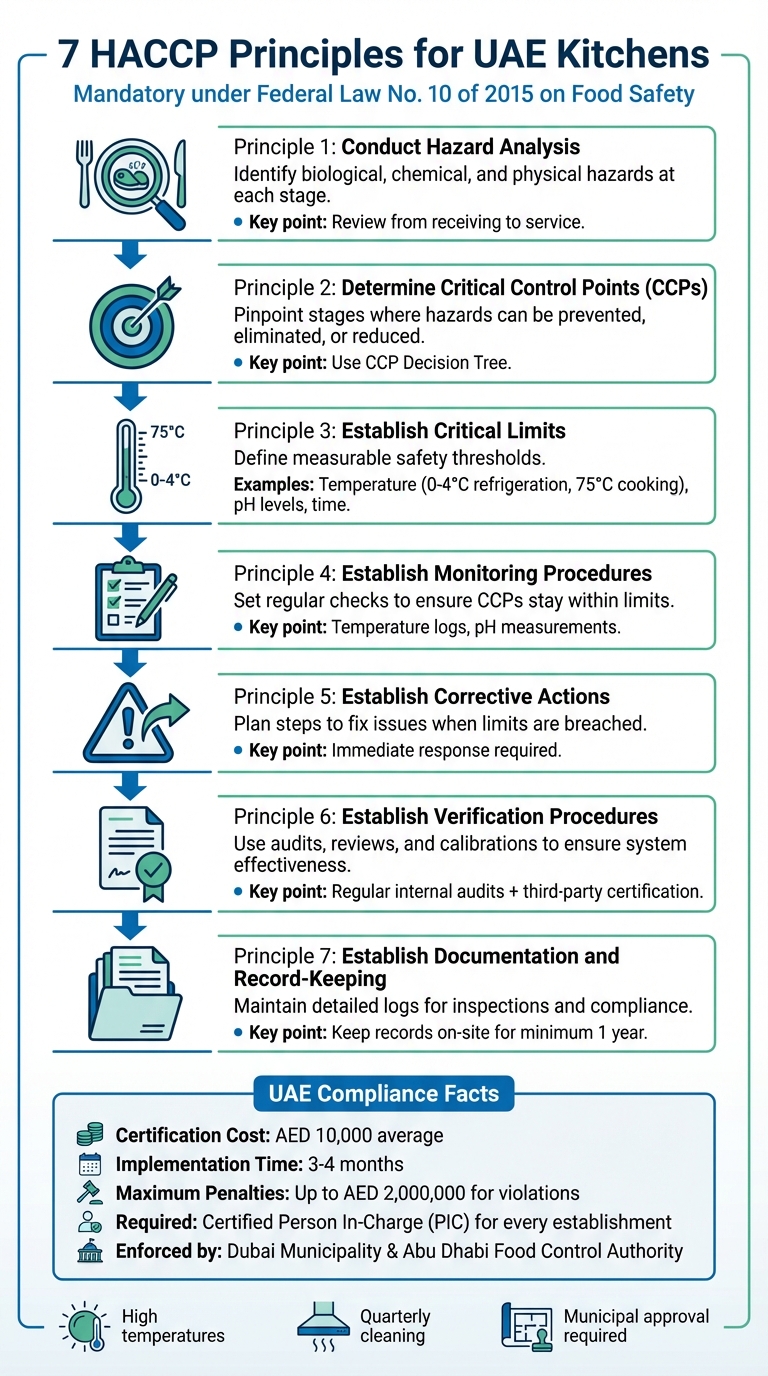
7 HACCP Principles for Food Safety Compliance in UAE Kitchens
Principle 1: Conduct a Hazard Analysis
The first principle of HACCP is all about identifying potential hazards that could compromise food safety. These hazards fall into three main categories: biological, chemical, and physical. Biological threats include bacteria like Salmonella and E. coli, viruses, and even pests. Chemical risks might come from cleaning agents, pesticides, or the incorrect use of sanitizers. Physical dangers could involve foreign objects like glass shards, metal pieces, or other debris that might accidentally find their way into food during processing.
"If the hazard analysis is not done correctly and the hazards warranting control within the HACCP system are not identified, the plan will not be effective regardless of how well it is followed." - National Advisory Committee on Microbiological Criteria for Foods
To start, bring together a team from various departments - quality assurance, production, maintenance, and sanitation. This team should carefully review every step of your operation, from receiving raw materials to storage, preparation, cooking, and final service. Documenting and verifying the process flow diagram on-site is critical to ensure that every detail is accurate. This groundwork is essential for developing practical control strategies later on.
Identifying Common Hazards
Once the initial hazard analysis is complete, the next step is to pinpoint hazards specific to your environment. For example, in UAE kitchens, biological hazards are particularly concerning due to the region’s climate. Chemical hazards might occur when fragranced cleaners or unsuitable sanitizers are used, while physical hazards could include fragments from machinery, packaging materials, or evidence of pest activity.
Temperature control is a key focus for kitchens in the UAE to prevent food spoilage. On average, implementing an HACCP system in the UAE takes about three to four months, with certification costs typically around AED 10,000.
UAE-Specific Considerations
The UAE’s challenging climate introduces unique food safety concerns. High temperatures can speed up spoilage and promote bacterial growth, necessitating stricter temperature monitoring and robust cold chain management practices.
"The minimum subscribed cleaning standard (as per Dubai Municipality) for any food establishment, is quarterly cleaning for kitchen extraction systems and hoods." - Rafael Sanjurjo Lopez, Regional General Manager, Blue
For high-volume kitchens, monthly cleaning of extraction systems is advisable to prevent contamination and fire risks. Smaller operations might manage with twice-yearly cleanings. Storage hazards also require careful assessment, as the UAE’s heat can impact both refrigerated and dry storage conditions. A striking example of the importance of hazard analysis is that nearly 45% of Dubai’s shawarma stands have faced shutdowns due to inadequate space, equipment, and storage compliance. This highlights how critical it is to address these issues proactively during the hazard analysis phase.
Principle 2: Determine Critical Control Points (CCPs)
After completing your hazard analysis, the next step is identifying Critical Control Points (CCPs) - specific points in the food handling process where you can implement measures to prevent, eliminate, or reduce food safety hazards to acceptable levels. These are the key moments that require precise control to maintain food safety.
"A critical control point is defined as a step at which control can be applied and is essential to prevent or eliminate a food safety hazard or reduce it to an acceptable level."
– National Advisory Committee on Microbiological Criteria for Foods
One of the most reliable tools for identifying CCPs is the CCP Decision Tree. This method uses a series of logical questions to evaluate each step in your process flow diagram, helping you determine if a step is critical for food safety or simply part of general hygiene practices. For instance, in a HACCP plan for beef patties, the cooking process is a CCP, with a critical limit of 71°C for 16 seconds. It’s important to note that CCPs can vary between facilities due to differences in layout, equipment, and operational procedures.
Common CCPs in UAE Kitchens
In UAE commercial kitchens, typical CCPs include thermal processes like cooking and reheating, refrigeration controls, and chilling protocols. For example, keeping precooked food at refrigeration temperatures between 0°C and 4°C prevents the growth of harmful microorganisms, making it a crucial control point for catering operations. Similarly, in large-scale food production, tools like metal detectors or X-ray scanners are often used at the end of the line to prevent physical contamination.
"Every food establishment in UAE whether involved in importation, selling, offering for sale or distribution... must comply to HACCP requirements."
– Sterling International Consulting
UAE regulations also extend beyond food handling to infrastructure requirements. For example, grease traps must be installed during the kitchen design phase to manage waste effectively, ensuring hygiene compliance. Other mandatory elements include floor drains, proper ventilation, and temperature-controlled storage areas. These features must be incorporated into kitchen layouts submitted for municipal approval before operations can begin.
Regulatory Requirements Around CCPs
In the UAE, identifying and managing CCPs isn’t just a best practice - it’s a legal obligation. All food establishments, from restaurants and hotels to catering services and food factories, must adhere to the Dubai Food Code and Abu Dhabi Codes of Practice. Dubai Municipality also requires every establishment to employ at least one Person In-Charge (PIC) responsible for food safety and CCP monitoring.
Planning for CCPs should start during the kitchen design phase. Local authorities require layout approvals to ensure that critical control measures are built into the infrastructure from the outset. Each CCP must have a defined critical limit that can be consistently monitored, whether through temperature checks, time tracking, or pH measurements, to maintain compliance and ensure ongoing food safety.
Once CCPs are identified, the focus shifts to setting critical limits to maintain control and safeguard food safety effectively.
Principle 3: Establish Critical Limits
Once you've pinpointed Critical Control Points (CCPs), the next step is to define critical limits - the specific, science-backed values that separate safe food from unsafe food. These limits ensure that processes stay within safe boundaries and signal when something has gone wrong.
"A critical limit is an exact value to which a physical, biological, or chemical hazard must be controlled." – One Education
Critical limits are measurable thresholds that demand immediate action when exceeded. For instance, to control Salmonella in raw chicken, a typical critical limit is maintaining an internal temperature of at least 70°C for 2 minutes. In the UAE, such standards aren't just best practices - they're legal obligations.
Let’s break down how these limits are established and monitored in UAE kitchens.
Setting Critical Limits for UAE Kitchens
Defining critical limits requires solid scientific evidence. These limits must align with regulatory standards, expert recommendations, or validated research - not guesswork. In UAE commercial kitchens, this typically means:
- Keeping refrigeration temperatures between 0°C and 4°C for high-risk foods like chicken.
- Ensuring cooking temperatures reach a minimum of 75°C to eliminate harmful pathogens.
For example, if a refrigerator's temperature exceeds 4°C, this should trigger immediate corrective action. Train the Person in Charge (PIC) and kitchen staff to respond promptly to such deviations.
To maintain accuracy, all monitoring equipment - like thermometers and refrigeration displays - should be calibrated regularly, especially given the UAE's high ambient temperatures. Document every critical limit in your HACCP plan, and keep signed monitoring records ready for audits. Implementing a HACCP system in the UAE typically costs around AED 10,000 for full setup and certification.
This structured approach naturally leads to the importance of temperature control, which is especially crucial in the UAE's climate.
Temperature Control in UAE Environments
The UAE's hot climate poses unique challenges for food safety. High outdoor temperatures increase the likelihood of food entering the "danger zone", where bacteria can multiply rapidly, particularly during receiving, storage, and preparation.
Automated systems can be a game-changer here. Digital sensors installed in refrigeration units provide continuous temperature monitoring and send real-time alerts if critical limits are exceeded. However, automation shouldn't replace manual checks. Best practices in the UAE include weekly verification of cold room temperatures using both external displays and a calibrated thermometer. Keep temperature logs on-site for at least one year for inspections.
The transition from delivery trucks to storage is a particularly vulnerable phase due to the extreme heat. Establish strict receiving temperature limits, and ensure staff transfer food into temperature-controlled storage immediately. If storage temperatures rise above 4°C, a practical corrective action is to prepare and serve the affected items the same day to minimise risks. Monthly reviews of temperature logs can also help identify patterns and address potential issues before they escalate.
Principle 4: Establish Monitoring Procedures
Once critical limits are set, the next step is to ensure they are consistently maintained. This is where monitoring comes in - a structured series of checks to confirm that your Critical Control Points (CCPs) stay within safe limits and to catch potential issues before they escalate.
"Monitoring is a planned sequence of measurements or observations at critical control points to ensure that the critical limits are continuously achieved." – MyHACCP
Whenever possible, prioritise physical and chemical measurements like temperature, time, pH, and moisture levels for immediate verification. These real-time checks allow kitchen staff to address problems on the spot, rather than waiting for lab results. This proactive approach is key to ensuring smooth operations.
Clearly define the specifics of monitoring: what needs to be measured, how it should be done, when it must occur, and who is responsible. For instance, refrigerator temperatures might be checked every 30 minutes using calibrated probes. Regular calibration of equipment like thermometers, pH meters, and sensors is essential to maintain accuracy.
This structured approach ensures responsibilities are well-defined and documentation remains robust.
Assigning Monitoring Responsibilities
Food safety regulations in the UAE mandate that every food establishment appoint at least one Person In-Charge (PIC) to oversee food safety measures. Day-to-day monitoring tasks are usually handled by trained kitchen staff, who conduct checks, document findings, and report any irregularities.
Senior staff should train new team members on monitoring procedures to ensure consistent compliance. Tools like colour-coded hygiene charts can also help staff follow schedules correctly.
The frequency of monitoring depends on the associated risks. For example:
- High-risk items like raw chicken might require checks for every batch.
- Refrigeration units might need temperature checks every 30 minutes.
Assign specific tasks to individuals or job titles and ensure all monitoring logs include the name of the person performing the check. This adds a layer of accountability, especially during inspections.
When roles and responsibilities are clearly defined, maintaining accurate logs becomes a seamless process, demonstrating ongoing compliance.
Maintaining Logs for Inspections
Well-organised and accurate logs are critical for inspections by authorities like Dubai Municipality or the Abu Dhabi Food Control Authority. These records serve as proof that critical limits are being consistently met.
Each record must be signed by the staff member responsible, with a manager or PIC countersigning to ensure accountability.
In the UAE, temperature logs must be kept on-site for at least one year before archiving. Digital HACCP software can simplify this process by keeping records easily accessible and minimising the risk of lost paperwork. For example, automated sensors in refrigeration units can continuously log temperatures and send real-time alerts if critical limits are breached. This reduces the need for manual checks.
Maintain daily logs that document temperature checks and any corrective actions taken. These logs should be signed and ready for inspection at all times. Additionally, remember that Dubai requires kitchen extraction systems and hoods to be cleaned at least quarterly, so ensure proper documentation of these activities as well.
sbb-itb-19c3c9a
Principle 5: Establish Corrective Actions
Even with top-notch monitoring systems, deviations from critical limits can still happen. That’s why having pre-planned corrective actions is crucial. These plans outline the steps needed to restore each Critical Control Point (CCP) and determine whether affected products should be discarded, reprocessed, or used safely.
"Since HACCP is a preventive system to correct problems before they affect food safety, plant management has to plan in advance to correct potential deviations from established critical limits." – Centre for Food Safety
In the UAE, regulations also mandate a formal investigation into the root cause of any deviation to prevent it from happening again. The Person In-Charge (PIC) or trained staff must have the authority to implement these corrective measures. This is especially critical in the UAE's high-temperature environment, where even minor delays can significantly increase food safety risks.
Here are some practical examples of how corrective actions can be applied effectively.
Examples of Corrective Actions
Corrective actions depend on the specific hazard and the CCP involved. For instance, if a cold room storing raw chicken exceeds the critical limit of 4°C, one solution is to prepare and cook the chicken on the same day rather than storing it beyond safe limits. Similarly, if a batch of meat doesn’t reach the required internal temperature of 70°C for two minutes during cooking, the immediate step would be to continue cooking until it meets the necessary time and temperature requirements.
If equipment malfunctions, it’s essential to recalibrate the device immediately and verify all products impacted by the issue. These actions help ensure that unsafe items don’t make it to customers.
Every deviation and corrective action must be documented in the HACCP logs as soon as possible. This practice not only provides a clear record for inspections by Dubai Municipality or the Abu Dhabi Food Control Authority but also reinforces your commitment to maintaining food safety. Tools like ATP swabs can also be useful, offering immediate feedback on cleaning effectiveness. If a surface fails the test, staff can quickly re-clean it.
Importance of Timely Responses
Quick action is vital when critical limits are breached. In the UAE’s climate, where high temperatures can accelerate food spoilage, delays in addressing issues like cooling system failures or unrefrigerated products can have serious consequences.
"Whenever a limit for critical control point is exceeded, the plant will need to take corrective actions immediately." – Centre for Food Safety
Having pre-planned corrective measures eliminates confusion during these critical moments. Staff should be well-trained and empowered to act without hesitation, ensuring food safety is never compromised. Waiting for management approval or second-guessing the next steps can waste precious time - time that’s especially valuable in maintaining the integrity of food products.
Principle 6: Establish Verification Procedures
Keeping a close eye on Critical Control Points is just the start - verification procedures are what truly ensure your HACCP system is functioning as intended. These steps confirm that your HACCP plan is not only being followed but also effectively managing hazards.
"Verification activities include the application of methods, procedures, tests and other evaluations, in addition to monitoring, to determine compliance with the HACCP plan periodically and when changes occur." – Centre for Food Safety
Verification goes beyond daily monitoring. It encompasses a range of activities, including reviewing records, conducting audits, calibrating equipment, and ensuring your team is clear on their responsibilities. In the UAE, strict regulations from Dubai Municipality and the Abu Dhabi Food Control Authority make verification not just important but mandatory.
Verification Through Regular Audits
Internal audits are your first line of defence in maintaining a strong HACCP system. These audits assess how well your system is working and help you catch minor issues before they grow into major problems. For instance, management should regularly review monitoring records, such as temperature logs or cooling registration sheets, on a monthly basis to ensure everything is accurate and up-to-date.
In the UAE, many kitchens conduct pre-assessment gap analyses before going for formal certification. Once the system is ready, a third-party certification body typically takes 7 to 10 days to complete a formal HACCP audit. This process includes an opening meeting, a facility inspection, a thorough review of documents, and a final discussion. The cost of implementing and achieving HACCP certification in the UAE often averages around AED 10,000.
Staff Training for HACCP Verification
A strong HACCP system hinges on knowledgeable and well-prepared staff. Training is key to ensuring everyone knows their role in verification. Staff involved in these activities must complete Level 2 training and have the authority to oversee compliance efforts.
"Training must be done before the product are used. The main management is also trained so that the manager can efficiently monitor and assist the staff in the right applications." – Binu Sivan, Senior Sales Manager, Kitchenmaster
Training shouldn’t just be theoretical - it should include hands-on exercises and group activities to solidify HACCP principles. Some kitchens use a buddy system, pairing experienced employees with new hires to guide them through hygiene and verification protocols. Visual tools like colour-coded hygiene charts and safety manuals also help teams grasp procedures, especially in diverse workforces.
Regular training should cover the calibration of monitoring instruments, such as thermometers, at set intervals. Advanced tools like ATP swabs offer instant feedback on cleaning effectiveness, doubling as both a verification tool and a motivator for staff.
When staff are well-trained and committed to following protocols, the system’s integrity is further supported by professional compliance services.
Silverline Kitchens' Compliance Services

Building a HACCP-compliant kitchen in the UAE requires meticulous planning and the right resources. Silverline Kitchens specialises in creating commercial-grade kitchens that align with HACCP standards, Dubai Municipality regulations, and Civil Defence requirements. Their comprehensive project management covers everything - from grease trap design to equipment calibration - ensuring your kitchen is built with compliance in mind. They also provide ongoing maintenance and after-sales support, helping kitchens maintain certification and quickly resolve any equipment issues that could compromise food safety.
Principle 7: Establish Documentation and Record-Keeping
Even the most well-implemented HACCP system can falter without proper documentation. Records are your safety net, providing proof that your processes meet food safety standards. This becomes especially critical during audits or when addressing food safety incidents.
"HACCP documentation will provide essential information and evidence that HACCP requirements have been satisfied and complied to." – Sterling International Consulting
Documentation isn't just about ticking off checkboxes. It's a way to provide verifiable evidence of compliance. In the UAE, regulatory bodies like Dubai Municipality and the Abu Dhabi Food Control Authority require clear and organised records to confirm adherence to local regulations. Here's a closer look at the key documentation needed to support your HACCP system.
Required HACCP Documentation
Every element of your HACCP system should be documented. Start with system design records, which include your hazard analysis, CCP decision trees, and verified flow diagrams. These documents demonstrate that your safety plan is scientifically grounded and tailored to your specific operations.
Daily compliance relies heavily on operational logs. These include temperature monitoring records, calibration logs, and cleaning schedules, which serve as evidence of active hazard control. In the UAE, temperature logs should be retained on-site for at least one year before archiving them.
Additionally, maintain UAE-specific compliance records such as trade licences, layout approvals, and documents identifying your Person In-Charge (PIC) along with their defined responsibilities. These records showcase how your documentation aligns with HACCP audits and local regulatory standards. Ensure you also document your HACCP team composition, including training records for all team members.
Deviation records are equally crucial. Corrective action forms and product disposal logs provide transparency on how safety failures are managed. These records should detail the investigation into the root cause of each deviation and the final decision regarding the affected products.
Using Digital Tools for Record-Keeping
While paper-based systems can leave room for errors or omissions, digital HACCP software offers a more reliable solution by capturing real-time data and streamlining inspections.
Digital tools enhance monitoring practices by automating corrective action prompts, centralising all records, and enabling your PIC to review logs daily. This proactive approach allows for immediate adjustments, preventing breaches of critical limits.
Dubai's "Smart City" initiatives align seamlessly with this digital transformation, encouraging the use of IoT sensors and AI to mitigate food safety risks. These technologies monitor temperature fluctuations and generate data trends, helping to prevent issues before they arise.
Beyond simplifying documentation, digital systems integrate smoothly with maintenance services. For instance, Silverline Kitchens offers comprehensive project management support, ensuring HACCP compliance through ongoing maintenance and after-sales services. Their offerings include equipment calibration, a key aspect of accurate record-keeping. By combining robust physical infrastructure with advanced digital tools, Silverline Kitchens helps businesses meet UAE regulatory standards efficiently and effectively.
Conclusion: Implementing HACCP in UAE Kitchens
The seven principles of HACCP lay out a detailed framework that transforms food safety practices from being reactive to proactive. Each principle - starting with hazard analysis and ending with thorough documentation - works together to create a system that not only protects customers but also enhances business operations. This approach ensures every step contributes to ongoing improvement.
In the UAE, adhering to HACCP standards is not optional; it’s a legal requirement for all food establishments, including restaurants, hotels, bakeries, and even mobile kiosks. While the certification process involves an investment of around AED 10,000, the benefits include smoother operations and improved safety protocols. Establishments can streamline their processes, earn customer trust by prioritising safety, and avoid costly penalties or product recalls.
"HACCP system provides a preventive and thus cost-effective approach in food safety." – Centre for Food Safety
With the Middle East’s cleaning and hygiene sector expected to grow by 275%, regulatory standards will only become stricter. A well-implemented HACCP system not only ensures compliance but also prepares businesses to meet these evolving demands, giving them a competitive edge.
Key Takeaways
- Hazard analysis helps identify risks and determine where controls are most needed.
- Critical limits, particularly for temperature control, are vital in managing food safety in the UAE’s extreme climate.
- Corrective actions establish clear steps to address any deviations, while regular audits and staff training ensure the system remains effective.
- Detailed documentation serves a dual purpose: proving compliance during inspections and fostering a team-wide commitment to food safety.
How Silverline Kitchens Can Help
HACCP principles do more than safeguard food safety - they provide a roadmap to operational efficiency, and Silverline Kitchens is here to guide you through the process.
Silverline Kitchens specialises in creating HACCP-compliant commercial kitchens tailored to meet the standards of Dubai Municipality, Abu Dhabi Food Control Authority, and Civil Defence. From initial planning to securing approvals and permits, their end-to-end project management ensures your kitchen is ready for operation without unnecessary delays.
Their support doesn’t end with installation. Silverline Kitchens offers ongoing maintenance, equipment calibration, and after-sales services to keep your kitchen running smoothly. Whether you’re launching a new venture or upgrading an existing one, their expertise ensures your infrastructure aligns with HACCP standards. With their guidance, implementing HACCP becomes a straightforward process, setting your business up for sustainable success.
FAQs
What are the penalties for not complying with HACCP regulations in the UAE?
Failure to meet HACCP regulations in the UAE can lead to hefty fines. These typically fall between AED 10,000 and AED 100,000, depending on how serious the violation is. For more severe breaches, like dealing with prohibited foods, the consequences are much steeper - fines can reach up to AED 500,000, and offenders may face a minimum prison sentence of one month.
Following HACCP guidelines doesn't just help you steer clear of these penalties - it also plays a key role in protecting public health and building a strong reputation for maintaining top-notch food safety standards.
How does the UAE’s climate influence the application of HACCP principles in commercial kitchens?
The UAE's intense heat, high humidity, and frequent sandstorms create a tough environment for maintaining food safety. These conditions make temperature control absolutely essential to prevent the rapid growth of harmful microbes, especially in perishable items. To stay ahead, critical limits need to be checked more often, and cleaning routines must be stepped up to tackle the risks posed by dust and moisture.
By tailoring HACCP principles to these specific challenges, commercial kitchens across the UAE can uphold strong food safety practices while meeting regulatory requirements.
What are the steps to get HACCP certification for a kitchen in the UAE?
To obtain HACCP certification in the UAE, start by ensuring your kitchen has a valid trade licence and that its layout or construction plans have been approved. Then, assemble a multidisciplinary HACCP team to carry out a hazard analysis and prepare essential documentation. This includes a HACCP manual, detailed standard operating procedures (SOPs), process flow diagrams, and clearly defined critical limits.
After implementing the system, train your staff thoroughly to ensure they can follow the established procedures. Conduct internal verifications regularly and address any problems through corrective actions. The final step is to have your kitchen undergo an external audit conducted by a UAE-approved certification body. If all requirements are met, your kitchen will be awarded the HACCP certification.
