


If I had to cut this decision down to one line, it would be this: buy fixed, long-life kitchen assets and lease high-wear or fast-changing equipment.
That’s the short answer. In the UAE, this choice affects more than the upfront bill. It shapes cash flow, maintenance costs, downtime risk, fit-out changes, and approval issues with Dubai Municipality, HACCP, and Civil Defence. With kitchen equipment often taking 45% to 55% of setup spend, and full kitchens reaching AED 300,000+, the wrong choice can put pressure on your budget for years.
Here’s how I’d look at it:
- Lease if I want lower upfront spend, fixed monthly payments, and support on service or replacements
- Buy if the equipment will stay in place for years and is tied to the kitchen fit-out or approvals
- Lease terms often run for 24 to 60 months
- Buying can cost less over the full life of the asset once payments stop
- Combi ovens often suit either route, depending on menu stability and upgrade plans
- Refrigeration is often better to buy for permanent sites, because it links to food safety and layout
- Dishwashers can suit leasing when service is bundled, due to heavy wear and UAE water hardness
- Extraction and ventilation are usually buy-and-install items because they are fixed to the site and tied to fire and safety rules
- Layout changes after approval can add AED 30,000 to AED 45,000 in rework costs
- A simple rule helps: test each item against cash flow, compliance, and useful life
Quick Comparison
| Point | Leasing | Buying |
|---|---|---|
| Upfront cost | Lower | Higher |
| Monthly cost | Fixed payments | None after payoff, aside from service |
| Ownership | No, unless buyout applies | Yes |
| Maintenance | Often included or partly covered | Owner handles it |
| Upgrades | Easier at end of term | Harder, may need resale or replacement |
| Long-term cost | Can be higher over time | Often lower if used for many years |
| Fit-out and approval stability | Less stable if units change | More stable for fixed layouts |
| Best for | High-wear or changing equipment | Fixed, long-life, built-in assets |
My takeaway: if a piece of equipment is built into the kitchen, tied to drawings and approvals, or expected to stay in service for many years, I’d lean toward buying. If it faces heavy daily wear, may need swapping, or I want to protect cash at launch, I’d lean toward leasing.
That mixed approach is usually the most sensible way to keep the kitchen running without putting finance and compliance in conflict.
sbb-itb-19c3c9a
Leasing vs buying: core financial and day-to-day trade-offs
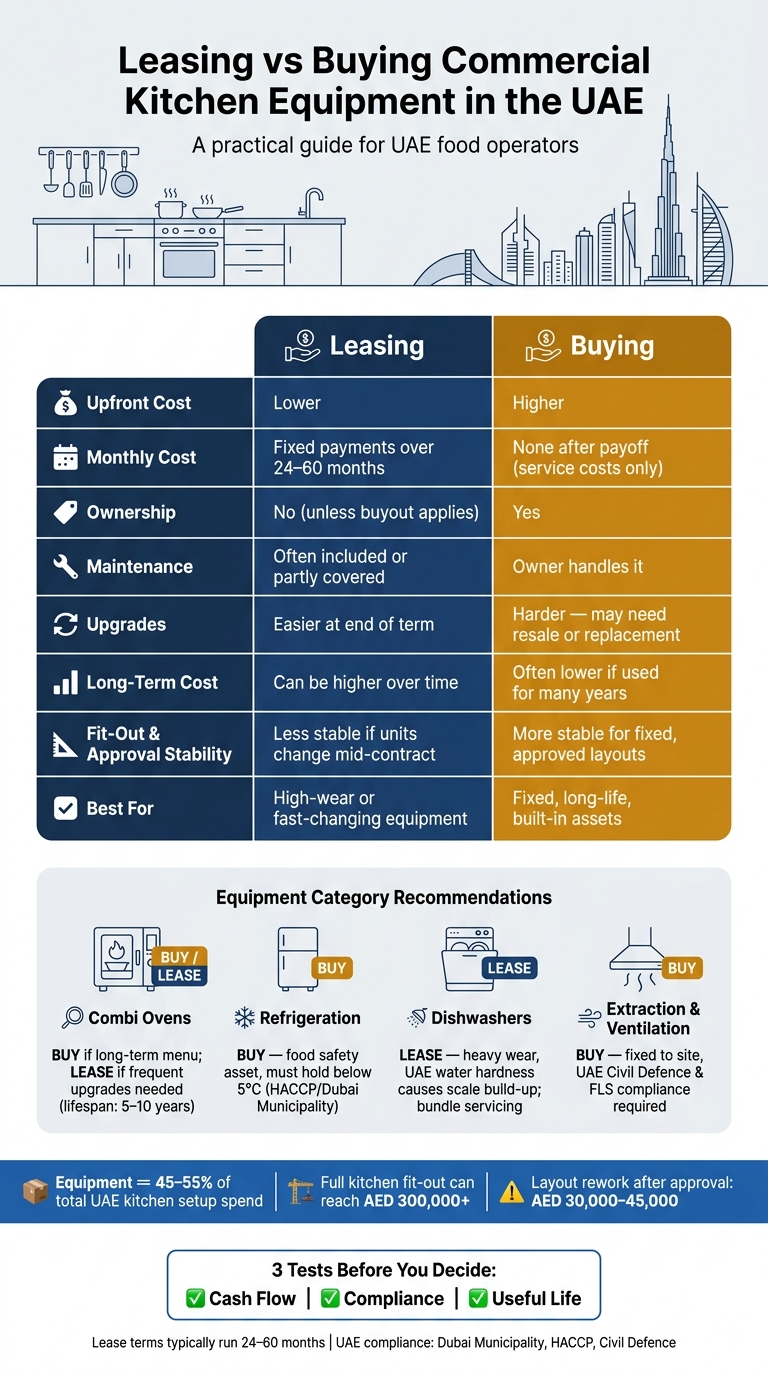
Leasing vs Buying Commercial Kitchen Equipment in the UAE: Full Comparison
The main gap comes down to cash flow, control, maintenance, and flexibility. In practice, the choice often falls into two camps: operators that need room to move now, and operators that want a lower long-term cost.
When leasing tends to make more sense
Leasing often works well for operators that want to protect cash and keep monthly outgoings steady. It leaves working capital available for rent, staffing, and stock. It can also make it easier to scale capacity up or down as demand shifts.
Most lease terms run from 24 to 60 months. That can mean faster upgrade cycles than a standard purchase.
In the UAE, equipment often deals with high ambient heat, heavy daily use, and the risk of costly downtime. That puts more strain on machines. Leasing can ease some of that pressure by cutting the maintenance burden and reducing downtime risk. Some lease deals also come with servicing and fast replacement support.
If demand is steady and the business has enough capital, ownership may offer better long-term value.
When buying tends to make more sense
Buying is often a better fit for established operations with steady, long-term use. Once the asset is fully paid off, lease fees stop. Over time, that can bring down the total cost of ownership.
Ownership also gives you more say over installation and workflow, without return-condition limits. The trade-off is depreciation. Owned equipment loses value over time.
The best option still depends on the lease term, warranty, service scope, and exit terms.
What to check before signing a lease or purchase agreement
Before signing, review the warranty, service scope, local spare-parts supply, early-termination terms, and the end-of-term buyout price. It also helps to match the agreement to the approved kitchen layout and installation scope.
These trade-offs vary by equipment type, especially for ovens, refrigeration, dishwashers, and extraction systems.
Leasing vs buying by equipment category
The type of asset changes the lease-or-buy call. A simple way to judge it is to look at three things: how fast it becomes outdated, how much upkeep it needs, and whether it stays fixed in place or can be moved.
Combi ovens and refrigeration units
Combi ovens sit in the upgrade-heavy camp. Lease a combi oven if you expect to swap to newer models often. Buy one if the same unit can support a steady, high-volume menu for years. These ovens are built for the long haul, with a typical lifespan of 5 to 10 years.
Refrigeration is different. It’s first and foremost a food-safety asset. Units need to hold temperatures below 5°C to align with Dubai Municipality and HACCP requirements. That makes them part of day-to-day kitchen control, not just another purchase. For permanent sites, buying is usually the better fit because the equipment is often built into the fit-out and supported by maintenance.
High-wear equipment works by a different rule: service support often matters more than ownership.
Dishwashers and warewash systems
Warewash equipment takes a beating. It deals with constant water, heat, and chemical exposure, so upkeep is heavy by default. On top of that, UAE water hardness speeds up scale build-up. That means descaling and chemical control are routine jobs, not nice-to-haves.
Leasing can work well here if the deal includes bundled servicing and fast-response maintenance. That helps cut downtime risk and keeps service moving. If you decide to buy, set up a maintenance plan from day one.
Infrastructure connected to the building should be judged as a compliance asset, not just a piece of equipment.
Extraction and ventilation systems
Extraction canopies, ducting, fire suppression, and ventilation are as much about compliance as they are about kitchen hardware. In the UAE, these systems need to meet UAE Civil Defence and Fire and Life Safety (FLS) requirements, and they’re usually part of a permanent kitchen fit-out.
For permanent kitchens, buying and having extraction systems professionally installed is usually the right move. They’re custom-built, tied to compliance, and made to stay in place for the long term.
Compliance, budgeting, and kitchen planning in the UAE
How lease or buy decisions affect approvals and HACCP controls
Equipment choices shape your approved kitchen layout, so finance and compliance need to be planned side by side. In the UAE, kitchen drawings are submitted to the Dubai Municipality Food Control Department and Civil Defence before installation. Those plans need to show extraction, drainage, grease traps, fire suppression, and food-flow zoning. If you change a canopy, cold room, or another fixed asset, that can affect the MEP drawings and lead to a layout update or a new submission. Fixed equipment can also make maintenance records easier to keep in order during audits.
Leasing adds another moving part. If a leased unit is swapped mid-contract for a different model, and that change affects ventilation load or drainage, your current approvals may no longer apply. That’s where buying fixed, built-in assets can help: it keeps the approved layout more stable. In a AED 300,000 kitchen, rework can add AED 30,000–45,000 to the budget.
Once that approval risk is on the table, the next step is to compare the full cost over the lease term or the asset’s working life.
A simple AED-based method for comparing your options
For fixed assets, compare total cost across the same time frame as the approval risk. A simple way to do this is to split equipment into two groups: long-life core assets and fast-wear or fast-changing items. Long-life core assets, such as combi ovens and walk-in cold rooms, often make more sense to buy. Fast-wear or tech-sensitive items, like dishwashers and ice machines, can work better under lease contracts that include servicing.
Run the numbers across 3-year, 5-year, and 10-year cost scenarios in AED. Add the lease payments or purchase price, then include the maintenance costs you expect to pay. Equipment makes up 45–55% of total kitchen setup spend in the UAE, so this isn’t a side task. It can shape a big part of your budget. It also helps to build 20% headroom into the design so you don’t end up upgrading too early and dealing with resubmission.
That split gives you a practical base for the final lease-versus-buy call.
Where Silverline Kitchens fits into the planning process
Finance choices can turn into approval problems when the layout isn’t fixed early. Silverline Kitchens can convert lease-or-buy decisions into HACCP-aligned 2D/3D and MEP drawings, along with grease trap, drainage, extraction, and Civil Defence coordination. Their professional kitchen design package is priced at AED 5,000 + VAT and covers 2D and 3D layouts plus MEP drawings. A clear warranty and aftercare scope can reduce the risk that comes with buying.
Conclusion: A clear framework for deciding what to lease and what to buy
Use three tests: cash flow, compliance, and useful life. Lease when cash flow and flexibility matter most. Buy when the asset is core, built for long use, and fixed into the kitchen. If the equipment will stay in service long enough to justify ownership over the lease term, buying usually makes more sense.
In practice, that often leads to a mixed ownership model, not an all-or-nothing choice. Buy fixed, compliance-linked assets. Lease high-cost equipment that changes fast. Permanent, approved assets tend to suit buying, while service-heavy or fast-changing assets often suit leasing.
Whatever split you choose, each decision should pass those three tests: does it support your UAE compliance approvals and HACCP controls, does it keep operations stable and predictable, and does it fit a realistic AED budget? The right split supports approvals, workflow, and total AED cost - not one that puts finance and kitchen design at odds.
FAQs
How do I calculate lease vs buy cost in AED?
Compare costs in AED over 5 to 7 years, not just the purchase price. Start with upfront costs, such as the purchase, installation, and any electrical or plumbing upgrades. Then add yearly costs like energy, maintenance, repairs, consumables, and service fees.
For buying, multiply those yearly costs by the equipment’s expected life and add the setup costs. Buying often makes more sense for daily, long-term use, while leasing can work well for short-term needs or when you want to keep working capital available.
Which kitchen items usually need fresh approvals if changed?
In the UAE, you’ll usually need new approvals when equipment changes affect your layout, utility loads, or fire safety systems.
That often applies to changes in ventilation and exhaust hoods, built-in fire suppression, and core MEP services like gas, power, or plumbing. If a major equipment swap alters the approved layout, day-to-day workflow, or HACCP zones, updated submissions are usually needed.
What lease terms should I check before signing?
Before signing an equipment lease in the UAE, make sure the terms line up with both your compliance duties and your day-to-day needs.
Check that the equipment meets Dubai Municipality and Civil Defence standards. Also confirm whether maintenance or an AMC is included in the lease. Just as important, the lessor should provide the technical reports and certifications you need for your compliance records and for any government rebate claims that may come up.
