


Making the most of limited kitchen space is critical for UAE restaurants, especially with high property costs and strict regulations. Here's what you need to know:
- In the UAE, commercial kitchens often face space constraints, with only 25-30% of total restaurant space allocated to them.
- Local regulations, like those from Dubai Municipality and Civil Defence, require strict separation of food prep zones, fire safety measures, and hygiene standards.
- Poor layouts can cause safety risks and inefficiencies, but the right design can boost productivity by up to 50%.
Top Layout Strategies for UAE Kitchens:
- Zone-Based Layout: Divides the kitchen into specialized stations for efficiency and compliance.
- Assembly Line Layout: Ideal for fast-food outlets, focusing on linear workflows.
- Galley Layout: Best for narrow spaces, with parallel rows for compact operations.
- L-Shaped Layout: Makes use of corner spaces for small or irregular kitchens.
- Work Triangle Configuration: Connects key areas (sink, stove, refrigerator) for smooth workflows.
- Modular Design: Uses mobile, multi-functional equipment for flexibility and space-saving.
Key Takeaway: Align your kitchen layout with your menu and ensure compliance with UAE regulations to maximize efficiency and safety. Companies like Silverline Kitchens can handle design, regulatory approvals, and installation, making it easier to meet local standards while optimizing space.
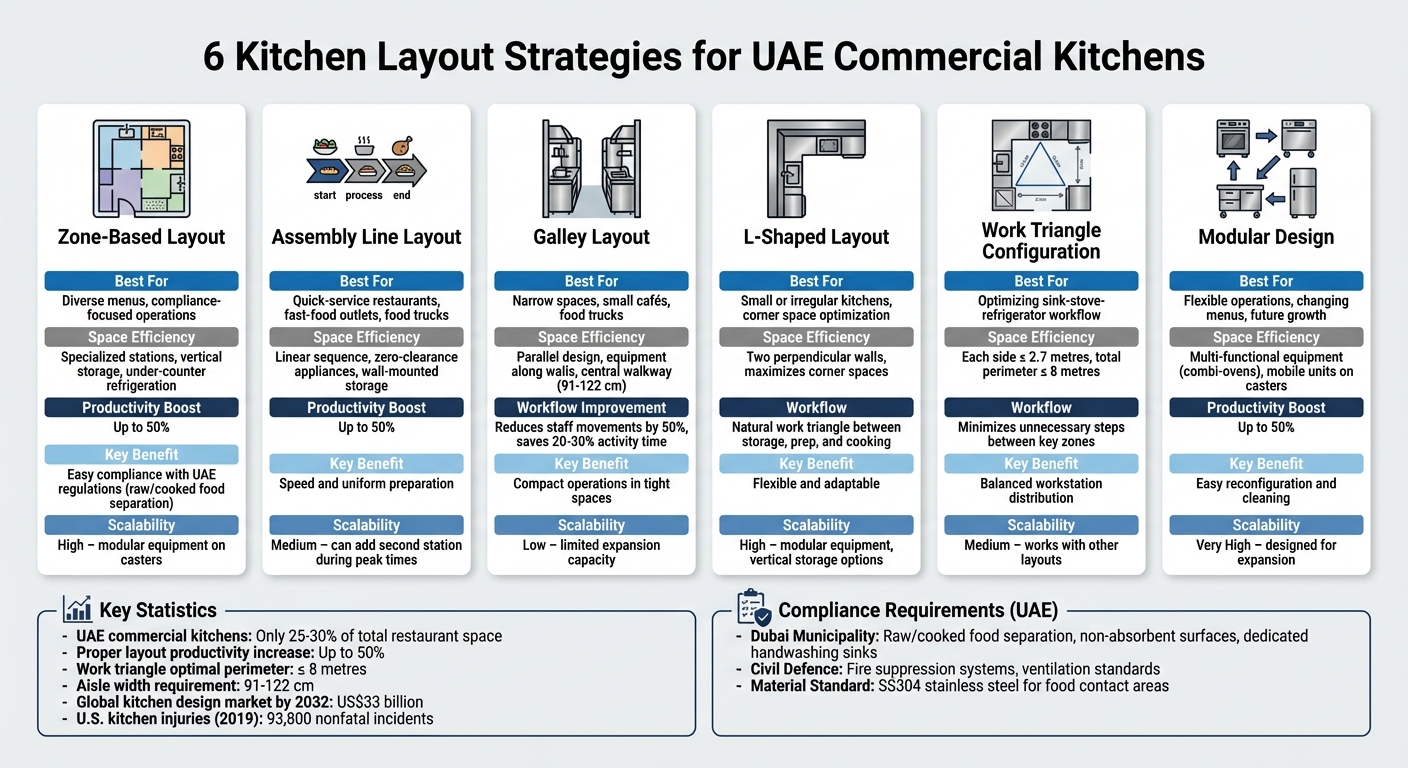
6 Commercial Kitchen Layout Strategies for UAE Restaurants Comparison
1. Zone-Based Layout
In UAE kitchens, where space and regulations can pose challenges, a zone-based layout offers a smart and practical solution. This method divides the kitchen into distinct stations, each dedicated to a specific task like salad prep, grilling, or baking. By organising these stations around the perimeter and keeping the centre open for staff movement, this layout ensures the efficient use of space while minimising the risk of staff collisions during busy service hours.
Space Efficiency
A zone-based layout makes the most of every square metre by creating specialised workstations that don’t overlap. Instead of overcrowding one area, you can utilise vertical space with wall-mounted shelves and under-counter refrigerators. This approach not only saves space but also promotes a smooth and organised workflow.
Workflow Optimisation
The efficiency of zone-based kitchens goes beyond just saving space - it creates a logical flow for food preparation. Tasks progress naturally from receiving ingredients to plating dishes. Each chef has a dedicated station, whether it’s for handling proteins, prepping vegetables, or crafting desserts. This setup allows multiple tasks to happen simultaneously without interference, which is especially crucial during peak hours. In fact, a well-thought-out layout can increase staff productivity by up to 50%.
Compliance with UAE Regulations
Strict food safety regulations in the UAE, such as those enforced by Dubai Municipality, require clear separation between raw and cooked food preparation areas to prevent cross-contamination. Zone-based layouts make it easier to comply with these rules by creating dedicated zones for high-risk items like raw proteins and ready-to-eat foods. Additionally, each zone is equipped with its own handwashing sink, separate from food prep and dishwashing areas, ensuring adherence to local health codes. This design prioritises both safety and compliance without sacrificing efficiency.
Scalability and Flexibility
Modern zone-based kitchens are designed with growth in mind. Modular equipment on casters allows stations to be reconfigured as your menu changes or your business expands. Multi-function appliances, such as combi-ovens, save space while increasing output. By planning for extra utility capacity - whether it’s gas, water, or electricity - during the initial design phase, you can easily add new equipment later without the need for costly renovations. This forward-thinking approach ensures your kitchen can adapt to future needs.
2. Assembly Line Layout
For quick-service and fast-food outlets in the UAE, an assembly line layout is a smart choice for maximising space and speeding up service. By arranging workstations in a linear sequence - from preparation to service - it creates an efficient workflow, even in compact spaces. Let’s dive into how this setup enhances space usage and streamlines operations.
Space Efficiency
Positioning workstations along a central row or island reduces unnecessary movement and keeps the kitchen footprint compact. Zero-clearance appliances can make use of awkward corners, while wall-mounted shelving and hanging racks help free up valuable counter space. These small adjustments can make a big difference in maintaining an organised and efficient kitchen.
Workflow Optimisation
This layout works particularly well for menus that involve uniform preparation steps. Each team member can focus on a specific task, which not only speeds up service but also ensures precision. Keeping commonly used tools and ingredients within arm's reach eliminates wasted effort. The straightforward, linear design also improves communication among staff. In fact, studies suggest this setup can increase staff productivity by as much as 50%.
Compliance with UAE Regulations
The assembly line layout simplifies compliance with Dubai Municipality's food safety standards. By separating clean tasks such as plating and service from dirty operations like washing, it ensures hygienic practices. Under-counter refrigeration units help keep raw ingredients chilled while reducing staff movement. To meet safety and cleaning standards, maintain traffic aisles between 91 and 122 centimetres wide, and choose non-absorbent, washable, and light-coloured surfaces.
Scalability and Adaptability
Modern assembly line kitchens are designed to grow with the business. Modular equipment on casters allows for quick reconfiguration when menus or order volumes change. Multi-functional appliances, such as combi-ovens, can replace several single-use units, saving space while adding flexibility. During busy periods, some kitchens even add a second assembly station to handle mobile orders. It’s also a good idea to install utility connections - gas, water, and electricity - with extra capacity to accommodate future upgrades or changes.
3. Galley Layout
For narrow commercial kitchens in the UAE, the galley layout is a smart way to make the most of limited space. This design features two parallel rows of cabinets, counters, and appliances, with a central walkway in between. By placing equipment along both walls, it utilises the available area effectively while keeping the middle clear for staff movement. This setup works especially well for food trucks, compact cafés, and long, narrow restaurant kitchens where every square metre counts. Like other efficient designs, the galley layout focuses on safety and smooth operations in tight spaces. It not only saves space but also enhances workflow.
Space Efficiency
The galley layout’s parallel design takes up less room than island or zone-based setups, making it a top choice for smaller kitchens. By positioning equipment along the walls, the central corridor stays open, allowing staff to move freely. Interior designer Amity Worrel highlights its practicality:
Chefs cook on a line in the galley. If you actually like to cook, a galley kitchen offers a more efficient, gourmet layout.
To make the most of the available space, consider modular or drop-in equipment that reduces unused areas.
Workflow Optimisation
This linear design naturally supports a step-by-step workflow, which is ideal for small teams handling streamlined menus. Placing prep areas between bulk storage and cooking zones creates a one-way flow. By optimising the work triangle, you can cut staff movements by up to 50% and save 20–30% on activity time. To avoid congestion in the narrow walkway, under-counter "day fridges" can be added to the prep line, allowing staff to stock up before service begins. When planning the layout, ensure there’s enough clearance - between 91 and 122 centimetres - for oven and refrigerator doors to open fully without obstructing the aisle.
Compliance with UAE Regulations
Adhering to Dubai Municipality standards is straightforward with a galley layout. This design easily meets the requirement to separate clean and dirty operations, aligning with HACCP protocols. Use non-absorbent, washable, and light-coloured materials for floors, walls, and ceilings to meet hygiene standards in food prep areas. Grouping cooking equipment together improves the efficiency of ventilation hoods and satisfies Dubai Civil Defence fire safety regulations. Dedicated hand-washing sinks, separate from food prep and dishwashing areas, are a must. Clearly designate zones for raw meat, poultry, and vegetable preparation. The compact and stainless steel-heavy design of a galley kitchen also makes cleaning and maintenance simpler compared to larger layouts. Beyond compliance, this setup supports operational needs as they evolve.
Scalability and Adaptability
While the galley layout is space-efficient, it can become crowded during high-volume operations or with larger teams. However, for smaller teams and focused menus, it remains highly practical. To increase storage capacity without taking up floor space, use vertical solutions like wall-mounted racks, hooks, and ceiling-height shelves. When installing utilities, ensure there’s enough gas, water, and electrical capacity to handle future equipment upgrades without major renovations. This forward-thinking approach can help maintain efficiency as your kitchen’s needs grow.
4. L-Shaped Layout
The L-shaped layout uses two perpendicular walls to make the most of small or irregularly shaped commercial kitchens in the UAE. By utilising corner spaces that might otherwise go to waste, this design optimises available room while leaving the centre open for easy staff movement. Equipment and workstations are arranged along these two walls, forming a natural work triangle between storage, preparation, and cooking areas. This setup reduces unnecessary steps and ensures clear pathways, which is particularly important during busy service times. While similar to the galley layout in terms of space efficiency, the L-shaped configuration uniquely capitalises on corner areas.
Space Efficiency
This layout is excellent for maximising corner spaces by aligning workstations along two adjoining walls, freeing up the centre for smooth staff movement. It’s particularly effective in kitchens where installing an island isn’t feasible due to space constraints. To further optimise, vertical storage solutions along both walls can be incorporated. Under-counter units like "day fridges" and storage bins keep essential ingredients close at hand, reducing the need for frequent trips to larger walk-in coolers. Sean Kearney from The Restaurant Warehouse highlights the importance of thoughtful design:
"The goal is to minimise steps and create an environment so intuitive that every team member knows exactly where they need to be and what they need to do."
Workflow Optimisation
The L-shaped layout naturally aligns with the work triangle concept, ensuring smooth transitions between refrigeration, prep areas, and cooking stations. This arrangement minimises the distance staff need to travel between tasks, streamlining operations. To maintain efficiency, ensure traffic aisles are at least 91 to 122 centimetres wide. Refrigeration and freezing units should be placed away from heat-generating equipment like ovens to prevent overworking. Modular equipment, such as worktables on castors or combi-ovens, adds flexibility, allowing the kitchen to adapt to seasonal menu changes without requiring major overhauls.
Compliance with UAE Regulations
The L-shaped configuration supports food safety standards set by HACCP and Dubai Municipality by clearly separating zones for raw meat, poultry, vegetables, and cooked food. This segregation minimises the risk of cross-contamination while maintaining an efficient workflow. Food prep surfaces must adhere to local regulations by being non-absorbent, washable, light-coloured, and crack-free, with SS304 stainless steel being the standard for food contact areas in the UAE. Dedicated handwashing stations should be integrated into the layout to meet hygiene requirements. Consulting with the Dubai Municipality Food Safety Department during the design phase ensures compliance with zoning and drainage requirements, including the installation of grease traps. This proactive approach ensures both safety and functionality.
Scalability and Adaptability
The L-shaped design is versatile enough to grow with the needs of a kitchen. Modular equipment on castors and multi-functional appliances allow for easy adjustments to handle increased demand or menu changes. Vertical storage, such as wall-mounted racks or stacked shelving, boosts storage capacity without expanding the kitchen’s footprint. When planning utilities, ensure the infrastructure can handle future upgrades in gas, water, and electricity requirements. By combining modularity with thoughtful planning, this layout remains a practical solution for long-term operational efficiency.
5. Work Triangle Configuration
The work triangle is all about creating clear and efficient pathways in the kitchen by connecting three key workstations: the sink (for cleaning and prep), the stove (for cooking), and the refrigerator (for storage). This setup complements the L-shaped layout by making the most of corner spaces while ensuring minimal steps between these essential zones. As Rohit Patel, Senior Designer at Häcker Kitchen, puts it:
"The goal of the work triangle is to minimise unnecessary steps and optimise workflow, thereby enhancing efficiency and productivity in the kitchen."
Space Efficiency
For the work triangle to function effectively, each side should ideally stay within 2.7 metres, allowing for easy reach without overextending. At the same time, workstations need to be spaced out enough to avoid congestion during busy times. Adding under-counter "day fridges" near the cooking line can cut down on unnecessary trips. Also, steer clear of placing high-traffic items like ice machines or waste bins within the triangle to prevent bottlenecks.
Workflow Optimisation
A well-designed triangle ensures balance, so no single workstation takes over the space. This allows for smooth movement of both materials and people. Each point of the triangle serves a specific function without obstructing the others. Sean Kearney, Founder at The Restaurant Warehouse, highlights this:
"A layout that doesn't respect the natural progression of food through these zones is just setting itself up for inefficiency."
Compliance with UAE Regulations
In the UAE, kitchen layouts must align with strict guidelines set by the Dubai Municipality to ensure food safety. For instance, raw and cooked food preparation areas must be physically separated to prevent cross-contamination - a critical factor when designing the work triangle. Additionally, all surfaces within the triangle, including floors, walls, and worktops, must be non-absorbent, washable, light-coloured, and free of cracks. Kitchens must also include dedicated handwashing stations separate from prep and pot-washing sinks. Collaborating with the Dubai Municipality Food Safety Department during the design phase can help avoid costly revisions and ensure compliance with zoning, drainage, and ventilation rules.
Scalability and Adaptability
To future-proof the kitchen, consider modular and multi-functional appliances. Planning for adequate gas, water, and electricity capacity upfront ensures that the space can handle future upgrades without requiring major overhauls. This kind of flexibility supports long-term efficiency and operational growth.
sbb-itb-19c3c9a
6. Modular Design Approach
The modular design approach takes flexibility and space adaptability to a new level, building on earlier layout strategies. Modular kitchens rely on multi-functional, mobile equipment to make the most of available space. For instance, a combi-oven can take on the roles of a convection oven, steamer, grill, and proofer, all in one unit - saving valuable floor space. Drop-in or modular equipment also helps declutter work areas.
Space Efficiency
Mobile work tables and caster-equipped equipment make it easy to reconfigure prep areas, whether you're rolling out a new menu or hosting a special event. These movable units also simplify cleaning, ensuring compliance with Dubai Municipality's sanitation requirements. Vertical storage solutions further enhance space efficiency, keeping countertops clear and ready for active food preparation.
Workflow Optimisation
A modular layout is designed to streamline workflow, reducing unnecessary backtracking. Equipment can be grouped into logical "pods" - like a hot line with fryers, griddles, and ranges - to minimise extra steps. In the UAE's fast-paced foodservice industry, this level of efficiency is a necessity. Additionally, stainless steel units, often made from SS304 or SS316 grades, feature hygienic corners and easy-to-clean surfaces, meeting the UAE's strict food safety standards.
Compliance with UAE Regulations
Dubai Municipality requires food preparation areas to have finishes that are non-absorbent, washable, and free of cracks. Modular designs align well with these standards, as units can be adjusted or replaced without the need for major structural changes. Moreover, compliance with HACCP and Dubai Municipality guidelines mandates segregation between raw and cooked food preparation areas. Early collaboration with Dubai Municipality and Dubai Civil Defence is essential to integrate fire suppression systems, grease traps, and ventilation into the design. Modular kitchens effectively balance operational efficiency with adherence to UAE regulations.
Scalability and Adaptability
Modular kitchens not only meet the UAE's strict standards but also set the stage for future growth. By over-provisioning for gas, water, and electricity, you can accommodate future upgrades without extensive renovations. This adaptability allows kitchens to evolve with new culinary trends or business expansion by swapping out or adding new units. This approach saves both time and money, especially as the global market for professional kitchen design services is expected to reach nearly AED 121 billion by 2032.
Comparing Layout Strategies
Assembly line layouts are all about speed and space efficiency, making them a go-to choice for high-volume operations like quick-service restaurants and food trucks. However, the linear design can sometimes create bottlenecks between stations, slowing down the workflow.
On the other hand, zone-based layouts divide the kitchen into specific functional areas - like salad prep, meat preparation, and frying zones. This setup reduces cross-traffic and confusion, making it a great option for businesses with diverse menus, such as catering companies or ghost kitchens. The downside? It requires more space. But the added benefit is that it helps with meeting regulatory requirements.
Now, let’s talk about galley layouts versus L-shaped configurations. Galley layouts use two parallel workstations, which is a smart way to make the most of narrow spaces - perfect for food trucks or small cafés. The catch? They’re tough to scale. Limited space means less mobility for staff and fewer options for adding new stations. On the flip side, L-shaped layouts are all about flexibility. They’re increasingly popular in Dubai’s open-plan kitchens, offering plenty of room for customisation and movement. This makes them ideal for full-service restaurants with expansion plans.
For an even smoother workflow, consider applying the work triangle principle. This design connects the sink, stove, and refrigerator, with a total perimeter that shouldn’t exceed 8 m to keep things efficient. Meanwhile, modular designs focus on adaptability by using mobile equipment and multi-purpose appliances. These setups allow quick adjustments when menus change, boosting productivity by as much as 50%. It’s worth noting that in 2019, the U.S. Bureau of Labor Statistics reported 93,800 nonfatal injuries in full-service kitchens - highlighting how the right layout can improve both safety and efficiency.
In the UAE, compliance is a major factor when choosing a layout. Dubai Municipality has strict rules, including separating raw and cooked food prep areas, installing proper ventilation for odour control, and ensuring grease traps are in place. Zone-based and L-shaped layouts tend to make it easier to meet these requirements compared to galley or assembly line setups. These layouts also help ensure fire safety and meet food hygiene standards, which are essential for operating in the region.
Custom Kitchen Design with Silverline Kitchens
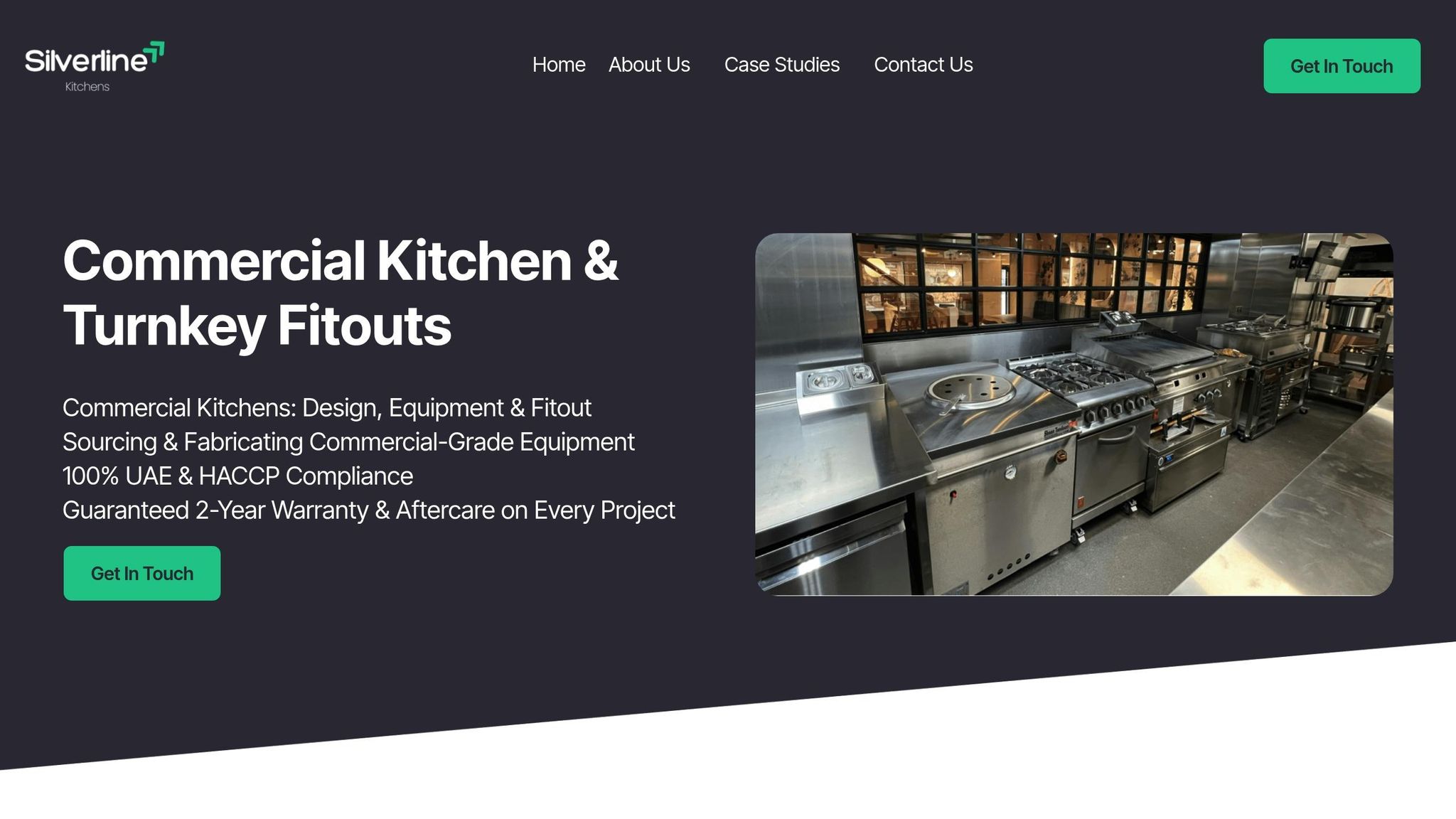
In the UAE, commercial kitchens must meet stringent regulations to operate legally and efficiently. Silverline Kitchens takes care of the entire process - from the initial design phase to the final installation - ensuring full compliance with HACCP, Dubai Municipality, and Civil Defence standards. This end-to-end service not only guarantees regulatory approval but also enhances operational efficiency.
A well-designed kitchen starts with the menu. Why? Because the menu dictates the equipment and layout needed to support smooth operations. As Lestov aptly puts it:
The kitchen - the beating heart of the operation - must be designed to meet some of the world's most rigorous standards.
Silverline’s approach revolves around tailoring the kitchen layout to match your menu and workflow. This method prevents unnecessary spending on equipment while ensuring an efficient flow through all stages: receiving, storage, preparation, cooking, plating, service, and cleaning.
Meeting UAE Standards
Silverline’s expertise shines in its strict adherence to Dubai Municipality and Civil Defence requirements. For instance, food zones must feature non-absorbent, washable surfaces in light colours, along with coved flooring that curves at least 10 cm up the walls. Civil Defence regulations add another layer of complexity, requiring automatic wet-chemical fire suppression systems for kitchen hoods, installed only by authorised vendors. To simplify this process, Silverline handles all the paperwork, including detailed architectural, mechanical, electrical, plumbing, and fire safety drawings, to secure No Objection Certificates and fit-out permits.
Maximising Space and Efficiency
Space is often a premium in commercial kitchens, and Silverline employs clever strategies to make the most of it. These include:
- Vertical storage solutions: Wall-mounted shelves and ceiling-mounted pan racks.
- Multi-functional equipment: Combi ovens that can bake, steam, and roast.
- Under-counter refrigeration: To fully utilise vertical space.
Additionally, they use 304-grade stainless steel as their standard material, ensuring durability and compliance with UAE regulations.
Long-Term Support
Silverline’s commitment doesn’t end with installation. They offer ongoing maintenance and after-sales support to minimise downtime and maximise long-term efficiency. By combining thoughtful design, regulatory compliance, and space-saving strategies, Silverline delivers kitchens that are not only ready for immediate operation but built to last.
Conclusion
When crafting the ideal kitchen layout, it's essential to align the design with your menu and operational needs. For instance, assembly line configurations are perfect for high-volume kitchens with limited menus, while zone-based layouts work best for diverse menus that require specialised stations. A well-thought-out layout should also follow the natural workflow of food through five key stages: storage, preparation, cooking, service, and washing. This structured approach not only boosts efficiency but also helps navigate the strict regulatory landscape in the UAE.
In the UAE, compliance with regulations is absolutely critical. Your kitchen must adhere to Dubai Municipality's food safety standards, Civil Defence fire safety requirements, and DEWA's utility specifications. Failing to meet these standards can lead to fines, delays, or even shutdowns - consequences that far outweigh the effort of meticulous planning.
Silverline Kitchens offers a clear example of how expert design tailored to UAE standards can save time and money. Their comprehensive process, which includes menu-driven layouts and full regulatory compliance, ensures every square metre of your kitchen is optimised for efficiency and safety. By incorporating vertical storage, multi-functional equipment, and strategically placed zones, they create kitchens that are ready to operate from day one and built to thrive for years to come.
The global demand for professional kitchen design services is on the rise, with the market expected to reach nearly US$33 billion by 2032. This growth highlights an important truth: investing in expert guidance isn't just a luxury - it’s a cornerstone of your restaurant’s operational success.
FAQs
How does a modular kitchen design enhance space and efficiency in UAE commercial kitchens?
A modular kitchen design revolves around pre-engineered, interchangeable units like cabinets, workstations, and cooking islands. These units can be customised and rearranged to adapt to changes in your menu or service style. Built with durable steel frames and standard metric dimensions (e.g., 600 mm × 600 mm), these modules allow for efficient equipment placement, streamlining workflow, minimising unnecessary movement, and boosting overall efficiency.
In the UAE, layouts such as L-shaped, U-shaped, and galley designs are particularly popular for maximising space while meeting Dubai Municipality and HACCP standards. For example, an L-shaped layout arranges prep and cooking stations along two adjoining walls, creating a seamless workflow. On the other hand, galley layouts work well in narrow spaces, with stations set up on both sides of a central aisle. Features like pull-out racks and refrigerated drawers offer practical built-in storage solutions, keeping ingredients and tools easily accessible and saving time during busy operations.
Silverline Kitchens specialises in crafting modular, commercial-grade kitchens designed specifically for the UAE market. By aligning with local standards - such as metric measurements, Celsius-based temperature controls, and AED-priced equipment - they help businesses make the most of their space, reduce labour costs, and maintain an efficient, well-organised kitchen setup.
What are the key regulations for designing a commercial kitchen in the UAE?
In the UAE, commercial kitchens are required to follow stringent regulations to maintain safety, hygiene, and operational efficiency. The Dubai Municipality (DM) mandates clear zoning for areas like food preparation, cooking, and service. These zones must have proper ventilation, effective drainage systems, and finishes that are both fire-resistant and easy to clean. Additionally, waste management systems must adhere to specific guidelines, and the layout should ensure smooth and efficient staff movement.
The Dubai Civil Defence (DCD) places a strong emphasis on fire safety. This includes the installation of fire-suppression systems, alarms, clearly marked emergency exits, and proper signage. A final fire-safety inspection by DCD is required before a kitchen can officially open. Meanwhile, the Dubai Electricity & Water Authority (DEWA) evaluates the utility systems, ensuring that the electrical and water setups can handle the demands of the planned equipment.
Adherence to the UAE Food Code and HACCP principles is non-negotiable. This involves maintaining proper temperature control (measured in °C), keeping raw and cooked foods separate, and ensuring overall food safety. Silverline Kitchens takes these regulations into account during the design process, helping to streamline approvals and deliver kitchens that are safe, efficient, and fully compliant with UAE standards.
Why is the work triangle layout essential for an efficient kitchen workflow?
The work triangle links the sink, cooktop, and refrigerator in a clear and efficient arrangement. This setup is designed to cut down on unnecessary movement, making tasks more ergonomic and workflows more seamless. By keeping travel distances short and avoiding cross-traffic, it helps boost efficiency while maintaining safety - essential in fast-paced commercial kitchens.
In the UAE, implementing a thoughtfully designed work triangle not only improves productivity but also aligns with local regulations and standards, ensuring a well-organised and compliant kitchen environment.
