


In the UAE, proper ventilation systems are not optional - they're mandatory for safety, hygiene, and compliance with strict regulations. Without these systems, commercial kitchens risk fire hazards, poor air quality, and hefty fines. Here's what you need to know:
- Fire Safety: Grease ducts must meet NFPA 96 standards, with a 120-minute fire rating. Certified fire suppression systems are required for kitchens with three or more burners.
- Air Quality: Ventilation systems prevent smoke, grease, and odours from contaminating the kitchen and dining areas. Pre-cooled makeup air ensures staff comfort in the UAE's extreme heat.
- Compliance: Adhering to Dubai Municipality and Civil Defence regulations is critical. Kitchens must meet size, layout, and airflow standards to avoid penalties or shutdowns.
- Energy Efficiency: Advanced systems like Demand-Controlled Ventilation (DCV) can reduce energy use by up to 97%, while proper pressure balance keeps odours contained.
Choosing the right materials, ensuring regular maintenance, and working with experienced professionals are key to meeting these requirements. Whether you're setting up a new kitchen or upgrading an existing one, compliance and efficiency go hand in hand.
UAE Regulatory Requirements for Kitchen Ventilation
In the UAE, commercial kitchens must meet strict regulatory standards to operate legally. Failure to comply can result in fines, rejected licences, or even closure. Both Dubai Municipality (DM) and Civil Defence enforce these requirements, covering everything from kitchen layout to fire safety.
"A single violation in your layout, ventilation, or waste management can lead to rejected permits, delayed openings, or immediate fines." - NMT Services
Dubai Municipality mandates that commercial kitchens occupy at least 40% of the restaurant's total area or a minimum of 300 sq. ft.. To prevent cross-contamination, a unidirectional food flow - from receiving to washing and preparation - is required. Exhaust chimneys must extend at least 2 metres above the nearest building to minimise odour issues for neighbours. Additionally, kitchen equipment must either be elevated 150 mm off the ground or mounted on wheels to simplify cleaning and meet inspection standards.
Civil Defence regulations focus on fire safety. Kitchen grease ducts must adhere to NFPA 96, the only approved standard for grease duct design in the UAE. Ductwork and insulation must have a 120-minute fire resistance rating, ensuring stability and safety. Fire suppression systems are mandatory, and detailed MEP (Mechanical, Electrical, and Plumbing) drawings must be submitted for approval before construction begins.
HACCP compliance forms the backbone of the UAE Food Code, ensuring kitchens meet essential food safety requirements. Ventilation systems must use food-grade materials, such as stainless steel, and feature smooth, washable surfaces. Proper airflow management is critical to prevent contaminants from spreading between "dirty" zones (e.g., washing areas) and "clean" zones (e.g., food prep areas), safeguarding food safety.
These regulations lay the groundwork for the technical standards outlined below.
Compliance Standards for Ventilation Systems
To meet UAE requirements, ventilation systems must adhere to specific technical standards. NFPA 96 governs grease duct and fire suppression systems, while DW172 provides guidelines for exhaust calculations and hood sizing. The UAE Fire & Life Safety Code requires UL 300-certified suppression systems. Hygiene standards, including unidirectional food flow and kitchen-to-restaurant area ratios, are enforced under the Dubai Food Code.
Duct materials must comply with ASTM E2336 or UL 2221 standards. While BS 476-24 is acceptable for smoke ducts, it is not permitted for grease ducts in UAE kitchens. Grease traps are mandatory for all drainage systems in cooking areas before waste enters the main sewage line. For heavy grease cooking (e.g., burgers or steaks), electrostatic precipitators (ESP) and carbon filters are required.
"According to the UAE life and Safety code, NFPA 96 is the only accepted practice to construct Kitchen Grease duct." - Airmaster Emirates
To stay compliant, ensure clean-out access panels are installed in ductwork at every directional change and at least every 3 metres. Ventilation systems should maintain negative pressure in the kitchen to contain odours, while also allowing adequate fresh air for staff comfort and safety. Keeping detailed documentation, including MEP drawings and maintenance logs for hoods, is vital for ongoing compliance.
sbb-itb-19c3c9a
Components of a Compliant Ventilation System
A commercial kitchen ventilation system in the UAE relies on several interconnected parts, each playing a crucial role in maintaining air quality and fire safety. These components work together to meet regulatory requirements and ensure efficient operation. Below, we break down how each element contributes to safety and compliance, in line with NFPA 96 and the UAE Fire & Life Safety Code.
Hoods, Ducts, and Grease Filters
Exhaust hoods are the first line of defence, capturing heat, smoke, and grease-laden vapours before they spread. Proper installation requires the hood to extend 150 mm to 300 mm beyond the cooking equipment on all sides and be mounted at a height between 700 mm and 1,200 mm above the cooking surface.
Grease filters are essential for trapping grease particles, which are a primary fire hazard in commercial kitchens. Baffle filters must be UL-listed and comply with NFPA 96 standards. For heavy grease applications, such as tandoor ovens, water mist technology is increasingly used to cool exhaust and lower fire risks. In urban high-rises, UV-C filtration systems are common to neutralise odours and vaporised grease before air is released. Regular maintenance is crucial - metal grease filters should undergo deep cleaning every 8 to 10 weeks to ensure safety and maintain airflow.
"Grease build-up is the biggest fire hazard in a commercial kitchen." - Clean Middle East
Ductwork acts as the pathway for contaminated air to exit the building. UAE regulations require a 120-minute fire rating for grease ducts. Straight duct runs are preferred to minimise air resistance and grease build-up, while clean-out access panels must be installed every 3 metres or at every directional change for easy maintenance. Insulated or double-wall ductwork is often used to prevent condensation when hot, grease-laden air meets cooler kitchen environments.
Exhaust fans, typically centrifugal upblast models, pull contaminated air through the system. Advanced systems use Variable Frequency Drives (VFD) to adjust fan speed based on cooking activity. Demand-Controlled Kitchen Ventilation (DCKV) systems, which employ optical and temperature sensors, can reduce energy consumption by up to 97%. For instance, Klima Global implemented Intelli-Hood-integrated hoods at the Al Seef Heritage Hotel in Dubai, achieving a 90% energy reduction and full Dubai Civil Defence approval in 2025.
Fire Suppression Systems and Fresh Air Supply
Efficient exhaust fans are complemented by fire suppression systems and make-up air units to complete the ventilation setup.
Fire suppression systems are mandatory for kitchens with three or more burners, as per the UAE Fire & Life Safety Code. These systems must be UL 300 or LPCB-certified and use wet chemical agents that activate within 3 to 10 seconds of detecting a fire. They automatically shut off gas and electrical supplies to cooking equipment. The wet chemical cools oils below 93°C, forming a barrier that prevents re-ignition. Non-compliance with gas shut-off valve regulations can result in fines of up to AED 30,000.
Make-up air (MUA) units are essential for replacing exhausted air and maintaining neutral pressure in the kitchen. Without proper MUA, negative pressure can lead to issues like slamming doors, backdrafts, and poor exhaust performance. Given the UAE's extreme heat, MUA units must deliver pre-cooled air to ensure a comfortable working environment for staff. All components, including the exhaust fan, make-up air unit, and fire suppression system, must be interlocked. When fire suppression activates, the exhaust fan continues running to remove smoke, while the make-up air fan and cooking fuel sources shut down immediately.
Regular maintenance is key to compliance. Systems must undergo bi-annual inspections by Dubai Civil Defence-approved contractors. Cleaning costs typically range from AED 1,500 to AED 5,000 per session. Detailed logs of inspections and tests are required for licence renewals and to avoid penalties during spot checks.
Ducted vs. Ductless Hood Systems: Choosing the Right Option
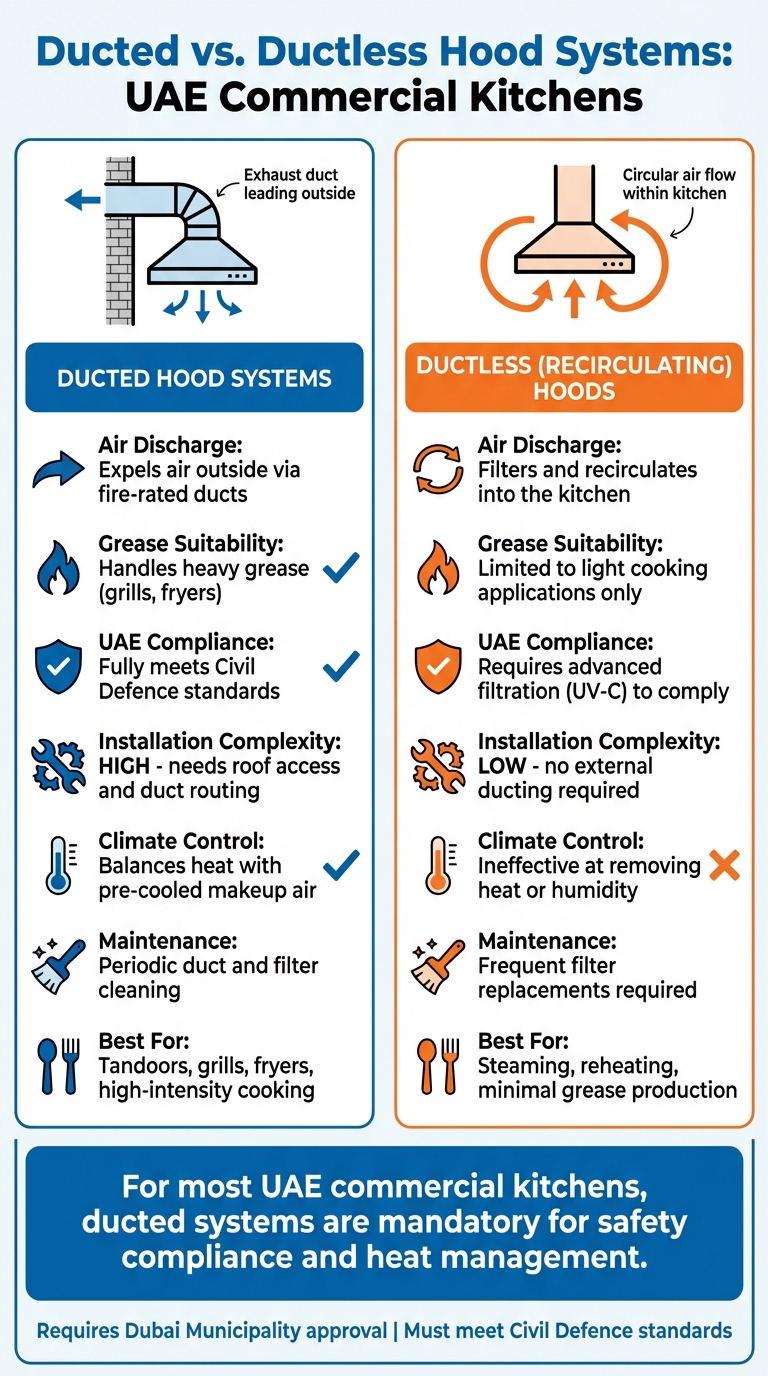
Ducted vs Ductless Kitchen Hood Systems Comparison UAE
When selecting a hood system, the decision comes down to factors like cooking intensity, building layout, and regulatory requirements. This choice isn't just about functionality - it directly ties into compliance with safety standards. Across Dubai and Abu Dhabi, ducted systems are often the go-to option, as they completely expel heat, smoke, and grease-laden air outside through fire-rated ductwork. On the other hand, ductless systems (also called recirculating systems) filter the air and return it to the kitchen. While easier to install, they have limited applications.
For kitchens using equipment like tandoors, grills, or fryers, UAE Fire & Life Safety Code mandates ducted systems. These integrate seamlessly with certified fire suppression systems, addressing key fire safety concerns. Ductless systems, however, are better suited for light cooking tasks, such as steaming or reheating, where grease production is minimal. In many Dubai municipalities, ductless systems must include advanced filtration methods, like UV-C or ecology units, to meet strict air purification standards.
"In most municipalities (especially Dubai), hoods must be paired with ecology units and sometimes UV systems to meet exhaust air purification requirements." - Klima Global
The UAE's climate adds another layer of complexity. Ductless systems don't remove heat or humidity, which can create uncomfortable working conditions for kitchen staff. Ducted systems, when paired with pre-cooled makeup air, excel in managing both kitchen climate and air pressure effectively. However, installing ducted systems is more complicated, requiring roof access, duct routing, and Civil Defence approval. Despite these challenges, their superior performance and compliance make them the preferred choice for most commercial kitchens.
"Non-compliance can lead to heavy fines, shutdowns, and even fires. That's why kitchen extraction systems must be designed and installed by professionals who understand both performance and code." - Ralph Jackson, CVAC International
For those considering ductless systems, obtaining prior approval from Dubai Municipality or the relevant Civil Defence department is essential, as strict standards govern exhaust filtration and air quality. Ultimately, for the majority of commercial kitchens in the UAE, ducted systems are the only practical option for meeting safety standards, managing heat, and ensuring operational efficiency.
Comparison Table: Ducted vs. Ductless Hoods
| Feature | Ducted Hood Systems | Ductless (Recirculating) Hoods |
|---|---|---|
| Air Discharge | Expels air outside via fire-rated ducts | Filters and recirculates into the kitchen |
| Grease Suitability | Handles heavy grease (grills, fryers) | Limited to light cooking applications |
| UAE Compliance | Fully meets Civil Defence standards | Requires advanced filtration to comply |
| Installation Complexity | High – needs roof access and duct routing | Low – no external ducting required |
| Climate Control | Balances heat with pre-cooled makeup air | Ineffective at removing heat or humidity |
| Maintenance | Periodic duct and filter cleaning | Frequent filter replacements required |
Adapting Ventilation for UAE's Climate
Designing ventilation systems that suit the UAE's climate is crucial for both operational efficiency and compliance with local standards. The region's intense heat and humidity pose significant challenges, affecting both the comfort of staff and the longevity of equipment. These strategies align with the regulatory and performance benchmarks previously outlined.
Pre-cooled makeup air plays a vital role in this setting. By using Fresh Air Handling Units (FAHUs), incoming air is tempered to maintain indoor temperatures between 24°C and 27°C. This ensures staff comfort while also easing the load on HVAC systems. In 2025, Systemair implemented a tailored ventilation solution for a City Storage Systems Holding cloud kitchen in Arjan, Dubai. By redesigning the FAHU and its condensing unit geometry, the system’s energy consumption dropped from 125 KW to 111 KW - an 11% reduction - while still meeting stringent indoor air quality requirements.
Demand-Controlled Kitchen Ventilation (DCKV) systems, like Intelli-Hood, further optimise energy use by adjusting fan speeds based on real-time demand. This approach led to a 90% energy savings at Al Seef Heritage Hotel in Dubai.
Pre-Cooled Makeup Air and Condensation Control
Managing condensation effectively is another key aspect of adapting to the climate. High humidity levels can lead to condensation when cold supply air encounters the hot air of a kitchen, increasing the risk of mould and corrosion. To counter this, using insulated or double-wall ductwork with thermal break canopies is essential.
"In hot and humid regions like Dubai or Doha, extra care is needed to prevent condensation and overload on HVAC systems. Insulated ductwork, high-efficiency filters, and thermal break canopy construction are design essentials." - Klima Global
For coastal areas, where salty air adds to the challenges, hoods and ducts made from high-grade stainless steel (Types 304 or 316) are highly recommended to prevent corrosion. Back-of-hood plenum supply systems can deliver pre-cooled air directly to the hood face, improving staff comfort without straining the main HVAC system. Moreover, Programmable Logic Controller (PLC) panels can synchronise FAHU operations with kitchen hood demand, avoiding unnecessary energy use during low-activity periods.
Routine maintenance is vital to ensure the longevity and efficiency of these systems. This includes quarterly full-system inspections and weekly cleaning of filters to prevent dust and grease accumulation on pre-cooling components.
Silverline Kitchens: Tailored Ventilation Solutions in the UAE

Silverline Kitchens combines three decades of U.K. expertise with a deep understanding of the UAE's unique kitchen requirements. Their ventilation solutions address both the region's challenging climate and strict regulatory standards. From start to finish, they ensure every project complies with the UAE Food Code, Dubai Municipality, and Civil Defence regulations. Whether it’s consultation, layout design, equipment supply, installation, or handover, Silverline Kitchens guarantees that extraction systems, fire suppression setups, and mechanical ventilation are installed to meet Fire Life Safety (FLS) standards, making projects "Dubai Municipality Ready" from the outset.
The company emphasises:
"We handle extraction systems, fire suppression, and mechanical ventilation to meet all Fire Life Safety (FLS) and Civil Defence requirements." - Silverline Kitchens
To combat the UAE’s intense heat and humidity, Silverline Kitchens uses top-tier stainless steel (Types 304 and 316) for enhanced corrosion resistance. They also integrate pre-cooled makeup air systems to improve staff comfort during scorching summer months. At the same time, grease traps and drainage slopes are designed to align with local sanitation requirements.
End-to-End Compliance and Performance
Silverline Kitchens doesn’t stop at installation. They offer comprehensive maintenance and repair services, supported by a 2-year warranty that includes scheduled inspections and filter cleaning to keep systems operating at HACCP-compliant levels. Recognised by leading developers across the UAE, they handle commercial installations for a variety of spaces, including restaurants, cloud kitchens, catering facilities, and even large residential villas. Whether it’s a new project or an upgrade, every system is tailored to enhance workflow, accommodate the menu, and maximise space efficiency.
Conclusion
In the UAE, proper commercial kitchen ventilation isn't just a suggestion - it's a legal requirement that ensures fire safety, food hygiene, and cost-effective operations. Adhering to Dubai Municipality TG19 and Civil Defence standards protects your business from fines, closures, and licensing complications. Beyond compliance, advanced ventilation systems can also help cut down on energy use, making them a smart choice for long-term savings in the UAE's challenging environment.
Tailoring ventilation systems to address the region's specific climate is equally important. Using materials resistant to corrosion and incorporating pre-cooled make-up air can significantly improve system performance. Maintaining kitchen temperatures between 24°C and 27°C not only supports staff safety but also boosts productivity. For high-intensity cooking setups, fire-rated ductwork with at least a 120-minute rating and UL 300-certified suppression systems are mandatory.
Regular maintenance is non-negotiable. Grease filters should be cleaned every 1–3 months, with professional duct inspections scheduled quarterly. Keeping detailed records of these activities is crucial, as Civil Defence inspections require proper documentation. Failure to provide these records can result in immediate penalties.
If you're setting up a new restaurant, cloud kitchen, or catering facility, working with experts who understand UAE regulations is key to passing inspections on the first try. Silverline Kitchens offers a comprehensive approach - from design and installation to ongoing maintenance - ensuring your system meets local standards while improving energy efficiency and workflow. With a 2-year warranty and thorough aftercare, they help keep your kitchen compliant, safe, and efficient for years to come. By choosing the right ventilation solutions, your commercial kitchen doesn’t just meet regulations - it excels in performance and operational efficiency.
FAQs
What approvals do I need for a new kitchen ventilation system in the UAE?
In the UAE, businesses must adhere to regulations established by authorities such as Dubai Municipality and Civil Defence. To gain approval, you’ll need to submit detailed plans that demonstrate compliance with key standards, including ventilation, fire safety, and hygiene.
Your systems must align with technical specifications, such as ensuring adequate airflow and incorporating fire suppression measures. Additionally, installations must be carried out by qualified professionals who are well-versed in NFPA (National Fire Protection Association) and HACCP (Hazard Analysis and Critical Control Points) standards. Meeting these requirements is essential for passing inspections and securing the necessary permits.
How do I calculate the right hood and duct size for my menu and equipment?
To determine the right hood and duct size, start by evaluating the heat, grease, and smoke produced by your cooking equipment. Make sure the hood extends slightly beyond the edges of the equipment to capture emissions effectively. It's also crucial to adhere to local airflow standards, such as NFPA 96 and the UAE Fire & Life Safety Code.
When designing ducts, they should be tailored to match the airflow requirements while minimising resistance. Collaborating with local experts can help ensure your setup aligns with regulations and operates efficiently.
What maintenance records does Dubai Civil Defence require during inspections?
Dubai Civil Defence mandates comprehensive maintenance records for kitchen ventilation and extraction systems. These records should include detailed logs of regular cleaning, inspections, and servicing. Keeping everything updated is not just about meeting fire safety standards - it’s also essential for passing inspections and ensuring the kitchen remains a safe and compliant space.
