


Yes - if your kitchen runs hard, runs long, and cannot afford breakdowns. In the UAE, the higher price of premium kitchen equipment can pay back in 1–3 years in many high-use sites, while cheaper units can cost more over time through energy use, repairs, spoilage, downtime, and compliance delays.
If I had to boil it down, I’d look at five things before spending more:
- Usage hours: premium units make more sense at 10–14 hours a day or around-the-clock use
- Downtime risk: if your kitchen handles 200+ orders a day, even a short outage can hit sales fast
- Compliance: poor fit with Municipality or Civil Defence rules can add 10–15% in rework costs
- Temperature control: steadier cooling and cooking help with food safety records kept for 3 years
- Service support: paying more only makes sense if spare parts and local technicians are easy to get in the UAE
Standard equipment can still be the right call for smaller cafés or lower-use sites. But for hotels, central kitchens, bakeries, QSR chains, and cloud kitchens, premium equipment often wins on full-life cost, not day-one price.
Quick Comparison
| Point | Premium equipment | Standard equipment |
|---|---|---|
| Upfront cost | Higher | Lower |
| Energy use | Usually lower | Often higher |
| Temperature stability | Tighter control | Less steady under load |
| Maintenance | Fewer faults in many cases | More callouts over time |
| Downtime risk | Lower | Higher |
| Compliance support | Often easier with logging and approvals | May need more manual work or rework |
| Best fit | High-volume, long-hour kitchens | Lower-volume, budget-led sites |
| Payback | Often 1–3 years in heavy-use kitchens | Lower day-one spend, but can cost more later |
So if you’re choosing between premium and standard kitchen equipment in the UAE, I’d keep the test simple: will the extra upfront spend come back through lower running cost and fewer service problems? If yes, premium is worth it. If not, a well-chosen mid-range unit is often the better buy.
How premium equipment addresses day-to-day operating problems
Durability and food-safe materials in high-use kitchens
Price is only one part of the story. In busy kitchens, the bigger issue is what happens during service when equipment starts slowing things down, breaks at the wrong time, or creates cleaning and inspection problems.
Premium stainless-steel prep stations and cooking surfaces are made for heavy daily use and easier sanitation. They often use commercial-grade stainless steel, sealed joints, and non-porous finishes. That setup helps with hygiene checks tied to cross-contamination and pest control. It also cuts replacement risk and helps kitchens stay in line for inspections.
Durability matters. But over the life of the equipment, energy performance often has a bigger effect on total spend.
Energy efficiency, temperature control and compliance
Premium refrigeration units and combi ovens often come with more efficient compressors, tighter door seals, and tighter temperature control. In plain terms, they can use less power and hold steadier temperatures during busy periods. That matters when kitchens are under load and still need refrigeration and ovens to stay within safe limits.
In the UAE, food safety rules require HACCP logs and temperature records to be kept for 3 years. Premium units with integrated sensors and automated data logging make that job far easier and cut manual recording errors.
The same goes for ventilation and grease traps. When equipment already meets compliance needs, approvals tend to move faster and rework costs are less likely. Those rework costs can reach 10% to 15% of the budget.
Once a kitchen has efficient, compliant equipment, the next pressure point is uptime.
Maintenance needs, downtime risk and production continuity
Premium equipment often uses better parts and needs servicing less often. That means fewer unplanned callouts and more stable day-to-day production.
For kitchens handling 200+ orders a day, even a brief outage can wipe out the early price saving from cheaper equipment. In a busy service window, a small breakdown isn't just annoying. It can delay orders, strain staff, and hit sales all at once.
sbb-itb-19c3c9a
Premium vs standard equipment: what the numbers show
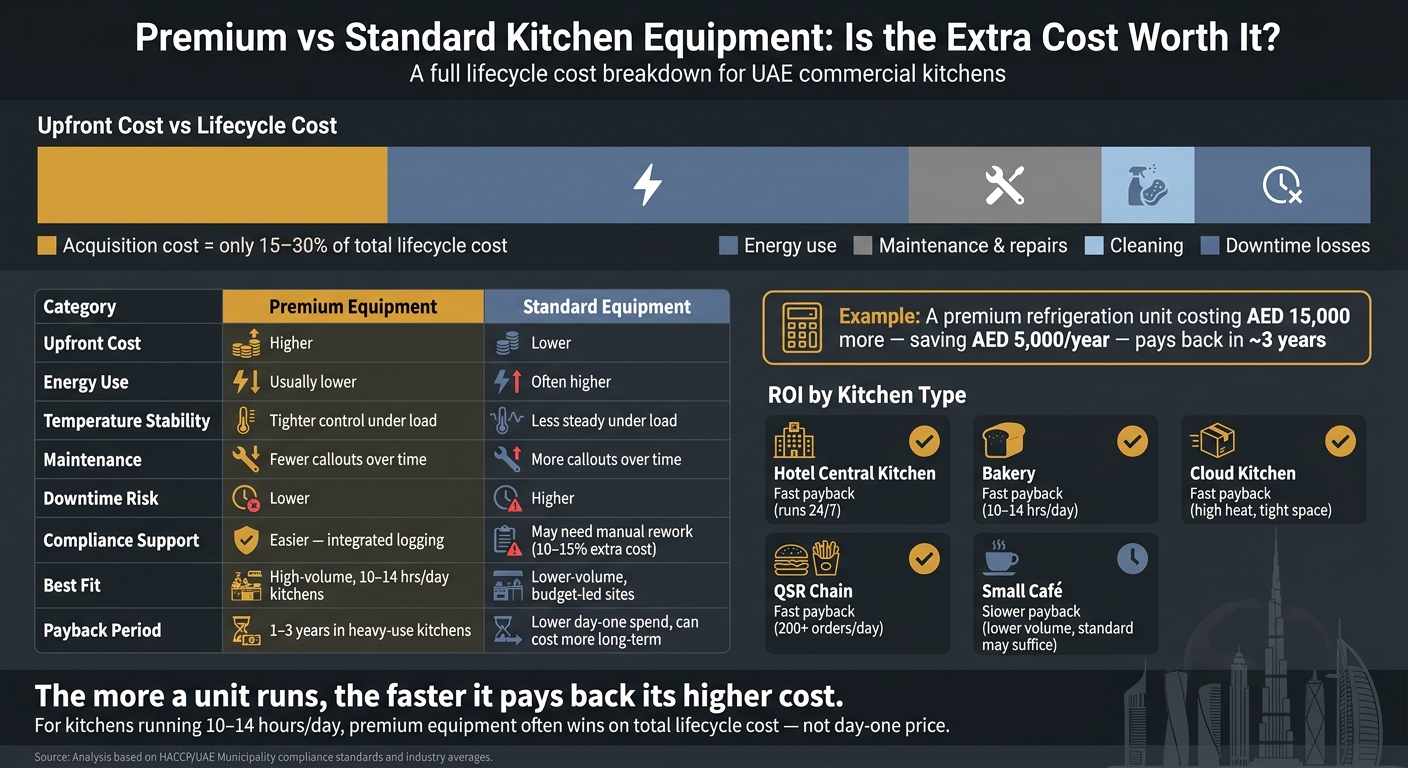
Premium vs Standard Kitchen Equipment: Full Lifecycle Cost Comparison
Upfront cost vs long-term operating cost
When uptime starts to look shaky, the math usually settles the debate. The main test is total cost across the equipment’s full life, not the sticker price on day one.
Acquisition cost makes up only 15–30% of lifecycle cost. The rest comes from energy use, maintenance, repairs, cleaning, and downtime. That’s why a lower-priced unit can look like a bargain at first, then slowly eat into your budget. Over five years, cheaper units can end up matching or even exceeding the cost of premium models once operating costs and replacement cycles are added in.
A simple way to look at it is to add up:
- annual energy savings
- maintenance savings
- avoided spoilage
- avoided downtime
Then compare that total with the extra amount paid upfront.
For example, if a premium refrigeration unit costs AED 15,000 more but saves AED 5,000 per year, the payback period is about 3 years.
That said, these savings don’t show up evenly across every site. They change a lot based on how many hours the equipment runs each day.
Return on investment by kitchen type and usage level
ROI from premium equipment isn’t the same for every operation. Usage hours are the big driver. The longer a unit runs each day, the faster those operating savings build up.
For high-volume restaurants, central kitchens, bakeries, and hotels where equipment runs 10–14 hours a day, payback on premium equipment can often land within 1–3 years. After that, the savings flow straight into margins.
Lower-volume cafés are a different story. If a combi oven or refrigeration unit is used lightly during short service windows, the gains are smaller and the payback period gets longer. In that setup, standard equipment can make more sense, unless the unit is protecting high-value ingredients or sits at the centre of the whole menu.
Put plainly: premium equipment pays back through heavy use. A hotel central kitchen running refrigeration around the clock in UAE heat will recover the extra spend much sooner than a small café with limited service hours.
When premium equipment is worth buying in the UAE
Operations that benefit most from premium equipment
Premium equipment makes sense when a kitchen works hard enough that breakdowns, waste, or uneven results start costing serious money. The best fit is usually an operation with high output, long operating hours, and very little room for downtime or mixed results.
Hotel banqueting kitchens and central production units in Dubai and Abu Dhabi are a good example. They often run across multiple shifts and push through large batch volumes. In that kind of setup, premium combi ovens can earn their keep by cutting batch failures and helping teams move service along faster.
High-end restaurants in places like DIFC, Jumeirah, and Yas Island have a different pressure point: consistency. Guests expect the same result every time. Premium equipment with multi-step programmes and fine control gives chefs a better shot at holding that standard during a busy service.
Cloud and delivery kitchens have their own headache. Space is tight, doors open often, and heat builds up fast. In those kitchens, premium refrigeration and ventilation that keep temperatures steady are easier to justify.
The rule is simple: the more a unit runs, the faster it can pay back its higher cost. Heavy daily use shortens the payback period.
If a kitchen fits that pattern, the decision should come down to fit, service support, and compliance readiness.
Checks to run before approving a premium purchase
Before signing off on the higher spend, a few checks are worth running.
Start with menu and volume fit. Make sure the equipment’s temperature range, humidity control, batch size, and cycle time line up with what the kitchen actually needs at peak periods. Oversizing is a common slip-up. If a unit runs well below capacity, the savings on energy or output often don’t justify the premium price.
Next is material grade. This matters even more in the UAE, especially in coastal locations and kitchens with heavy cleaning routines. Use Grade 304 for most food-contact surfaces. Use Grade 316 in coastal, dishwashing, or chlorine-heavy areas. It also helps to inspect welds and joints. Smooth, crevice-free finishes reduce harbourage points and make hygiene easier to manage.
Then check spare parts and service support. This gets missed more often than it should. A premium unit only pays off if the brand has local spare parts and trained service teams across the Emirates. If support is slow or parts are hard to get, the higher price starts looking far less sensible.
Last, confirm compliance compatibility before buying, not after. Check HACCP, ventilation, and Civil Defence fit early in the process. It’s also smart to keep a 10% to 15% contingency in the equipment budget for UAE kitchen projects.
Conclusion: A practical buying approach for UAE commercial kitchens
Once you compare day-to-day use, uptime, and compliance, the picture gets much easier to read. Premium equipment makes sense only when better uptime, lower energy use, and stronger compliance results make up for the higher purchase price.
For high-volume kitchens - such as large hotels, central kitchens, cloud kitchens, and QSR chains - that higher upfront cost often balances out through lower running costs and fewer breakdowns. For smaller cafés and startups working with tighter budgets, well-specified mid-range equipment often gives better value, especially when it comes with strong UAE compliance and local service support.
The right decision usually comes back to a few plain factors: lifecycle cost, food safety, maintenance workload, and how well the equipment holds up during peak demand. The best buy isn’t always the most expensive one. It’s the one that fits your workload, compliance needs, and after-sales support.
In the UAE, premium equipment tends to pay off only when heavy use and higher risk make that extra level of reliability worth the price.
FAQs
How do I calculate ROI before buying?
Calculate ROI by looking at the total cost of ownership over 5 to 7 years. Start with the purchase price. Then add projected energy costs based on DEWA tariffs, along with expected maintenance expenses.
Next, compare those costs with the savings you’re likely to get. Premium equipment can cut annual running costs in a few clear ways:
- Fewer emergency repairs
- Lower utility bills
- 25 to 30 per cent energy savings from regular maintenance
- A 30 to 50 per cent longer lifespan with professional service contracts
That’s the bigger picture. A lower upfront price can look good on paper, but the day-to-day cost of running and servicing the equipment often makes the bigger difference over time.
Which kitchen types benefit most from premium equipment?
Premium kitchen equipment delivers the most value in high-volume operations like large catering services, hotel kitchens, and multi-concept venues. In these settings, the gains are pretty clear: better durability, lower energy use, and multi-use performance. That matters when a kitchen is pushing out food at scale day after day.
In the UAE, that value goes even further. Lower energy use can help cut utility bills in AED, and equipment that puts less load on ventilation and cooling systems can ease pressure on HVAC in the region’s hot climate. When the kitchen runs hard for long hours, that kind of efficiency isn’t just nice to have - it affects day-to-day costs.
It also makes sense for businesses with strict compliance needs, including restaurants and cloud kitchens. Advanced controls and food-safe design can make HACCP monitoring simpler and help smooth out inspection approvals. For operators who need consistency, clean records, and fewer surprises during checks, that can save a lot of hassle.
What should I check before approving a premium unit?
Check that the unit is suitable for the UAE climate and local rules. It should be rated for ambient temperatures above 43°C, carry regional approvals such as G-mark, SASO, or ESMA registration, and meet recognised safety standards like NSF, CE, or UL.
You’ll also want to confirm that it includes the required compliance features, such as digital thermostats with external displays, and that it fits your site’s electrical load, layout, and fire safety requirements for Civil Defence and Dubai Municipality.
