


Cloud kitchens are reshaping the UAE's food industry by offering a cost-effective, delivery-focused alternative to traditional restaurants. With no dining spaces or waitstaff, these kitchens operate exclusively online, catering to the region's tech-savvy, delivery-driven population. The UAE's diverse demographics, high internet penetration (99%), and growing online food delivery market (expected to exceed $2.8 billion by 2026) make it an ideal environment for this model.
Key Highlights:
- Lower Costs: Setting up a cloud kitchen costs AED 150,000–350,000 versus AED 500,000–2 million for a traditional restaurant.
- Delivery Growth: Food delivery accounted for 87% of online purchases in Dubai (Winter 2023).
- Multi-Brand Potential: A single kitchen can house multiple virtual brands, maximising resources and revenue.
- Tech Integration: Platforms like Talabat and Deliveroo streamline orders and logistics, improving efficiency.
Cloud kitchens thrive on reduced overheads, rapid scalability, and advanced technology, making them a smart choice for the UAE's fast-paced, digital-first market.
Key Drivers of Cloud Kitchen Growth in the UAE
Changing Consumer Behaviour
The UAE’s fast-paced, urban lifestyle, coupled with its young and diverse population, has significantly influenced dining trends. In cities like Dubai, where the majority of residents are expatriates, there’s a constant demand for a variety of cuisines paired with the convenience of food delivery. Many consumers now rely on apps to order meals instead of dining out.
Interestingly, 74% of diners discover new restaurants through social media rather than by physically passing by a location. This shift underscores the importance of having not just a well-run kitchen but also a strong digital presence to thrive in today’s market.
The numbers back this trend: delivery orders accounted for 29% of total restaurant orders in Q1 2026, up from 25% the previous year. Meanwhile, dine-in orders dropped from 4.95 million to 4.57 million during the same period. This growing preference for delivery is reshaping the food industry and creating financial opportunities for cloud kitchens.
Cost Advantages Over Traditional Restaurants
Opening a traditional restaurant in a prime Dubai location can cost anywhere from AED 500,000 to over AED 2 million, whereas setting up a cloud kitchen typically requires only AED 150,000 to AED 350,000. Monthly rents in industrial areas like Al Quoz or Ras Al Khor range between AED 4,000 and AED 8,000. Without the expenses of dining spaces or front-of-house staff, cloud kitchens operate on a leaner model, enabling them to reach profitability in just 6 to 12 months, compared to the 18 to 24 months it takes for traditional restaurants.
Moreover, cloud kitchens often adopt a multi-brand strategy, allowing them to run several virtual brands under one roof. This approach enables them to offer a variety of cuisines and price points while using the same equipment and team. Such operational efficiency makes cloud kitchens highly scalable and cost-effective, aligning with the compliance and operational standards discussed later.
Role of Technology and Logistics
Technology plays a pivotal role in the success of cloud kitchens, driving efficiency through tools like predictive demand forecasting, real-time order tracking, and seamless integration with delivery platforms. Platforms like Talabat, Noon Food, Careem, and Deliveroo provide cloud kitchens with instant digital visibility and access to millions of active users. Talabat alone holds an impressive 35% share of the UAE food delivery market.
Talabat’s proprietary "Pepper" platform is a game-changer. It manages over 500 kitchen stalls across more than 30 hubs in the UAE and uses predictive forecasting to align rider arrivals with order readiness. This has led to a 9% improvement in delivery times across its network.
"We're not just placing kitchens, we're predicting demand, optimising preparation, shortening delivery loops and identifying the right partners before the market does." - Tarek El Halabi, Country Lead, Kitchens, talabat UAE
sbb-itb-19c3c9a
Regulatory and Design Standards for Cloud Kitchens in the UAE
UAE Food Safety and Regulatory Compliance
Before cloud kitchens can legally operate in the UAE, they must obtain both a commercial licence and meet stringent food safety standards.
Different authorities oversee compliance across regions. In Dubai, the Dubai Municipality (DM) is responsible for food establishment approvals, while Abu Dhabi is governed by the Abu Dhabi Agriculture & Food Safety Authority (ADAFSA). Federal-level standards are set by the Ministry of Climate Change and Environment (MOCCAE). The UAE Food Code acts as the primary reference for hygiene, safety, and facility design requirements.
Operationally, cloud kitchens must adopt a Hazard Analysis & Critical Control Point (HACCP) system alongside a Food Safety Management System (FSMS). Additionally, at least one team member must hold a Person-in-Charge (PIC) certification, and all food handlers are required to have valid medical fitness certificates. Another critical step involves registering every food product in the National Accreditation & Registration System before it is offered to customers.
"A cloud kitchen in Dubai is not a shortcut around regulation. It is a different operating model under the same food safety and licensing expectations as any other food establishment." - EZONE Business Setup
Setting up on the mainland often proves more practical for cloud kitchens, as local municipal authorities oversee food establishment approvals and delivery operations.
These requirements directly influence the design and layout solutions necessary for compliance.
Key Design Elements for Cloud Kitchens
The design and physical layout of a cloud kitchen are pivotal - not only for operational efficiency but also to ensure regulatory compliance. A frequent reason for inspection failures is the lack of proper separation between areas for raw and ready-to-eat foods.
Key design requirements include:
- Ventilation: Mechanical systems must effectively prevent grease and smoke buildup while ensuring no contamination reaches food preparation areas.
- Grease Management: Installing a grease trap is mandatory. For kitchens measuring 50–150 m², a 100-litre grease trap made from Grade 304 stainless steel or HDPE is required.
- Temperature Control: Hot food must be maintained at a minimum of 63°C, cold food at no more than 5°C, and raw meat must be stored between 0°C and 5°C in a dedicated refrigerator.
- Fire Safety: Starting Q1 2026, kitchens must use heat detectors instead of smoke detectors and connect their fire alarm systems to a Dubai Civil Defence (DCD)-approved 24/7 central monitoring station. This is a mandatory requirement for trade licence renewals.
- Surface Materials: Floors should be non-absorbent, slip-resistant, and free of cracks. Similarly, walls and ceilings must be smooth and washable.
Typically, setting up a compliant cloud kitchen takes between 4 to 8 weeks, depending on how prepared the operator is before submitting approval applications.
How Silverline Kitchens Supports Compliance
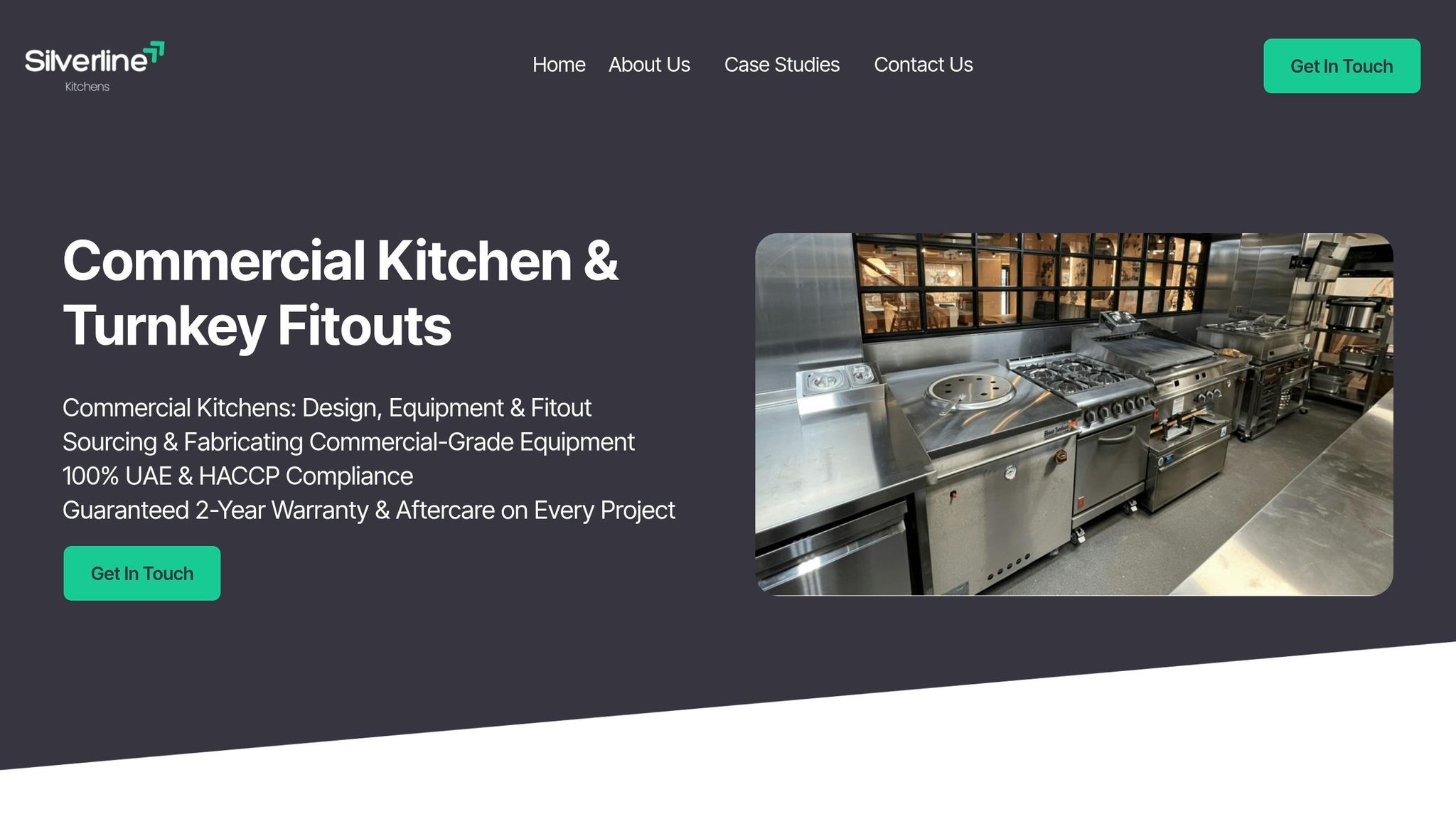
Addressing compliance early can save operators both time and money. Silverline Kitchens works closely with cloud kitchen operators to design layouts that meet HACCP standards, ensuring proper flow separation is part of the floor plan.
One essential step is obtaining layout approval from the Dubai Municipality before starting any fit-out work. Silverline Kitchens expedites this process by submitting applications simultaneously to the DM, Dubai Civil Defence (DCD), and master developers, reducing the approval time to as little as three weeks.
In addition, Silverline Kitchens provides equipment that meets UAE compliance standards, simplifying the setup process. Their services also cover FSMS documentation, including temperature logs, cleaning schedules, and staff training records, which are often reviewed during unannounced inspections.
Financial and Operational Benefits of Cloud Kitchens
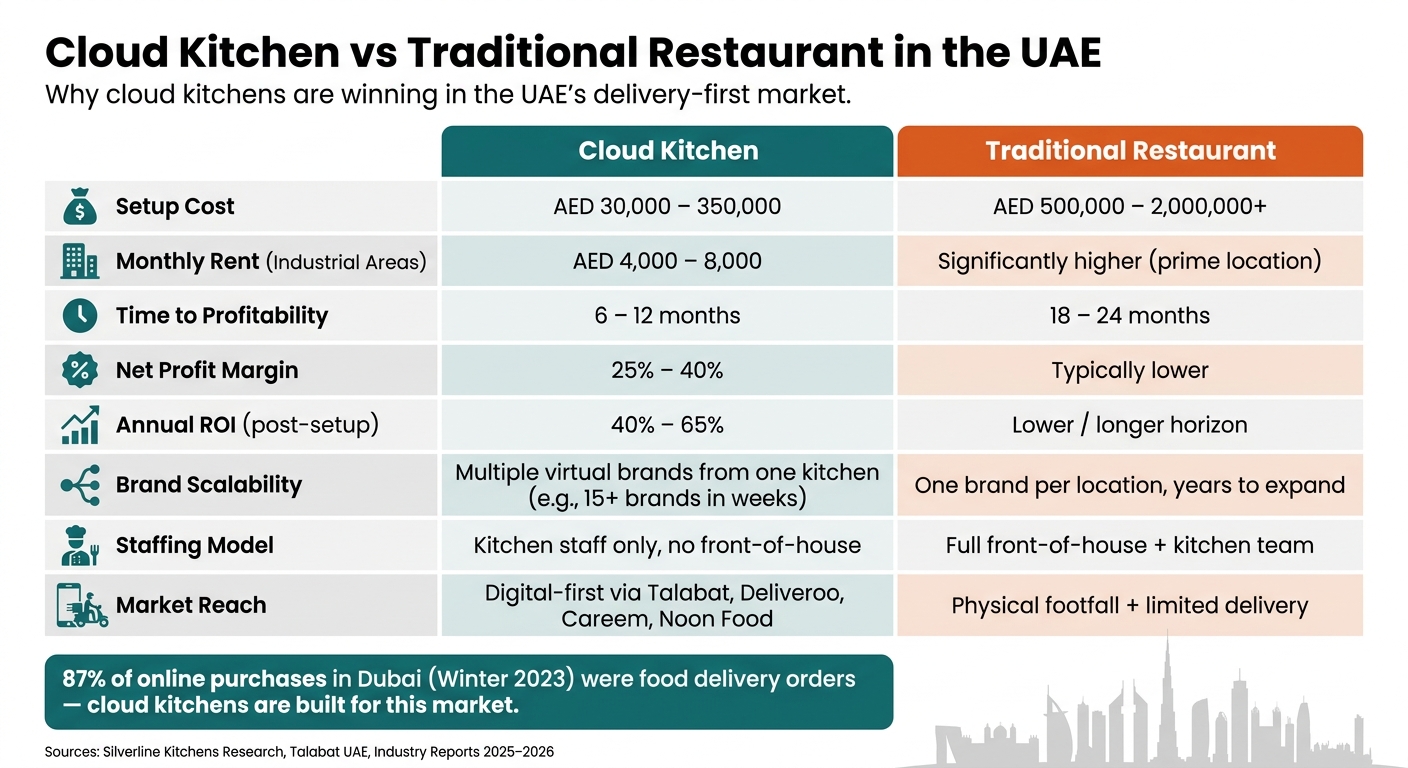
Cloud Kitchen vs Traditional Restaurant: Cost & Performance Comparison in UAE
Cost Efficiency and Scalability
Cloud kitchens bring a host of operational advantages, particularly in terms of cost savings and scalability. Start-up costs are significantly lower compared to traditional restaurants. For instance, setting up a shared kitchen can cost between AED 30,000 and AED 80,000, while a small dedicated space might range from AED 80,000 to AED 150,000. With no dining area to maintain or front-of-house staff to pay, these savings can be channelled into improving food quality and marketing efforts.
Scalability is another major perk. Instead of investing in a second physical location - which often takes years to become profitable - cloud kitchens can launch additional virtual brands in just weeks. Rebel Foods, for example, successfully introduced over 15 micro-brands within six months using their existing cloud kitchen setup. These cost efficiencies allow operators to adapt and enhance their operations without significant financial strain.
Workflow Optimisation and Menu Planning
The reduced financial burden of cloud kitchens enables operators to focus on streamlining workflows and crafting efficient menus. Without the complexities of dine-in services, operations can be simplified, as all orders come through delivery platforms. This setup allows for workflows that prioritise speed and consistency.
Menus in cloud kitchens are designed with delivery in mind. They are typically short and versatile, featuring dishes that travel well and are quick to prepare. A popular strategy is the "core ingredient" approach, where approximately 80% of ingredients are shared across multiple virtual brands. This not only reduces waste but also simplifies procurement processes.
"Efficient layouts can improve staff productivity by up to 50%, reducing fatigue and errors in high-pressure environments." - Dr. Maria Gonzalez, Food Industry Consultant
Technology Integration for Efficiency
Technology is the backbone of cloud kitchen operations, enhancing efficiency at every step. Orders from platforms like Talabat, Deliveroo, and Careem are consolidated through Kitchen Display Systems integrated with a unified POS. This setup provides teams with a real-time overview of orders, ensuring a smooth workflow.
A great example is Talabat Kitchens, which uses an in-house platform called Pepper to manage over 500 kitchen stalls across 30 hubs in the UAE. The system synchronises rider GPS data with kitchen preparation times, ensuring that food is ready just as the rider arrives.
"Technology plays a central role in ensuring order accuracy, optimising prep time and coordinating handovers between kitchen teams and riders." - Tarek El Halabi, Country Lead, Kitchens, talabat UAE
Beyond order management, data analytics tools help operators track top-performing menu items by neighbourhood and time of day. This data-driven approach enables rapid menu adjustments to keep up with shifting consumer preferences.
The Future of Cloud Kitchens in the UAE
Evolving Regulations and Sustainability Standards
The regulatory landscape for cloud kitchens in the UAE is shifting, with a strong focus on eco-conscious practices. By 2026, new rules will prioritise the use of environmentally friendly packaging and encourage the adoption of electric delivery fleets. Additionally, ADAFSA has implemented stricter allergen management protocols. These require kitchens handling over 50 covers to have separate preparation zones and dedicated equipment for the 14 major allergens.
For operators managing multiple outlets, a central kitchen licence is mandatory. This licence comes with specific requirements like blast chilling capabilities - cooling food to 3°C within 90 minutes - and the use of continuous data-logging thermometers. These regulations are reshaping how kitchens are equipped and designed, influencing operational strategies from the outset and encouraging the development of forward-thinking kitchen models.
Multi-Brand Kitchens and Data-Driven Models
Cloud kitchen operators are increasingly running 3 to 5 virtual brands under one roof to cater to varied market demands. This approach not only maximises revenue but also leverages technology for precision.
Data-driven strategies are at the core of this model. AI-powered platforms are being used for demand forecasting, enabling operators to tweak menus in real time, adjust delivery zones, and pinpoint which dishes perform best based on location and time of day. By 2025, some UAE operators had rolled out AI-driven temperature monitoring and smart packaging systems. These systems send real-time alerts if food temperatures fall outside safe ranges during preparation.
"Imagine your kitchen alerting you before your stock runs out or adjusting cooking times automatically for peak orders - this is not the future, it's 2026 in UAE cloud kitchens." - Kitchen Works
The sector's growth reflects its potential. Valued at USD 430 million in 2025, the UAE cloud kitchen market is projected to hit USD 1.08 billion by 2032, with a CAGR of 14.1%.
What This Means for Kitchen Design and Operations
Keeping up with these changes, kitchen designs are moving towards modular and flexible solutions. As brands adapt quickly to market shifts and evolving regulations, modular layouts with reconfigurable cooking zones allow operators to make adjustments without incurring high renovation costs. Practical considerations, such as using Grade 304 stainless steel for food-contact surfaces and maintaining at least 150 mm floor clearance for equipment, ensure compliance with municipal cleaning standards.
Sustainability is also becoming integral to kitchen design. Features like dedicated stations for biodegradable packaging, integrated waste segregation systems, and IoT-enabled sensors are no longer optional. These elements are increasingly demanded by both regulators and consumers, making end-to-end project management - from design to regulatory compliance - essential for success in this evolving market.
Conclusion
Key Takeaways
Cloud kitchens have firmly established themselves as a cornerstone of the UAE's food and beverage industry. This trend is fuelled by a tech-savvy population and a strong delivery culture, with 87% of all online purchases in Dubai during winter 2023 being food orders. The financial advantages are hard to ignore - cloud kitchens operate at much lower costs compared to traditional restaurants, particularly when it comes to monthly rent. Successful multi-brand kitchens in the region are achieving impressive net profit margins of 25% to 40%, with annual ROI ranging from 40–65% after the initial setup period.
However, cutting costs alone won't guarantee success. Compliance with strict regulations is non-negotiable. From ensuring separate pathways for raw and cooked food to installing grease traps and using non-porous surfaces, maintaining a compliant kitchen design is essential. This highlights the importance of having expert guidance to meet UAE's regulatory standards effectively.
How Silverline Kitchens Helps Achieve Compliance
While cost efficiency is important, it must go hand-in-hand with adherence to regulations. Building a high-performing, compliant cloud kitchen requires more than just good ideas - it demands careful planning, the right equipment, and a deep understanding of UAE regulations from the start.
Silverline Kitchens offers comprehensive support throughout this process. From creating initial layouts and sourcing equipment to managing grease trap installation and ongoing maintenance, they handle every detail. Their end-to-end project management ensures kitchen designs meet municipality requirements before construction begins, minimising the risk of costly redesigns or delays in approvals. With their structured approach, operators can achieve scalable and efficient cloud kitchen setups across the UAE.
FAQs
What licences do I need to run a cloud kitchen in Dubai or Abu Dhabi?
To operate a cloud kitchen in the UAE, you’ll need a trade licence issued by the Department of Economy and Tourism or the appropriate authority in your emirate. Additionally, a food safety permit from the local municipality is required.
In Dubai, this process involves obtaining a Permit for Food Related Activities and a Civil Defence (DCD) fire safety NOC. If you're setting up in Abu Dhabi, you must secure a food establishment permit from ADAFSA. Also, ensure your kitchen layout aligns with the UAE Food Code regulations.
How can I design my kitchen to pass UAE food safety inspections first time?
To successfully pass UAE food safety inspections on your first attempt, it’s crucial to plan and design your kitchen with compliance in mind right from the beginning. Start by ensuring a unidirectional workflow - from receiving to cleaning - to minimise the risk of cross-contamination. Use materials that are durable, easy to clean, and hygienic for all surfaces.
Additionally, install a fire suppression system that meets Civil Defence approval standards. Proper temperature control is non-negotiable; maintain food at the required safe temperatures at all times. Implement a Food Safety Management System based on HACCP principles to identify and manage potential hazards effectively.
Lastly, keep comprehensive records to demonstrate compliance. This includes detailed cleaning schedules, temperature logs, and other documentation that inspectors may request.
How do I choose the right location and delivery radius for my cloud kitchen in the UAE?
When picking a spot for your cloud kitchen, it’s all about finding the sweet spot between affordable rental costs and fast delivery times. Areas like Al Quoz in Dubai or Mussafah in Abu Dhabi are excellent options. Why? These industrial zones typically offer lower rental prices while still providing solid access for delivery riders.
Instead of focusing on foot traffic, prioritise a delivery coverage area that gets your food to customers quickly. This focus on speed ensures your cloud kitchen runs efficiently and meets customer expectations for fast service.
