


The way kitchens are designed in the UAE depends heavily on whether they serve dine-in customers or focus solely on food delivery. Restaurant kitchens aim to balance customer experience with efficient operations, while cloud kitchens are delivery-focused and designed for speed and cost-efficiency. Here’s a quick breakdown:
- Space Requirements: Restaurants need larger spaces (750 sq ft minimum), while cloud kitchens operate in smaller areas (200 sq ft+).
- Location: Restaurants prefer high-traffic, premium locations, while cloud kitchens thrive in industrial zones like Al Quoz or Mussafah.
- Costs: Restaurant fit-outs range from AED 200,000 to AED 800,000, compared to AED 150,000–500,000 for cloud kitchens.
- Profit Margins: Restaurants often see single-digit margins, whereas cloud kitchens can achieve 15–30%.
- Technology: Cloud kitchens rely on delivery platform integrations and IoT-enabled equipment for efficiency.
Quick Comparison
| Aspect | Restaurant Kitchen | Cloud Kitchen |
|---|---|---|
| Minimum Space | 750 sq ft (300 sq ft kitchen) | 200 sq ft+ |
| Location | High-traffic areas | Industrial zones |
| Setup Cost | AED 200k–800k | AED 150k–500k |
| Profit Margins | Single-digit | 15–30% |
| Approval Time | 15–30 working days | 1–3 weeks |
| Focus | Dine-in & ambiance | Delivery speed & efficiency |
Both models must comply with UAE regulations like HACCP and Civil Defence codes, but their design priorities differ. Restaurants focus on guest experience, while cloud kitchens prioritize delivery efficiency and scalability.
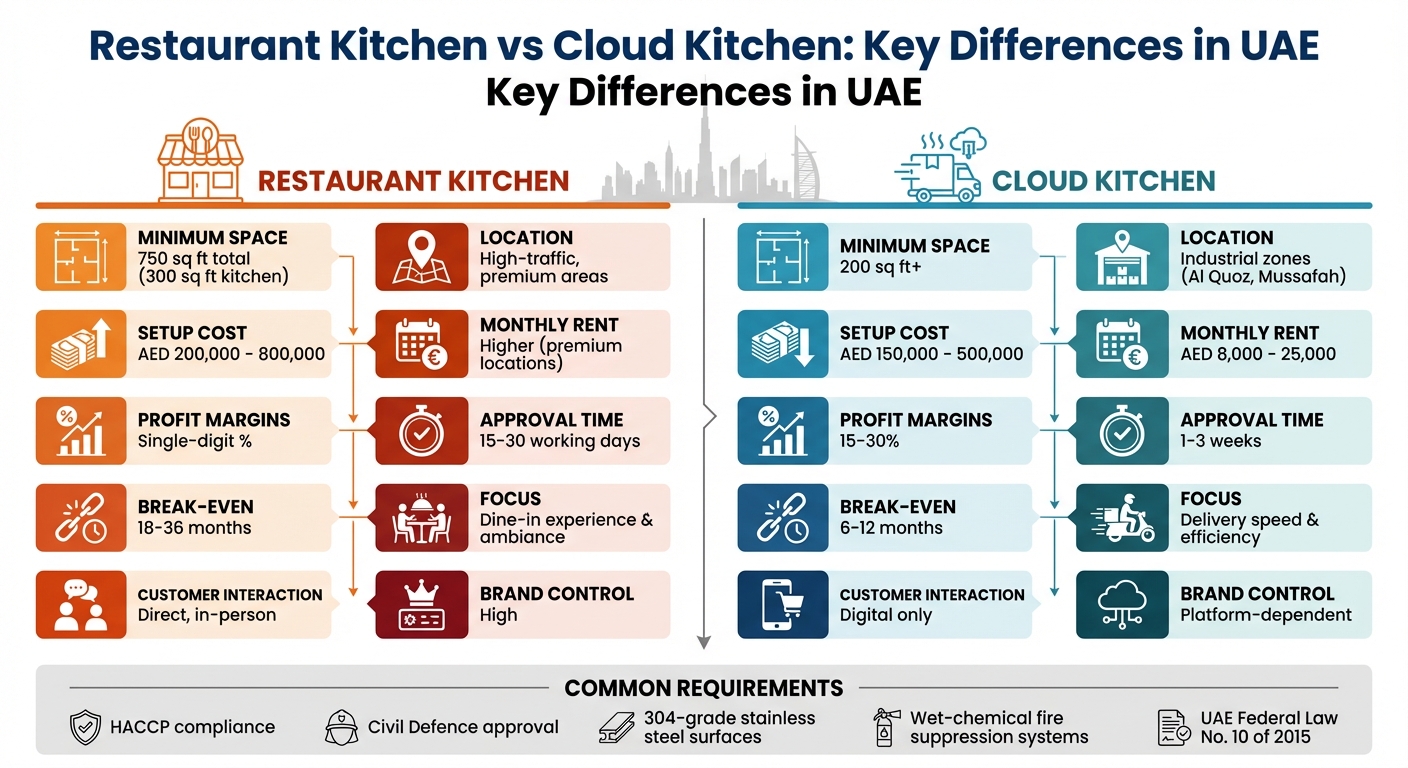
Restaurant Kitchen vs Cloud Kitchen: Key Differences in UAE
1. Restaurant Kitchen Design
Layout and Space Allocation
Designing a restaurant kitchen is all about balancing efficiency in food preparation with smooth customer service. In Dubai, regulations stipulate a minimum of 300 sq ft for kitchen space and 750 sq ft for the entire restaurant. A useful rule of thumb is to allocate around 5 square feet of kitchen space per dining seat.
The workflow in a well-designed kitchen typically follows a logical sequence: Receiving → Storage → Cold Prep → Cooking Line → The Pass (Assembly & Pick-Up) → Dish Drop → Cleaning. The Pass serves as the crucial handoff point between kitchen and service staff, equipped with heat lamps and order display systems to ensure timely and accurate service. To avoid congestion during busy hours, work aisles should be 107–122 cm wide, even when cabinets or doors are fully open.
Many modern restaurants are embracing open kitchen concepts, which connect the cooking area with the dining space. According to Muhammad Rady of RadyInterior:
"Invisible design" ensures infrastructure like refrigeration and exhaust systems are hidden within joinery walls or under-counter spaces, keeping the space visually appealing without compromising functionality.
This approach integrates concealed elements such as under-counter refrigeration and flush storage, ensuring the kitchen remains both functional and aesthetically pleasing. Such layouts also pave the way for incorporating advanced technologies to optimise operations.
Equipment and Infrastructure
A traditional restaurant kitchen relies on a variety of equipment to handle diverse menu offerings. The core cooking line typically includes ranges, grills, fryers, ovens, and steamers. To meet hygiene and durability standards, all surfaces, sinks, and shelving must be made of 304-grade stainless steel. High-capacity ventilation hoods are essential for removing grease, smoke, and heat, with airflow calculated based on the BTU output of the equipment.
Sanitisation is another critical component. Commercial dishwashers must reach a final rinse temperature of at least 82°C to effectively kill pathogens. Kitchens must also have separate sinks for handwashing, food preparation, and warewashing to meet municipal requirements. Grease traps are mandatory for compliance with environmental standards. Flooring should be made of commercial-grade epoxy or quarry tiles, with a curved edge (coved) extending at least 4 inches up the wall for easier cleaning.
Operational Flow and Technology Integration
A well-thought-out operational flow is essential for timely service. Efficient kitchens map their processes - Cold Prep, Cooking Line, Pass, Dish Drop, and Cleaning - to avoid bottlenecks. Cooking stations should have at least 38 cm of counter space on either side of the stove to accommodate plates and utensils. Additionally, preparation counters set at a height of 85–95 cm help reduce physical strain on staff during long shifts.
Technology is playing an increasingly important role in modern kitchens. IoT-connected equipment can monitor energy usage in real-time and send alerts for maintenance needs. Induction cooking is another game-changer, transferring over 90% of energy directly to cookware compared to the 40–50% efficiency of gas stoves. This not only lowers air conditioning costs by reducing ambient heat but also aligns with Dubai's environmental goals.
Regulatory Compliance
Every restaurant kitchen in the UAE must secure approval from Dubai Municipality or the Abu Dhabi Agriculture and Food Safety Authority, as well as Civil Defence for fire safety. Compliance with UAE Federal Law No. 10 of 2015 requires implementing a food safety management system based on HACCP principles, which mandate clear separation between raw and cooked food zones. Clean areas (like prep, cooking, and assembly zones) must be distinctly separated from dirty areas (such as dishwashing and waste disposal).
Fire safety is a top priority, with automatic wet-chemical suppression systems (e.g., ANSUL systems) integrated into kitchen hoods. These must be installed by Civil Defence-approved vendors. Electrical outlets in wet areas are required to have a waterproof IP66 rating. The overall approval process for a restaurant kitchen typically takes 15 to 30 working days.
In Dubai, professional kitchen fit-outs can cost anywhere from AED 200,000 to over AED 800,000, depending on the size and the type of cuisine offered. These considerations highlight the unique demands of restaurant kitchens, which differ significantly from cloud kitchen setups - an area that will be explored next.
2. Cloud Kitchen Design
Layout and Space Allocation
Cloud kitchens operate with a much smaller footprint - around 200 sq ft - compared to the expansive 2,000 sq ft often required for traditional restaurants. This compact size allows operators to set up in cost-effective industrial areas like Al Quoz in Dubai or Mussafah in Abu Dhabi. With no need for dining areas, every square metre is dedicated to kitchen operations.
The layout is designed for efficiency, following a clear sequence:
Receiving/Storage → Preparation → Cooking/Production → Assembly/Pick-up (The Pass) → Washing/Sanitisation.
Unlike traditional restaurant kitchens, which must accommodate both kitchen staff and front-of-house traffic, cloud kitchens are streamlined to minimise staff movement and avoid congestion in tight spaces. Many facilities are set up to support multiple virtual brands within the same kitchen, allowing operators to maximise equipment utilisation and generate more revenue from the same space. This setup also prioritises high-efficiency, multi-functional equipment to make the most of the available area.
Equipment and Infrastructure
Cloud kitchens rely on compact, energy-efficient equipment to optimise their limited space. For instance, commercial induction ranges are becoming a popular choice as they transfer over 90% of energy directly to cookware, outperforming gas stoves in both efficiency and heat management. Proper ventilation is crucial, with hood systems tailored to the equipment’s BTU output and enhanced by automatic wet-chemical fire suppression systems, as mandated by Civil Defence.
Hygiene is a top priority, with all surfaces and equipment meeting strict standards. To save space and boost functionality, multi-purpose equipment like combi ovens - capable of steaming, baking, and roasting - is commonly used. This approach eliminates the need for redundant appliances while maximising productivity within a small footprint.
Operational Flow and Technology Integration
Efficiency in cloud kitchens extends beyond equipment to the operational flow, heavily supported by advanced technology. Kitchen Display Systems (KDS) are a key tool, consolidating orders from platforms such as Talabat, Deliveroo, Careem, and Noon into one interface. This reduces the risk of missed orders and ensures real-time tracking. The assembly zone, or "The Pass", is designed for speed, featuring heat lamps and digital displays to coordinate seamlessly with delivery riders.
IoT-enabled equipment plays a vital role, monitoring energy use and sending maintenance alerts to prevent unexpected breakdowns. Additionally, many operators are moving toward direct ordering channels to bypass third-party platforms, which often charge commissions of 25%–35%. This digital-first strategy allows cloud kitchens to launch operations in as little as eight weeks, a stark contrast to the year-long timeline often required for traditional restaurants. While technology drives efficiency, strict adherence to regulations remains a non-negotiable aspect of the business.
Regulatory Compliance
Cloud kitchens must adhere to the same health, fire safety, and hygiene regulations as traditional restaurants, including HACCP protocols and Civil Defence-approved systems. However, the approval process is notably quicker, often taking just 1–3 weeks.
Initial setup costs typically range between AED 150,000 and AED 500,000, depending on the location and equipment choices. Business licences in zones like Meydan Free Zone start at AED 12,500, while monthly rentals for kitchen spaces can vary from AED 8,000 to AED 25,000.
sbb-itb-19c3c9a
Advantages and Disadvantages
Let’s delve into the trade-offs between restaurant kitchens and cloud kitchens, highlighting how each model influences operations, costs, and long-term strategy.
Restaurant kitchens come with the benefit of direct customer interaction, which reduces dependence on third-party platforms. This direct relationship fosters brand loyalty and cuts down on the need for heavy digital advertising. However, these kitchens require a hefty initial investment and ongoing expenses. Prime locations, front-of-house staff, and the extra utilities needed to keep large dining areas cool in the UAE’s intense summer heat all add to the cost. These factors make restaurant kitchens a more expensive option but one that offers greater control over branding and customer relationships.
Cloud kitchens, on the other hand, are a cost-effective alternative. They can operate in industrial areas where monthly rent ranges between AED 8,000 and AED 25,000. A 200 sq ft cloud kitchen can handle delivery volumes comparable to a 1,000 sq ft restaurant. Another advantage is their ability to run multiple virtual brands from the same space, which boosts equipment usage and revenue potential.
However, cloud kitchens come with their own challenges. High aggregator fees and customer acquisition costs through digital marketing can significantly cut into profits. Additionally, the lack of a physical presence may impact brand loyalty over time. Traditional restaurants, while more expensive to set up, maintain stronger control over customer data and relationships, which can be a critical advantage.
"Cloud kitchens are not just a trend - they're the future of food business in the UAE. They allow entrepreneurs to start small, reduce risks, and scale quickly." - Tech4Serve
The choice between these models ultimately depends on your business goals and financial resources. If you're testing a new concept or need to launch quickly, cloud kitchens offer a lower-risk option with faster break-even timelines - typically 6 to 12 months compared to the 18 to 36 months required for traditional restaurants.
Conclusion
Deciding between a restaurant kitchen and a cloud kitchen comes down to your business model, budget, and operational goals. Restaurant kitchens demand significant upfront investment and prime locations, as they’re designed to balance guest experience with efficient food preparation. On the other hand, cloud kitchens offer a more cost-effective setup, often operating from industrial zones like Al Quoz or Mussafah, with a focus on delivery efficiency and scalability.
Both options must adhere to UAE regulations, such as HACCP standards and Civil Defence approvals. However, their priorities differ: restaurant kitchens emphasise guest-centric design and smooth front-of-house (FOH) and back-of-house (BOH) integration, while cloud kitchens prioritise fast delivery, optimised packaging workflows, and the flexibility to support multiple brands. Aligning your kitchen design with your operational strategy is critical to staying competitive in the UAE market.
"A commercial kitchen is the engine of the business - if it fails, the entire restaurant fails." - Muhammad Rady, RadyInterior
Crafting your kitchen layout around your menu is essential. By finalising an itemised menu first, you can ensure that every dish’s equipment and workflow needs are accounted for. If your goal is to achieve a quick break-even - typically around six months for cloud kitchens compared to about five years for traditional restaurants - a delivery-focused concept might be the better choice.
For expert guidance in designing a compliant and efficient kitchen tailored to your vision, Silverline Kitchens provides comprehensive solutions. From HACCP-compliant layouts and equipment procurement to Dubai Municipality approvals and ongoing support, they’re equipped to help you succeed. Whether you’re opening a cosy neighbourhood café or a multi-brand cloud kitchen, the right design partner can transform your kitchen into the powerhouse of your business.
FAQs
What are the key benefits of cloud kitchens compared to traditional restaurants?
Cloud kitchens bring several advantages to the table, making them a smart choice for food businesses in the UAE. One of the biggest perks? Lower costs. Without needing a dining area or waitstaff, these kitchens cut down on major expenses like rent, utilities, and staffing. Plus, they’re often set up in industrial zones such as Al Quoz or Mussafah, where rents are far more affordable compared to high-traffic retail areas.
Another standout benefit is their quick and flexible setup. Unlike traditional restaurants that require lengthy fit-outs and licensing, cloud kitchens can be up and running in just a few weeks. They also give business owners the freedom to experiment with multiple virtual brands or cuisines under a single licence. This means testing out new ideas and keeping up with market trends becomes a lot less risky - and a lot more affordable.
Lastly, cloud kitchens are built with a delivery-first approach. They’re tailored to handle online orders through platforms like Talabat, Deliveroo, and Careem Food. This focus on delivery helps streamline operations, minimise food waste, and eliminate the need for dine-in services. It’s a model that fits perfectly with the UAE’s booming demand for food delivery. On top of that, it ensures compliance with local rules by steering clear of unlicensed dine-in activities.
What are the regulatory differences between designing a restaurant kitchen and a cloud kitchen in the UAE?
In the UAE, the regulations for restaurant kitchens and cloud kitchens differ significantly due to their distinct operational setups.
For restaurant kitchens, the approval process is more detailed. It includes permits for the kitchen layout, proper ventilation systems, fire safety measures, emergency exits, and waste management protocols. Restaurants that offer seating areas must also comply with additional fit-out and hospitality standards set by Dubai Municipality (DM). Moreover, obtaining HACCP certification and adhering to the UAE's strict health and safety regulations are non-negotiable.
On the other hand, cloud kitchens cater exclusively to food delivery services, removing the need for dining spaces or hospitality features. The licensing process is more straightforward, focusing on food safety, hygiene practices, HACCP certification, and occupational health standards. Approvals are often managed through platforms like FoodWatch or free zones such as Meydan Free Zone, with fewer requirements compared to traditional restaurants.
The key distinction lies in the extent of approvals: while restaurants must address comprehensive fit-out and hospitality compliance, cloud kitchens prioritise food safety and streamlined operations.
How does technology enhance the efficiency of cloud kitchens in the UAE?
Technology is at the heart of making cloud kitchens quicker and more efficient. By linking directly with popular delivery platforms like Talabat, Deliveroo, Careem Food, and Noon Food, orders flow straight to kitchen-display systems. This eliminates the need for manual input, cutting down preparation delays. This integration doesn’t just speed things up - it also helps with inventory management. By tracking how much of each ingredient is used per order, the system can send automatic restocking alerts. This approach helps reduce waste and keeps operations profitable, even in compact spaces as small as 25–30 m².
Smart tools powered by IoT, such as intelligent ovens, temperature-controlled storage units, and automated dispensers, ensure precise cooking and faster prep times. On top of that, data analytics offer valuable insights into order patterns, peak hours, and menu performance. This allows for better staff scheduling and smoother workflows. Together, these technologies turn cloud kitchens into data-driven hubs, meeting the UAE's demand for fast and dependable food delivery - often within just 30 minutes.
