


Sloped flooring is a must for commercial kitchens in the UAE. It helps meet HACCP standards by ensuring proper drainage, preventing water pooling, and reducing contamination risks. Here’s why it’s essential:
- HACCP Compliance: UAE regulations require food establishments to follow strict hygiene standards. Sloped floors are key to managing water flow and keeping kitchens safe.
- Prevents Water Pooling: Standing water can breed bacteria like Listeria monocytogenes and attract pests. Proper slopes eliminate this risk.
- Supports Cleaning: Sloped floors make it easier to clean and disinfect surfaces, ensuring hygiene in high-risk areas.
- Durable and Safe: Materials like epoxy or urethane concrete withstand heavy loads, chemical exposure, and temperature changes, while anti-slip finishes enhance safety.
For UAE kitchens, a 1–2% slope gradient is ideal, directing liquids toward drains without creating hazards. Properly installed flooring also includes coved wall junctions and expansion joints to prevent cracks and contamination. This design helps businesses avoid penalties and maintain food safety standards.
Visit Silverline Kitchens for tailored solutions that meet HACCP requirements.
How Sloped Flooring Supports HACCP Compliance
Sloped flooring plays a key role in supporting HACCP protocols by directing contaminants away from surfaces. By using gravity, these floors guide water, oils, and waste into drainage systems, preventing the buildup of harmful substances.
Why Proper Drainage Matters
Standing water on floors can become a breeding ground for pathogens like Listeria monocytogenes. To address this, the European Food Safety Directive 852/2004 mandates that floors must "allow adequate surface drainage" and remain easy to clean and disinfect.
"When designing the drainage system the floor needs to be sloped - this avoids the water pooling and means that waste liquid flows in the right direction." – Dave McNeece, Managing Director, Flowcrete Americas
Experts recommend floor gradients ranging between 1:100 and 1:80, with wash-down areas requiring at least a 2% slope to ensure proper cleaning and reduce microbial risks. This setup not only prevents bacterial growth but also reduces slip hazards and makes cleaning more efficient. In fact, one study found that 25% of 1,645 food safety incidents were linked to microbiological contamination.
By maintaining effective drainage, sloped flooring directly tackles the risks of water pooling and the contamination hazards that follow.
Preventing Water Pooling and Contamination
Efficient sloped flooring eliminates standing water, which is a known carrier of contaminants. When left unchecked, stagnant water can spread harmful particles through droplets, airborne transmission, or even workers' footwear.
A compelling example comes from the UAE-based Abela & Co, which serves over 100,000 meals daily. Their four central kitchens, supported by a dedicated stewarding division making up 15% of the workforce, use ATP swabbing to ensure cleanliness. This rigorous approach has helped them maintain an 11-year HACCP certification.
Beyond microbial concerns, stagnant water can attract pests and lead to the buildup of scale deposits, both of which create additional challenges for hygiene. In dairy facilities, for example, sloped floors paired with stainless steel drainage prevent the accumulation of acidic byproducts like whey, which can corrode surfaces. To confirm a well-designed floor, it’s recommended to test with water and ensure no puddles remain after one hour.
Designing and Installing Sloped Flooring for HACCP Standards
HACCP Sloped Flooring Design Requirements for UAE Commercial Kitchens
The technical aspects of flooring can make or break compliance with inspections over time. Proper drainage is essential for meeting HACCP standards, and the design and installation of sloped flooring play a critical role. A well-thought-out plan ensures your kitchen stays compliant with HACCP requirements in the long run, helping you avoid the expense of future modifications.
Recommended Slope Gradients for UAE Kitchens
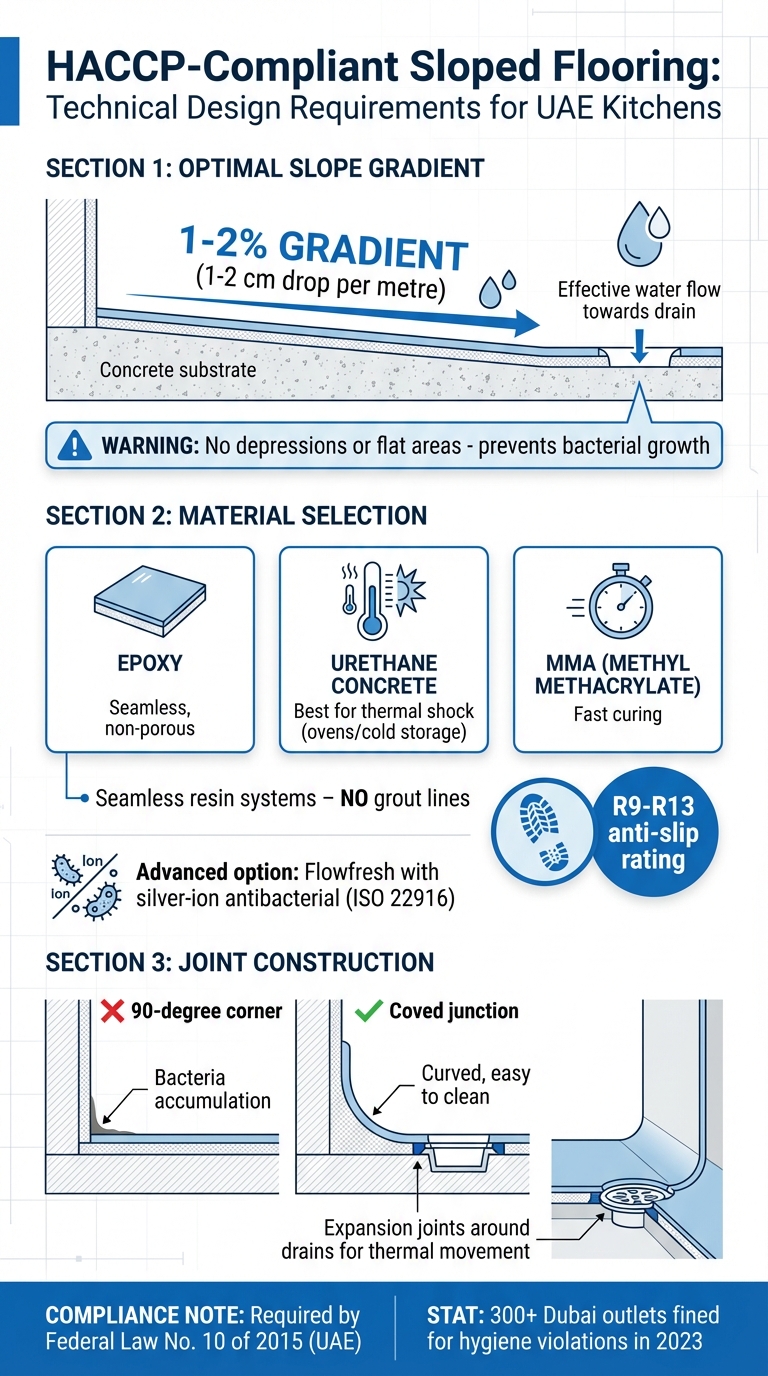
For commercial kitchens in the UAE, a 1–2% gradient is considered ideal. This translates to a drop of 1–2 cm for every metre of flooring. Maintaining a consistent slope across the entire floor is crucial. Any depressions or flat areas can trap water, creating a breeding ground for bacteria.
Material Selection for Durability and Hygiene
Choosing the right materials is just as important as the slope itself. Seamless resin systems like epoxy, urethane, and methyl methacrylate (MMA) are preferred for HACCP compliance. Unlike traditional tiles with grout lines that can harbour bacteria, these materials create a continuous, non-porous surface. Urethane concrete is particularly effective in areas exposed to extreme temperature changes, such as near ovens or cold storage, as it withstands thermal shock better than epoxy.
For staff safety, ensure the flooring has an anti-slip rating between R9 and R13. Advanced systems like Flowfresh go a step further by incorporating silver-ion antibacterial agents that meet ISO 22916 standards, offering added protection against microbes. Seamless joints are another key factor in maintaining hygiene and preventing contamination.
Creating Seamless Joint Construction
The areas where floors meet walls are critical for hygiene. These junctions are prone to bacteria accumulation if not designed properly. Using coving - a curved, concave transition - eliminates hard-to-clean 90-degree corners .
Professional installation is essential to achieve a smooth, gap-free extension of the flooring up the walls. Around drainage channels, expansion joints should be installed to allow for thermal movement and prevent cracks, which could otherwise lead to contamination. With Federal Law No. 10 of 2015 requiring HACCP systems for all food businesses in the UAE - and more than 300 outlets in Dubai fined for hygiene violations in 2023 - these details are not just recommendations but necessities.
For expert guidance and installation of HACCP-compliant sloped flooring solutions tailored to UAE regulations, visit Silverline Kitchens at https://silverlinekitchens.com.
sbb-itb-19c3c9a
Integrating Sloped Flooring into a Compliant Kitchen System
When designing a kitchen that meets HACCP standards, infrastructure planning plays a key role in achieving compliance. Sloped flooring, when integrated with drainage systems, equipment placement, and workflow, ensures a kitchen operates efficiently while adhering to hygiene regulations. Proper drainage planning is especially critical to align all components seamlessly.
Drainage and Infrastructure Planning
To complement earlier guidelines on seamless floor-to-wall junctions, sloped flooring must work hand in hand with the drainage system. The slope ensures that water, oils, and other liquid waste flow naturally toward drainage channels using gravity. Any misalignment in the slope can result in pooling, creating an environment where bacteria can thrive.
The connection between resin flooring and stainless steel drains is particularly sensitive due to the differing expansion rates of these materials. Dave McNeece, Managing Director at Flowcrete Americas, highlights this issue:
"A joint, installed on either side of a drainage channel, will counteract the fact that the stainless steel drain will have a different coefficient of movement to the surrounding flooring system."
Additionally, wastewater must pass through a properly sized grease trap. To prevent surface water from entering underground grease traps, raised kerbs or surface channels are essential. Equipment placement should never obstruct the flow of wastewater to the drains. Furthermore, soil and waste pipes within the kitchen must be enclosed in impervious, rust-proof ducts - commonly made from 1.6 mm stainless steel - and should include inspection openings for maintenance.
A well-designed drainage system not only ensures hygiene but also aligns with UAE regulatory requirements.
Professional Kitchen Design for Regulatory Compliance
In 2023, Dubai was home to over 13,000 restaurants and cafés, with more than 300 establishments fined for hygiene violations that same year. This underscores the importance of professional kitchen design. Federal Law No. 10 of 2015 requires all food businesses in the UAE to implement HACCP systems, with compliance overseen by Dubai Municipality and the Abu Dhabi Agriculture and Food Safety Authority (ADAFSA).
Silverline Kitchens specialises in creating commercial-grade kitchens that integrate sloped flooring with drainage, equipment layouts, and workflow planning to meet these regulations. Their comprehensive project management ensures every detail - from grease trap sizing to the placement of expansion joints - is designed for compliance. This holistic approach not only meets HACCP standards but also adheres to Dubai Municipality and Civil Defence regulations, avoiding the costly consequences of disjointed installations. For expert advice on crafting fully compliant kitchen systems, visit https://silverlinekitchens.com.
Conclusion
Sloped flooring plays a critical role in ensuring HACCP compliance for commercial kitchens in the UAE. By preventing water from pooling and efficiently directing waste liquids toward drainage channels, properly designed floors help eliminate the conditions that encourage microbial growth. This seamless integration of drainage and flooring not only protects food safety but also ensures smooth operations in a regulatory environment where hygiene violations can lead to severe penalties. It also lays the groundwork for tackling the technical complexities of installation.
Getting the slope gradients right and accounting for material variations require expert design and installation. As Dave McNeece, Managing Director at Flowcrete Americas, explains:
"To meet the HACCP International standard, floors need to allow for adequate drainage and cleaning, facilitating the fast and effective removal of excess liquid and slippery contaminants from the area."
In the UAE, Federal Law No. 10 of 2015 mandates HACCP systems for all food establishments, making robust flooring design a non-negotiable requirement. In fact, nearly 45% of certain food establishments in Dubai have faced closures due to non-compliance with space, equipment, and hygiene standards. A well-executed sloped flooring system, complete with proper drainage and coved wall junctions, helps avoid these costly setbacks while ensuring durability under the challenging conditions of UAE kitchens.
For a comprehensive approach to kitchen infrastructure, Silverline Kitchens offers end-to-end project management to ensure compliance with Dubai Municipality, ADAFSA, and Civil Defence standards. Learn more at https://silverlinekitchens.com. A precisely engineered sloped flooring system not only safeguards food safety but also improves operational efficiency and ensures your kitchen meets regulatory requirements from the very beginning.
FAQs
Why is a 1–2% floor slope important for HACCP compliance in UAE commercial kitchens?
A floor slope of 1–2% is crucial in UAE commercial kitchens to ensure water flows correctly toward floor drains. This simple yet essential feature prevents water from pooling, which could otherwise lead to bacterial growth, hygiene problems, and slip risks. By maintaining this slope, kitchens can adhere to HACCP hygiene standards, creating a safer and cleaner space for food preparation.
Beyond hygiene and safety, a well-sloped floor makes cleaning much easier, reducing the time and effort required for staff. This small design detail is vital for meeting UAE regulations and upholding top operational standards.
How does sloped flooring help maintain hygiene in commercial kitchens?
Sloped flooring plays a crucial role in commercial kitchens by guiding liquids towards drains, effectively preventing water from collecting on the surface. Pooled water not only poses a safety hazard but can also encourage the growth of harmful microbes, putting hygiene at risk.
With proper drainage, sloped floors simplify cleaning and disinfection processes, significantly lowering the chances of microbial contamination. This feature is essential for adhering to HACCP standards and ensuring compliance with the UAE's stringent food safety regulations.
What are the best flooring materials for HACCP compliance in commercial kitchens?
For HACCP-compliant sloped flooring, it's crucial to use seamless, non-porous materials to maintain proper drainage and hygiene. One of the top choices is polyurethane resin flooring, known for its strength, water resistance, and antimicrobial properties. This type of flooring can be installed with a gentle slope (1–2%) to guide liquids towards stainless steel drains, aligning with food safety standards and UAE regulations.
Another reliable option is food-grade epoxy flooring, which offers a tough, impermeable surface that withstands heavy equipment, chemical spills, and high-temperature cleaning. Its smooth, grout-free finish helps prevent bacterial build-up, making it particularly effective for wet areas where hygiene is critical.
Both flooring options work seamlessly with stainless steel drainage systems built to withstand hot water and harsh cleaning agents. Silverline Kitchens specialises in providing and installing these HACCP-approved flooring solutions, ensuring your commercial kitchen operates safely and efficiently.
