


A clean-looking kitchen is not enough in the UAE. If I run a restaurant, I need daily proof that my team is cleaning properly, storing food at the right temperatures, preventing cross-contact, checking staff hygiene, handling waste, and keeping records. If I miss these checks, the cost can be high: penalties under UAE food safety law can reach AED 2,000,000, and a business can also face suspension or closure.
Here’s the article in one clear view:
- I need an FSMS based on HACCP
- I should assign each task to one person, one time, and one shift
- I must check sanitisers, dishwashers, fridges, freezers, hot holding, and probe thermometers on a set schedule
- I need to keep raw and ready-to-eat food fully apart
- I should enforce handwashing, illness reporting, glove changes, and uniform checks
- I must control bins, drains, leaks, and pest signs every day
- I need signed logs, cleaning rosters, and maintenance records kept for at least 3 years
A few numbers matter most:
- Chilled food: ≤5 °C
- Frozen food: ≤−18 °C
- Hot holding: ≥60 °C
- Dishwasher final rinse: 82 °C
- Cooking target for poultry and minced meat: 75 °C
- Cooling: 60 °C to 20 °C within 2 hours, then 20 °C to 5 °C within 4 more hours
- Chlorine sanitiser: 50–200 ppm
- Quat sanitiser: 200 ppm
What I like about this checklist is that it turns food safety rules into simple shift tasks: clean it, check it, sign it, fix it if it fails, and file the record. That is the core of daily kitchen compliance in the UAE.
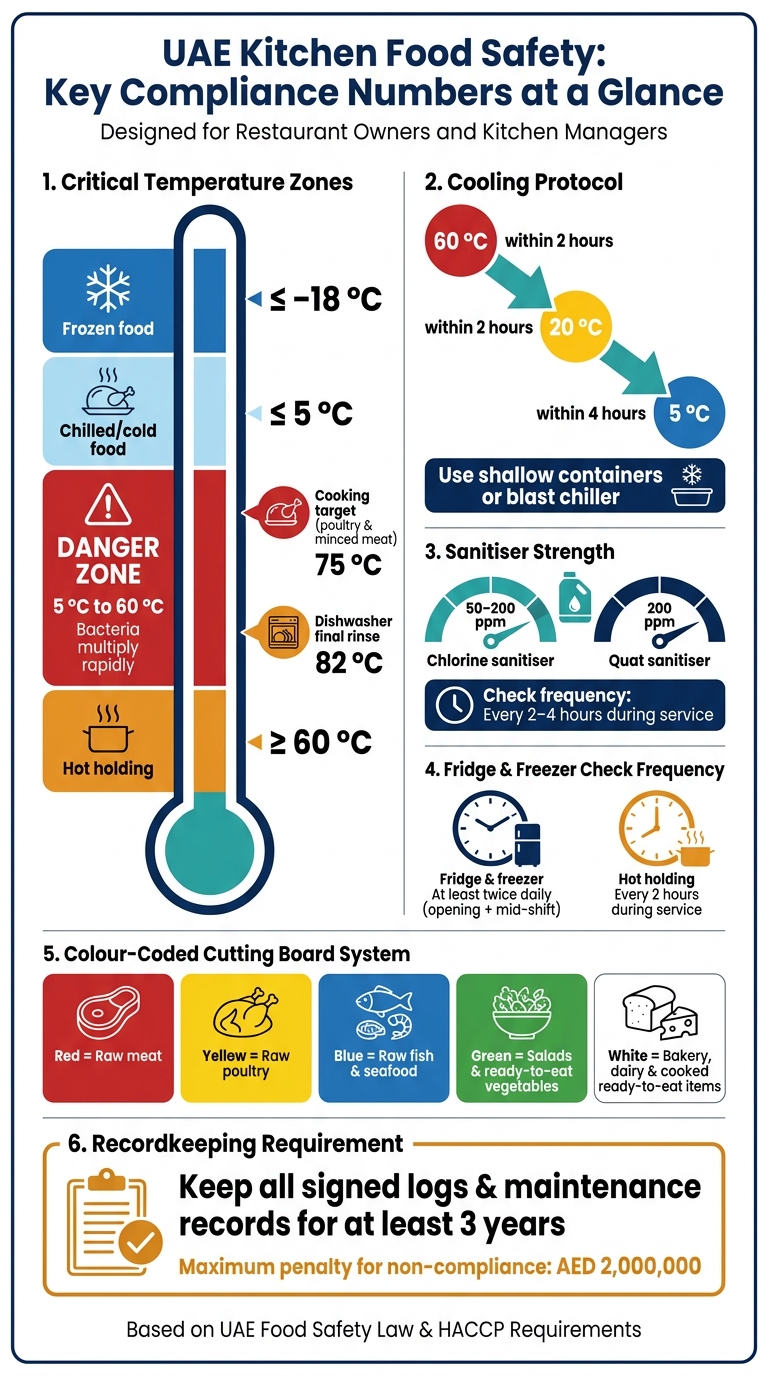
UAE Kitchen Food Safety Temperature & Compliance Quick Reference
Cleaning and Sanitation Checklist
This checklist covers the cleaning and sanitation controls inspectors look for in a UAE commercial kitchen. The tasks below are grouped by how often they need to be done.
Daily Cleaning Tasks for Prep, Cookline, Dishwashing, and Floors
Clean prep tables before opening, between raw and ready-to-eat work, after spills, and at least every 4 hours during service. For all food-contact surfaces - including cutting boards, knives, and smallwares - use this order: scrape off debris → wash with hot water and detergent → rinse → sanitise with an approved disinfectant → air dry. The rinse step is not optional. If you apply a chlorine-based sanitiser before rinsing, it won’t work as well.
Sanitiser strength matters just as much as the cleaning steps. Check it at the start of each shift and every 2–4 hours during service. Use 50–200 ppm for chlorine and 200 ppm for quats. If the solution looks cloudy or has debris in it, throw it out straight away. Record each check on a Sanitiser Monitoring Log with the date, time in 24-hour format (17:30), area, measured ppm range, any corrective action taken, and staff initials.
During service, wipe and sanitise grill plates, fryer surrounds, splash zones, control knobs, and fridge handles. Mechanical dishwashers must hit the required final-rinse temperature of 82 °C or use approved chemical disinfection. If you’re washing manually, use a three-compartment sink system: wash, rinse, and sanitise.
Sweep and wet-mop floors every day with a food-safe degreaser. Clean spills on the spot, and pay close attention to corners, under benches, and around drains, where grease and pests tend to build up. Handwash basins - including taps, handles, and splashbacks - should be cleaned and disinfected at least once a day. Waste bins should be emptied, washed, and disinfected at the end of each shift.
Weekly and Monthly Deep-Clean Tasks
Weekly and monthly deep-cleaning deals with the areas that routine wipe-downs often miss. That’s usually where trouble starts during an inspection.
| Area | Task | Minimum Frequency | Responsible Role |
|---|---|---|---|
| Cookline (behind/under equipment) | Move equipment where safe; remove debris; degrease floors, skirting, and equipment sides; rinse and air-dry | Weekly | Stewarding supervisor + night shift team |
| Oven interiors and racks | Apply approved oven cleaner; remove carbonised grease; rinse and wipe thoroughly | Weekly | Head chef or sous chef |
| Refrigeration shelves and gaskets | Remove shelving where possible; wash, rinse, and sanitise; clean door seals, fan guards, and drip trays | Weekly | Stewarding team |
| Floor drains and channels | Apply drain-safe degreaser; brush accessible parts; flush with hot water to disrupt biofilm | Weekly | Stewarding supervisor |
| Dry store shelves | Clear products; discard spills and expired stock; clean and disinfect shelves and corners | Monthly | Storekeeper + hygiene officer |
| Hood filters and canopy interior | Remove and clean filters; degrease accessible hood surfaces; arrange professional duct cleaning per contract | Monthly (filters); per contract (ducts) | Kitchen manager + external contractor |
| Thermometers and oven calibration | Check probe and fridge thermometer accuracy; verify oven temperature against setting; arrange servicing if out of tolerance | Monthly | Hygiene officer or maintenance |
Each task should clearly state the area, method, frequency, and responsible role. Vague entries won’t satisfy inspection records.
Once cleaning controls are fixed, the next inspection risk is temperature control and storage order.
sbb-itb-19c3c9a
Food Storage, Temperature Control, and Contamination Prevention Checklist
Once surfaces are clean, the next job is keeping food safe during storage and service. In UAE kitchens, storage and temperature control are common inspection trouble spots. The fix is simple on paper: set firm limits, check them on schedule, and keep signed records.
Cold Storage, Freezing, Cooking, and Hot Holding Checks
Keep chilled high-risk food at ≤5 °C, freezers at ≤−18 °C, and hot holding units at ≥60 °C. Food should stay out of the 5 °C to 60 °C danger zone. For high-risk foods, record the core temperature during cooking. That is usually 75 °C for poultry and minced meat. Cooling should follow a two-stage method: bring food from 60 °C to 20 °C within 2 hours, then from 20 °C to 5 °C within a further 4 hours. Shallow containers help. A blast chiller also helps if your FSMS includes one.
Temperature checks need to happen as part of the routine, not just when someone remembers. Check and record fridge and freezer temperatures at least twice daily - at opening and again mid-shift. Check hot holding at set-up and every 2 hours during service. Each reading should have a named staff member attached to it. Use calibrated probe thermometers, and if a unit falls out of range, log the corrective action straight away. Keep signed temperature and calibration logs for at least 3 years.
Once time and temperature are under control, the next risk is mix-ups between raw and ready-to-eat food.
Cross-Contamination Controls for Raw, Cooked, and Ready-to-Eat Food
Set shelves by risk, from top to bottom. That means ready-to-eat foods like washed salads, desserts, and cooked dishes on the top shelves. Put cooked meats and prepared components in the middle. Raw fish and whole cuts of meat should go on lower shelves. Raw poultry and minced meat belong on the bottom shelf in lidded, leak-proof trays. If you don’t have separate fridges, keep raw food sealed and fully apart from ready-to-eat items.
Every item should go into a food-grade, lidded container with a label showing the product name, date prepared or received, and use-by date in dd-mm-yyyy format. In shared storage, use English-Arabic labels. High-risk prepared items such as cooked rice, hummus, and cream-based sauces are often kept for only 24–72 hours under refrigeration, based on your kitchen's hazard analysis.
Colour coding helps staff make the right call fast, especially during a busy shift:
- Red for raw meat
- Yellow for raw poultry
- Blue for raw fish and seafood
- Green for salads and ready-to-eat vegetables
- White for bakery, dairy, and cooked ready-to-eat items
Put a clear wall chart near each prep station so the system stays consistent.
When staff switch from raw prep to ready-to-eat work on a shared station, they need to clean and sanitise the surface properly. A quick wipe won’t do the job. Supervisors should also spot-check colour-coded boards and knives during peak service to make sure the right tools are being used and shared equipment is sanitised between tasks.
Next, control staff hygiene, waste handling, and pest risks that can undo good storage practice.
Personal Hygiene, Waste Handling, and Pest Control Checklist
Once storage is under control, staff hygiene and waste handling often become the next trouble spots during an inspection. These issues are usually small, but they’re easy for inspectors to spot: an empty soap dispenser, an uncovered bin, or a staff member wearing jewellery on the prep line.
Staff Hygiene and Handwashing Checks
Start each shift with a quick visual check. Staff should have a clean uniform, restrained hair, short nails, and no hand, wrist, or ring jewellery on the prep line. Before any food handling starts, hands should be washed at a handwash basin only, using soap and warm running water, then dried with a single-use paper towel or hygienic dryer. Taps should be turned off without contaminating hands again.
Handwashing must also happen after toilet use, handling raw food, dealing with waste, cleaning, eating, drinking, coughing, taking breaks, and before putting on or changing gloves. Gloves need to be changed when moving from raw to ready-to-eat tasks, after touching bins or non-food surfaces, or any time they tear or look dirty.
Cuts and wounds should be covered with a bright-coloured waterproof dressing. Any staff member with vomiting, diarrhoea, fever, jaundice, or another food-safety illness must be kept away from food handling until cleared under policy. A short supervisor fit-for-work check before service can help catch problems early. Illness reports and return-to-work decisions should also be recorded.
Post clear handwashing signs in Arabic and English above every basin and at kitchen entry points. During Ramadan, keep the same hygiene controls in place and increase spot checks before and after iftar.
Waste Storage and Pest Prevention Checks
After personal hygiene, waste handling and pest access are the next areas inspectors tend to focus on. Bins in prep and dishwashing areas should be lined, covered, and emptied before they overflow. During busy evening service, assign specific staff members to empty bins more often, and do it at once if there’s any odour or leakage. At closing, move waste to the collection point and inspect the bin area for leaks, odours, or spills. Waste sacks and packaging should be stored off the floor on designated racks or pallets.
For pest prevention, the daily check should include doors, vents, and screens. Any gaps should be reported and fixed. Drains need to stay free of grease and food debris, and any standing water should be cleared at once. If staff spot droppings, gnaw marks, flies, or cockroach activity, they should log the date, location, pest type, and corrective action. Contractor visit reports and bait station records should also be filed and kept ready for inspection.
Equipment Cleaning, Recordkeeping, and Closing Review
After cleaning, storage, hygiene, and pest control, the last step is to check the equipment and lock in the records. This is where many teams slip. If cleaning jobs are vague, or no one owns them, they often don’t get done properly. So this part covers the day-to-day cleaning checks, maintenance points, and the records that show the work happened.
Equipment Cleaning and Maintenance Checks
Each piece of equipment needs a clear routine. No guesswork.
- Fryers: Clean baskets and empty drip trays daily. Wipe exterior surfaces. Deep-clean the fryer vat weekly with a manufacturer-approved degreaser. Record oil-change dates and note any thermostat irregularities.
- Grills and flat tops: Scrape after each service. Deep-clean weekly, including grates, splash zones, and surrounding walls.
- Slicers and grinders: Disassemble after use. Wash, sanitise, dry, and reassemble blades and food-contact parts while staff wear cut-resistant gloves.
- Dishwashers: Check strainers, filters, and spray arms daily. Descale on a set maintenance schedule. Log the final rinse each shift.
- Steamers and combi ovens: Remove racks, wipe interiors, and inspect door gaskets. Isolate the steam supply and allow equipment to cool before cleaning.
- Steam boilers and pressure equipment: Test and certify every 12 months by a licensed technician. Keep the certificate on file.
Some trouble spots are easy to miss because they’re out of sight. That’s why the cleaning schedule should also cover behind undercounter fridges, under grill plinths, around grease trap lids, and under dishwashing machine bases. Keep clearances open and make sure removable panels stay in place for access.
Logs, Rosters, and the Final Compliance Summary
Records are what turn “we did it” into proof. Inspectors don’t just want a clean kitchen on the day they visit. They want to see a pattern of checks, completed on time, over weeks and months.
Once a task is done, record it straight away. Don’t leave it for later. A missed entry can look the same as a missed task.
| Record Type | Frequency | Purpose | Responsible Staff |
|---|---|---|---|
| Cleaning roster | Daily / Weekly / Monthly | Confirms tasks completed per schedule | Line cook, steward, supervisor |
| Dishwasher final rinse log | Each shift | Confirms rinse reaches ≥ 82 °C | Dishwasher operator |
| Equipment maintenance reports | Per service visit | Tracks servicing of gas appliances and steam equipment | Manager |
Cleaning rosters should name every area and each piece of equipment, along with the task frequency, the role in charge, and a sign-off space. Keep equipment cleaning and maintenance records for at least 3 years.
The final walk-through is the last safety net before handover. It helps spot defects before they turn into bigger problems on the next shift. A manager or supervisor should confirm that cold storage is at or below 5 °C, hot holding is at or above 60 °C, and frozen storage is at or below −18 °C. Any equipment fault, drainage issue, or access problem found during the shift should be logged and escalated. If the same issue keeps showing up in one area, the problem may be the layout, not only the cleaning schedule.
FAQs
What should my FSMS include?
Your Food Safety Management System (FSMS) should be built around HACCP principles. That means having a written HACCP plan in place, along with system design records, hazard analysis, and verified process flow diagrams.
It should also cover the day-to-day records that prove the system is working, including:
- defined CCPs and critical limits
- SOPs for daily tasks, monitoring, and cleaning
- PIC and staff training records
- temperature, calibration, and hygiene logs
- corrective action, deviation, calibration, and maintenance records
What if a temperature check fails?
Take action at once to stop foodborne illness and stay compliant. Pause the process, set aside any products affected since the last successful check, and fix the issue without delay.
For example, if a refrigerator is above 4°C, move the contents to a working unit. If the food is still safe, you can also prepare and serve it at once. If the equipment is faulty, recalibrate or repair it. Then record the incident, the action taken, and the staff involved in your HACCP corrective action log.
How should I prepare for a UAE kitchen inspection?
Keep your food safety records organised and easy to access. That includes daily temperature logs, equipment calibration certificates, cleaning schedules, and current fire safety documents. Temperature logs should stay on-site for at least one year.
Your Person In-Charge (PIC) should also be ready to show HACCP compliance at any time. In plain terms, they need to show your critical limits, any corrective actions taken, and how issues were handled.
It also helps to check the basics before an inspection:
- Staff training records are up to date
- Handwashing stations are fully stocked
- Internal audits are done on a regular basis
- Records meet Dubai Municipality or other local authority standards
This kind of prep saves time and avoids last-minute scrambling when an inspector asks to see proof.
