


If I run a restaurant in the UAE, I need to keep five things under control every day: licences, HACCP records, food temperatures, staff hygiene, and cleaning and pest logs. If any one of these fails, I could face warnings, stock loss, or even closure.
Here’s the short version:
- Licences and approvals: I need the right trade licence, food establishment approval, and a written HACCP-based food safety system.
- Records: Inspectors can ask for temperature logs, receiving checks, cleaning records, pest reports, training files, health cards, and calibration records on the spot.
- Temperatures: Chilled food must stay at 5 °C or below, frozen food at −18 °C or below, and hot holding at 60 °C or above. Cook raw animal foods to approved limits such as 75 °C for 30 seconds.
- Time control: Food left in the 5 °C to 60 °C danger zone for too long may need to be thrown away.
- Hygiene: Staff need valid health cards, clean uniforms, hand washing, and clear illness reporting rules.
- Cleaning and pests: I need written cleaning schedules, approved chemicals, pest control records, and clean waste areas.
- Traceability: Every item should link back to an approved supplier, batch, delivery check, and date label.
- Inspection readiness: UAE inspections may be unannounced, so the kitchen should be ready on every shift.
A few figures show how strict enforcement is. Dubai Municipality logged 69,461 inspections and issued 451 temporary closure orders in 2020. In Fujairah, inspectors confiscated 603 kg of spoiled or expired food during 1,285 inspections.
So the point is simple: food safety in the UAE is not just about cooking safely. It is also about proof - written records, staff checks, labelled stock, and a kitchen setup that supports clean work.
This article breaks that down into the daily rules I must follow in a UAE restaurant kitchen.
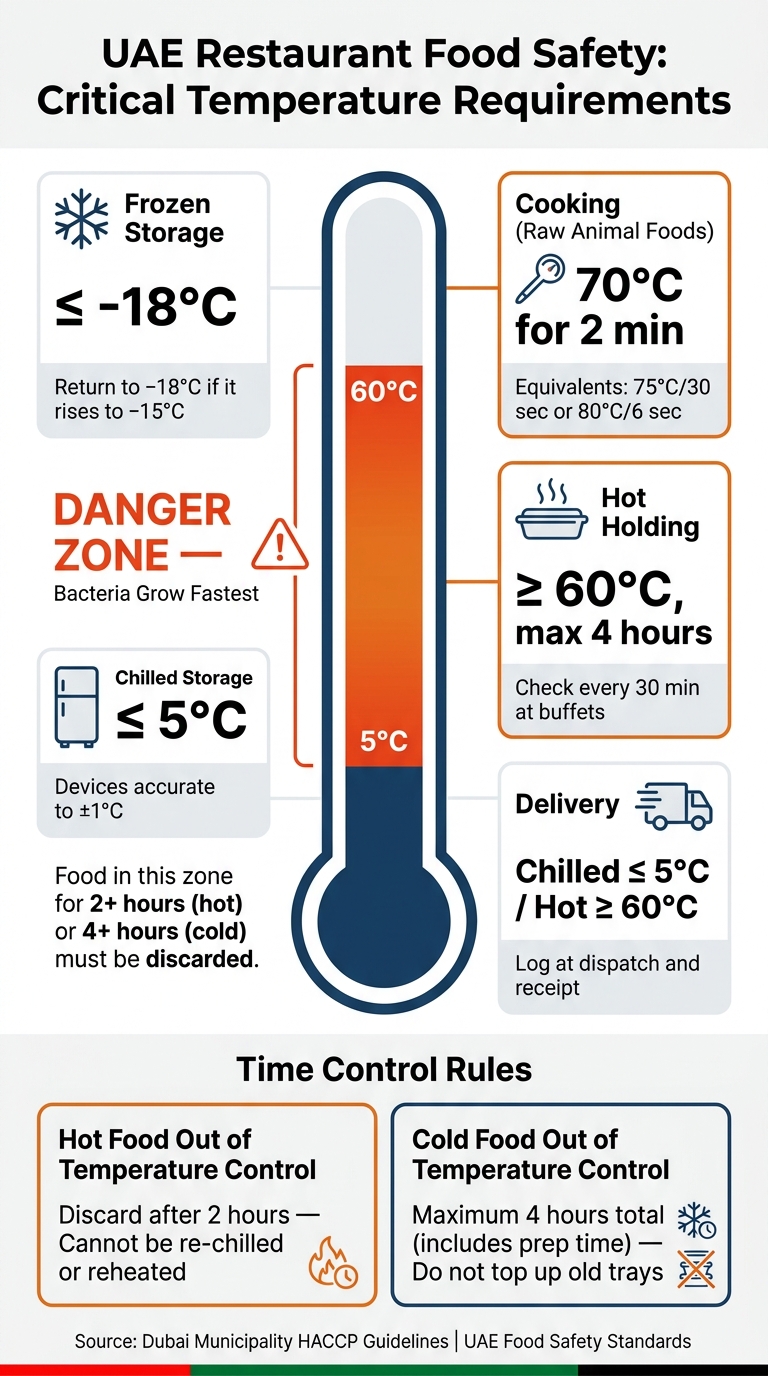
UAE Restaurant Food Safety Temperature Requirements at a Glance
1. Mandatory licences, HACCP systems, and inspection records
Trade licence, food establishment approval, and documented FSMS
The first compliance check is simple: get the paperwork right.
Before opening, you need a trade licence that lists the correct business activity, plus a food establishment permit from the local food authority, such as Dubai Municipality or ADAFSA. That permit shows the premises, kitchen layout, hygiene facilities, and daily operations meet the relevant food code.
You also need a written HACCP-based FSMS. This should cover hazard analysis, CCPs, critical limits, monitoring procedures, corrective actions, verification, and document control. Your SOPs, forms, and logs should be dated and kept in order. Critical limits must be clear and measurable, such as poultry cooked to at least 75 °C and chilled storage kept at 0–5 °C. Audit reports must be kept for at least three years.
Records inspectors expect to find on site
Inspectors don’t just want to see a system on paper. They want proof that it works every day.
Each CCP log should include:
- the date and time
- the measured value
- the staff member’s signature
- any corrective action taken
They also expect current temperature logs, receiving logs, calibration records, cleaning and disinfection schedules, pest control reports, health cards, and food safety training records. Supplier approval lists should show that suppliers are registered and approved through the municipality’s digital platform.
A certified PIC should be on duty for every shift to manage these records and deal with inspectors directly.
Digital compliance tools and kitchen design support
Records matter. But a kitchen still has to be set up in a way that makes compliance possible.
In Dubai, DMChecked and FoodWatch bring food safety records, plans, and live logs into one place. Suppliers must be registered on the platform, and pest control documents, including visit reports, corrective actions, and follow-up records, must be stored digitally. DMChecked also allows remote video inspections, which means inspectors can review records without being on site.
Silverline Kitchens designs commercial kitchens around HACCP, Dubai Municipality, and hygienic workflow rules, so the layout, equipment, and service areas support compliance from day one.
2. Food handling, storage temperatures, and personal hygiene rules
Required temperatures for receiving, storage, cooking, cooling, and hot holding
Once records and licences are sorted, inspectors turn to what happens in the kitchen and on the service line.
The main rule is simple: keep high-risk food out of the 5 °C to 60 °C danger zone, where bacteria grow fastest.
Cold storage has to stay under control at all times. Chilled food must be kept at 5 °C or below, while frozen food must stay at −18 °C or below. If frozen stock drifts up to between −15 °C and −18 °C, it must be brought back to −18 °C as soon as possible. For raw foods of animal origin, the Dubai HACCP guide sets 70 °C for 2 minutes as the standard cooking point, with approved equivalents such as 75 °C for 30 seconds or 80 °C for 6 seconds.
Hot food can’t just sit there indefinitely. Hot holding must stay at 60 °C or above, and the total holding time must not go past 4 hours. Cooked and chilled food should, in most cases, be used within 72 hours, and every container needs clear date coding.
Delivery checks matter too. Chilled items must arrive at ≤5 °C, and hot items at ≥60 °C. Temperatures should be logged at both dispatch and receipt. For buffets, record temperatures every 30 minutes and install sneeze guards on open stations.
| Stage | Required temperature | Key monitoring point |
|---|---|---|
| Frozen storage | ≤ −18 °C | Temperature log; return to −18 °C if it rises |
| Chilled storage | ≤ 5 °C | Temperature log; devices accurate to ±1 °C |
| Cooking (raw animal foods) | 70 °C for 2 min (or equivalent) | CCP log with time and probe reading |
| Hot holding | ≥ 60 °C, max 4 hours | Every 30 min during buffet service |
| Delivery (hot) | ≥ 60 °C | Log at dispatch and receipt |
| Delivery (chilled) | ≤ 5 °C | Log at dispatch and receipt |
Time control, cross-contamination prevention, and allergen separation
Temperature checks are only part of the picture. Once food slips outside safe limits, time becomes the next line of defence.
If high-risk hot food sits between 5 °C and 60 °C, it must be thrown away after 2 hours. It cannot be re-chilled or reheated for later use. High-risk cold food can remain out of temperature control for up to 4 hours, and that includes prep time. Staff need to track the full time food spends outside control. Also, don’t top up an old tray with new food. That’s a common mistake, and inspectors watch for it.
Cross-contamination controls need to be clear and consistent. Use colour-coded chopping boards and utensils, and clean and sanitise them between raw and ready-to-eat tasks. Raw ingredients should always be stored below ready-to-eat food in covered, labelled containers marked RAW or RTE. Slicers and mincers must be taken apart and sanitised before they are used for cooked or ready-to-eat food.
Allergen control now gets close attention during inspections. Dedicated utensils and equipment should be used for major allergens such as nuts, shellfish, and sesame. These ingredients should be stored in sealed, labelled containers away from bulk stock. Buffet labels must clearly show which major allergens are present, and serving utensils should stay with their own dish. Inspectors may ask the Person in Charge to explain how allergen labelling works and what controls are in place to stop cross-contact.
Health cards, hand washing, uniforms, and staff training
Food safety depends just as much on staff habits as it does on fridges, probes, and logs.
Every food handler must have a valid health card issued after medical screening. A register of cards and expiry dates should be kept on site and ready for inspection.
Staff with diarrhoea, vomiting, fever, jaundice, or infected wounds must be kept away from food handling until they are medically cleared. There should also be a written exclusion policy, plus a record of each decision to reassign duties or send an unwell employee home.
Hand-wash basins must be easy for staff to reach without having to cross prep zones. Hands must be washed between raw and ready-to-eat tasks. Gloves are not a substitute for hand washing.
Personal presentation is part of the inspection too. Staff must wear clean protective clothing, keep hair fully covered, and use beard nets where needed. Jewellery should be removed except for a plain wedding band, and perfume and loose accessories should be avoided. Dirty uniforms and missing head coverings are recorded as hygiene breaches, and they affect inspection scores directly.
Training records also need to stay up to date. They should show that food handlers have been briefed on temperature control, hygiene, and grooming rules. On every shift, a certified Person in Charge must check hygiene, allergen controls, and staff exclusion measures.
3. Cleaning, sanitation, pest control, and traceability controls
After temperature control and hygiene, inspectors move on to another big area: cleaning, pest control, and traceability. This is where paperwork and day-to-day practice need to match.
Written cleaning schedules and approved sanitation practices
Cleaning needs to follow a written schedule that sets out the task, method, chemical, dilution, contact time, frequency, and sign-off. Inspectors don’t just want to see a plan on paper. They want proof the work was actually done.
For food-contact surfaces, cleaning should follow six steps: pre-clean, detergent wash, rinse, sanitise, final rinse, and air-dry. The flow matters too. Cleaning should move from high-risk areas to low-risk areas so contamination doesn’t spread across the kitchen.
Use only authority-approved sanitisers, and keep safety data sheets plus dilution instructions on site. Staff should check sanitiser concentration with test strips, make sure surfaces stay wet for the full labelled contact time, and record dishwashing final-rinse temperatures and sanitation task completion on daily closing forms.
| Area | During service | Daily | Weekly / monthly |
|---|---|---|---|
| Prep counters and food-contact surfaces | Sanitise every 30 minutes or hourly during service | Full clean and sanitise | - |
| Cook line and equipment knobs | Wipe between tasks | Full clean | Deep clean behind equipment |
| Dishwashing area | Monitor rinse temperature | Full clean and sanitise | Deep clean |
| Cold rooms and refrigerators | - | Wipe exteriors; check seals | Deep clean |
| Dry store | - | Sweep and check for spillage | Deep clean |
| Bin room and external waste area | Empty bins as needed | Clean and disinfect bins | Deep clean |
Chemical products should be kept away from food and food-contact surfaces in a separate, clearly labelled chemical storage area, with locking where needed.
Once cleaning records are in place, the next focus is stopping pests before they get a foothold.
Municipality-compliant pest control and waste handling
Pest control should be managed as an IPM programme with a licensed contractor, structural proofing, monitoring, and full records. The contractor should hold a municipality licence. Service frequency is often monthly as a base level, but many high-risk, high-volume kitchens need visits every two weeks or even weekly, especially in warmer months.
Keep the signed contract, service reports, pesticide details, trap layouts, pest logs, corrective actions, and staff awareness records on site. In Dubai, guidance commonly expects the past 12 months of pest control records to be ready for immediate review on site. Inspectors also look at patterns. If the same pest issue keeps showing up, it needs to be investigated and fixed, not just sprayed and forgotten.
Small faults can cause big trouble. Gaps, leaks, weak waste control, and open bins can turn normal cleaning issues into repeat violations. Seal gaps around pipes, drains, and door frames. Keep internal waste bins covered, empty them through the day, and clean and disinfect them after each emptying. External waste should stay away from food prep and storage areas, with scheduled collection in place.
Supplier records, traceability, date coding, and allergen documentation
Traceability means being able to link each ingredient from supplier to service. In the UAE, restaurants should buy only from approved, registered suppliers and keep records that show that chain clearly.
Each delivery should create a receiving record with the supplier name and licence details, product description, batch number, delivery date and time, vehicle conditions, temperatures for chilled and frozen items, packaging integrity, and any rejected items. Prepared foods should be labelled with the product name, production date and time, use-by date, and storage area.
Temperature and calibration records must be kept for 3 years, while complaint and corrective-action records must be kept for at least 1 year.
| Record type | Key fields required |
|---|---|
| Supplier records | Supplier name and licence/approval status, product description, batch number, delivery date and time, quantity, receiving temperature and condition |
| Internal production records | Menu item or product name, ingredients and batch codes, production date and time, responsible staff, internal batch code, storage area, use-by date |
| Allergen documentation | Allergens present in each menu item, ingredient sources, cross-contamination controls, allergen matrix version and date |
If an ingredient is removed from its original packaging, its batch identity and traceability details should move to the internal label. That record trail helps the PIC isolate affected stock fast during complaints, recalls, or inspections.
Keep these files tidy and easy to pull up straight away for inspector review.
sbb-itb-19c3c9a
4. Inspection readiness and compliant kitchen design
Once records, temperatures, hygiene, and pest control are under control, the last test is simple: can the kitchen pass an unannounced inspection on any shift?
A pre-inspection checklist for restaurant managers
Municipal inspections are often unannounced, so the safest way to operate is to treat every day like inspection day. A weekly internal walk-through by the PIC or duty manager, using a checklist that matches municipality criteria, is one of the best ways to keep compliance on track.
That weekly review should check that core compliance files are current, easy to access, and ready to show straight away. Temperature logs should be complete, up to date, and signed, with any corrective actions clearly recorded. The PIC's certificate also needs to be available during the shift.
Daily checks should cover the basics that inspectors notice fast:
- Handwash stations are stocked
- Uniforms are correct
- Units are holding safe temperatures
- No staff with illness symptoms are handling food
A kitchen is much easier to manage when the layout helps staff do the right thing without extra effort.
How layout and equipment choices reduce food safety violations
A one-way flow from receiving to storage, prep, cooking, and service helps cut cross-contamination and lowers the chance of inspection findings. When the layout is poorly planned, staff end up relying on workarounds. That’s where problems start. Cleaning takes longer, movement gets messy, and contamination risks go up.
Dedicated hand-wash sinks in each work zone, kept separate from food-prep and dishwashing sinks, make hygiene controls far more practical on a busy shift. Cold rooms and refrigerators should have enough capacity to hold chilled high-risk foods at or below 5 °C and frozen items at or below −18 °C, while still leaving room for proper air circulation. Hot-holding units should keep food at 60 °C or above, with thermometers and logs close by for easy checking.
Drainage matters too. Proper slopes and correct grease-trap placement help stop standing water and make sanitation less of a headache. Non-porous, durable, easy-to-sanitise finishes lower the risk of contamination and pest issues. Storage shelving should also keep food at least 15 cm off the floor to meet storage hygiene checks.
How Silverline Kitchens supports compliance-focused kitchen projects

Kitchen design should cut down the violations inspectors flag most often. Silverline Kitchens designs HACCP-aligned layouts, drainage, ventilation, and easy-to-sanitise finishes that support compliance from day one.
Conclusion: The food safety standards every UAE restaurant must keep under control
UAE food safety compliance is not a one-off task. It’s a daily job, and enforcement is active across every emirate. In 2020 alone, Dubai Municipality logged 69,461 field inspections and issued 451 temporary closure orders. In Fujairah, inspectors confiscated 603 kg of spoiled or expired food across 1,285 inspections.
On the ground, those numbers reflect what staff do every single day. It starts with the basics: a valid trade licence, food establishment approval, and a HACCP-based FSMS that people actually use in day-to-day work, not one that sits untouched in a folder. After that, control depends on steady checks around temperature, hygiene, cleaning, and pest management. That’s the backbone of compliance in any UAE restaurant.
Just as important, those controls need to be written down. Supplier records, stock coding, and daily logs show that the system is working as intended. Inspectors aren’t only judging whether the kitchen looks clean at that moment. They want to see routines that staff follow again and again, with proof to match.
Layout plays a big part too. A kitchen can have good intentions and still create problems if the flow makes safe working habits hard to follow. Restaurants with disciplined records and a compliant kitchen setup are less likely to run into violations. When equipment placement and kitchen design cut contamination risk and make cleaning easier, staff can do the right thing with less friction, and inspectors have fewer site issues to pick up.
Keep licences current, review the FSMS on a regular basis, retrain staff, and stay up to date with municipality requirements.
FAQs
How often do UAE restaurant inspections happen?
In the UAE, restaurants go through regular inspections by authorities such as Dubai Municipality and the Abu Dhabi Agriculture and Food Safety Authority to make sure they stay compliant.
These visits happen on a routine, periodic basis. They sit alongside checks tied to trade licence approvals and food safety system audits. During an inspection, officers look at kitchen conditions, food handling practices, and records such as HACCP plans and temperature logs.
Who needs a health card in a restaurant?
In the United Arab Emirates, every restaurant team member who handles food must have a valid health card.
This card shows that the employee has completed the required medical screenings and is fit to work in a food-handling setting. Keeping these records up to date is a standard part of municipality inspections and local food safety compliance.
What records should I keep ready for inspectors?
Keep clear records for HACCP, day-to-day work, and safety compliance. In plain terms, you should be able to pull up the right document when an inspector asks for it.
That usually includes your HACCP plan, supplier audit records, official inspection reports, staff training certificates, and internal assessment records.
You’ll also want to keep daily records such as:
- Temperature logs
- Cleaning records
- Grease trap and waste disposal records
- Pest control documents
- Fire safety records
- A HACCP corrective action log for any deviations and the actions taken
Good recordkeeping does more than tick a box. It helps your team spot issues early, show that checks are being done, and prove that the right action was taken when something went off track.
