


Most Dubai kitchen inspection failures come from small daily misses, not one big problem. In H1 2025, Dubai Municipality made 34,700 food inspection visits, so weak routines are hard to hide.
If I had to sum up the article in one line, it would be this: you fail when control breaks down in storage, hygiene, equipment, or records.
Here’s the short version of what usually goes wrong:
-
Food temperatures drift out of range
- Chillers above 5°C
- Freezers warmer than −18°C
- Hot holding below 63°C
- Missing temperature logs or no corrective action noted
-
Food is stored the wrong way
- Raw food placed above ready-to-eat food
- Unlabelled containers
- Food kept on the floor instead of at least 15 cm up
-
Cleaning and staff hygiene slip
- No written cleaning schedule
- Empty hand-wash stations
- Poor handwashing
- Missing food-handler training records
-
Pest control records are weak
- Signs of pests under or behind equipment
- No monthly service record
- No licensed contractor file, bait map, or sighting log
-
Ventilation and grease build-up are ignored
- Steam, grease, or drips near prep and cooking areas
- Dirty filters and ducts
- Grease trap service records missing
-
Equipment is damaged or badly placed
- Cracked, rusted, or hard-to-clean surfaces
- Broken seals
- Equipment blocking drains or sitting outside hood coverage
-
HACCP and inspection files are incomplete
- Old HACCP plans
- No certified PIC on shift
- Missing calibration, supplier, Halal, allergen, or pest records
One point matters more than most: a kitchen can look clean and still fail if the paperwork is missing or out of date.
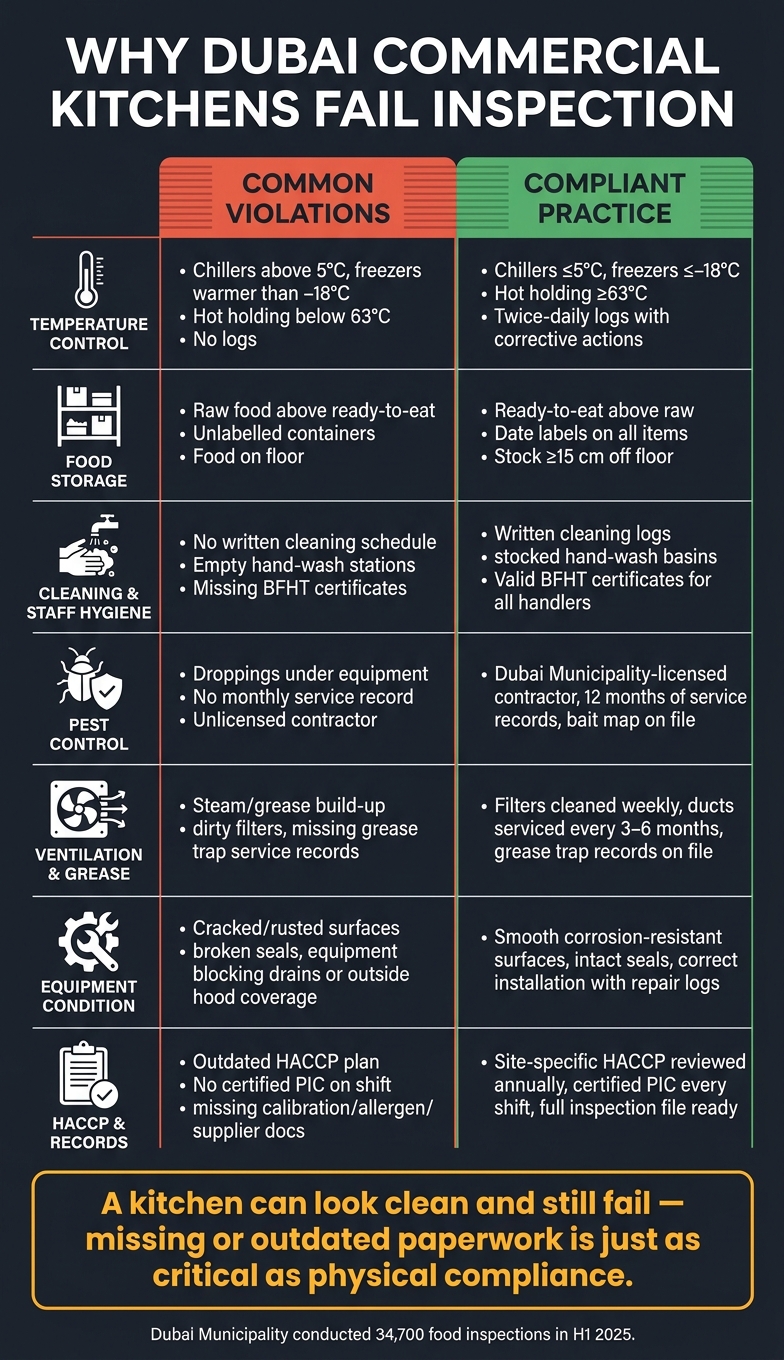
Dubai Commercial Kitchen Inspection Failures: Common Violations vs. Compliant Practices
Quick comparison
| Area | What inspectors often find | What you should have |
|---|---|---|
| Temperature control | Unsafe readings, no logs | Twice-daily checks, corrective actions |
| Storage | Raw over ready-to-eat, no labels | Clear separation, date labels, stock off floor |
| Hygiene | Dirty stations, poor handwashing | Cleaning logs, stocked hand-wash basins |
| Pest control | Droppings, no record trail | Licensed contractor, 12 months of records |
| Ventilation | Steam, grease, bad odours | Clean filters, duct service, trap records |
| Equipment | Rust, cracks, broken seals | Smooth cleanable surfaces, repair logs |
| Records | Expired or missing files | Current HACCP, PIC, training, supplier docs |
If you want to pass inspection in Dubai, the fix is simple: keep the kitchen inspection-ready every day, and keep the file ready to show at once.
sbb-itb-19c3c9a
Food storage and temperature control failures
Temperature and storage slips are some of the most common violations in Dubai kitchens. Inspectors often cite sites that can't show steady control, even when the equipment looks fine. In many cases, the issue isn't a major fault. It's weak day-to-day routine.
Chillers, freezers and hot holding outside safe temperature limits
Keep chillers at 5°C or below, freezers at −18°C or colder, and hot holding at 63°C or above. Food kept in the 5°C to 60°C danger zone can enter rapid bacterial growth.
Inspectors often flag chillers running above 5°C, poor freezer door seals, and hot holding below the safe limit. Overloaded units can create warm spots. And if probe thermometers are missing or not calibrated, staff can't check food properly.
One good reading on its own doesn't mean much. Without logs, you can't prove control. Keep temperature records twice a day and note the corrective action for any reading outside range. These records matter in the HACCP and inspection file.
Raw and ready-to-eat food stored incorrectly
Temperature control is only one part of the picture. Storage layout can trip up a kitchen just as fast.
Store ready-to-eat food above raw meat, poultry, seafood and eggs. If raw food drips onto cooked food, the cross-contamination risk is immediate. Inspectors flag this straight away because it's easy to spot and easy to prevent.
Label every item with the product name, production date and use-by date. Unlabelled containers, mixed old-and-new stock, and food stored on the floor are all common violations. Keep stock at least 15 cm off the floor.
Once storage is in order, inspectors usually move fast to cleaning, hygiene and pest control.
Cleaning, hygiene and pest control gaps
Inspectors often fail kitchens that can’t show daily cleaning, hygiene, and pest-control routines. And the trigger can be something small but serious: an empty hand-wash station, dirty food-contact surfaces, or pest droppings under the cooking range.
The good news? Most of these issues are preventable. What matters is simple: steady routines, staff discipline, and records that back up what your team is doing.
Missing cleaning schedules and poor staff hygiene
Dubai expects a written cleaning routine that clearly shows the right detergent, sanitiser, and sign-off. For manual cleaning and dishwashing, sanitising should be done with hot water at about 82°C for 30 seconds. If staff aren’t following a set process - or you have no written schedule to prove they are - inspectors will spot the gap fast.
Open-food prep areas must have a dedicated hand-wash basin stocked with liquid soap and single-use paper towels. Staff also need to wash their hands for at least 20 seconds at key moments:
- after using the toilet
- after handling raw food or waste
- before touching ready-to-eat food
If the soap dispenser is empty, or the hand-wash basin is being used for food prep, that alone can lead to a citation.
Inspectors don’t stop at sinks and surfaces. They also check uniforms, hair restraints, and food-handler certificates. Every food handler must hold a valid BFHT certificate from an EIAC-accredited provider. Missing or expired certificates - or not keeping an expiry-date register - are common paperwork failures. They’re also some of the easiest issues to fix before inspection day.
Keep these records ready and easy to show:
- daily cleaning logs
- chemical inventory
- grooming policy
- training records
- BFHT certificate copies
When cleaning standards drop, pest issues usually aren’t far behind.
Pest activity and incomplete pest control records
Any pest sign - droppings, live or dead insects, gnaw marks, or food debris in hidden spots - is treated as a high-risk violation. Inspectors don’t just look at what’s in plain sight. They check under equipment, behind fridges, around floor drains, and inside cupboard corners.
Dubai also requires pest control to be done only by Dubai Municipality-licensed companies. If you use an unlicensed contractor, or try to handle treatment in-house, that’s a violation on its own. The basic rule is monthly licensed treatment of kitchen and prep areas, with more frequent visits for high-risk sites.
Your file should include a licensed pest-control contract, 12 months of service records, a bait map, SDS sheets, and an internal sighting log reviewed by the PIC.
After hygiene and pest control, inspectors usually turn to ventilation, grease build-up, and equipment condition.
Ventilation, grease and equipment problems
Once hygiene and pest control are in shape, inspectors turn to heat, grease, and the condition of your equipment. This is where many kitchens slip up. A place can look clean at first glance, but if steam hangs in the air or grease is building up above the line, that will stand out fast.
Faulty exhaust systems and poor grease management
A weak or poorly maintained extraction system is a common inspection failure point in Dubai commercial kitchens. Mechanical or mixed ventilation must stop grease and condensation from building up on walls and ceilings or dripping onto food or food-contact surfaces. If inspectors spot visible steam during service, droplets on light fittings, or a greasy film on ceiling areas, they will treat that as poor extraction or unbalanced make-up air.
Grease control also needs to be planned and recorded, not handled ad hoc. Hood canopies should be cleaned daily, grease filters washed weekly, and ductwork and fans serviced every 3–6 months based on cooking load. Grease traps must be emptied and cleaned at the required intervals by an approved waste company, and the service reports need to stay on file.
| Common failure | Compliant practice |
|---|---|
| Filters missing, damaged, or hard to remove | Baffle filters that are easy to remove and cleaned weekly |
| Grease dripping from hoods or ducts | Smooth, clean hood surfaces with no condensate or drips |
| Grease trap inside a food-prep zone or overflowing | Correctly sized trap located away from food areas, serviced by an approved contractor |
| No documented cleaning schedule | Written daily/weekly logs and third-party service reports on file |
Blocked grease traps, slow drains, and odours from the waste area are all red flags inspectors notice straight away. If staff hear gurgling or spot slow drainage, book maintenance before inspection day. That small delay can turn into a failed visit.
Damaged or non-compliant kitchen equipment
Equipment condition gets close attention because damaged surfaces give bacteria and pests places to settle. Dubai Food Code says food-contact surfaces and equipment must be smooth, non-absorbent, corrosion-resistant, and easy to clean. Cracked worktops, rusted stainless steel, broken door seals, and exposed insulation all count as non-compliant.
Installation matters too. Appliances placed outside the hood coverage area, equipment blocking floor drains, or gas connections that do not meet Civil Defence standards all add food and fire risk. And when equipment is awkward to clean because of where it sits, or because it has worn down over time, grease and food debris start building up in the spots no one can reach properly.
A weekly kitchen check helps catch these issues early. Look for cracked surfaces, rust spots, broken seals, and wear around hinges, handles, and edges. Log each issue, fix what you can, and replace items that are past repair. Keep those repair and service records with your inspection file.
HACCP and inspection records that are often missing
Once the kitchen clears the physical checks, inspectors usually turn to the paperwork. That’s where many sites slip. A kitchen can look spotless and still fail if the records don’t show day-to-day control. Record-keeping is also a legal requirement under Federal Law No. 10 of 2015.
HACCP programme, PIC certification and daily logs
These records back up the controls inspectors have already checked, including storage, hygiene, pest control, ventilation and equipment.
One common issue is an HACCP plan that hasn’t been touched since the licence was first approved. Inspectors expect a current, site-specific HACCP system, reviewed every 12 months and updated after any change to the menu, process, equipment or layout. A generic template with no site detail is treated as non-compliance.
PIC certification is just as important. Every food establishment must have at least one full-time, on-site Person in Charge who is certified in food safety. High-risk operations must have a certified PIC on every shift. The certificate stays valid for five years, must be registered in Foodwatch, and must be available on site. If the PIC leaves, the business must appoint a replacement within 30 days and get that person certified within about 45 days.
Daily logs often fail for simple reasons: they’re incomplete, unsigned, or written up later instead of at the time. Inspectors expect records for chillers, freezers, hot holding, cooking, cooling and reheating at the required intervals, with corrective action noted for every breach. These records should be easy to pull out in one inspection file, not scattered across drawers, clipboards and someone’s desktop.
| Record | What inspectors expect | Common gap |
|---|---|---|
| HACCP plan and flow diagrams | Current, site-specific, reviewed within 12 months | Outdated consultant template, no annual review |
| PIC certificate and registration | Valid certificate, Foodwatch registration, PIC on duty | Expired certificate, no certified PIC on shift |
| Temperature and cooking/cooling/reheating logs | Complete, signed, dated records with corrective actions | Missing entries, no corrective actions, logs prepared on inspection day |
| Thermometer calibration records | Dated calibration checks for all probes and devices | No calibration records or undocumented checks |
| Supplier and Halal documentation | Approved supplier list, delivery records, valid Halal certificates | Unapproved suppliers, incomplete traceability, missing Halal certificates |
| Pest control records | Current contract, visit certificates and signed internal sighting log | Missing certificates, no logbook, unclear actions between visits |
| Allergen matrix and controls | Documented allergens per dish, staff training records | No allergen register, untrained staff |
How to put together a pre-inspection compliance file
The easiest way to handle this is to build one inspection-ready file. Keep everything in a clearly labelled physical file or digital folder, and arrange it in the same order an inspector is likely to review it.
Start with licences and permits. Then place the HACCP section straight after that: the plan, flow diagrams, hazard analysis, CCP table, monitoring forms, corrective action records and the latest annual review notes.
Next, keep a PIC and training section. This should include the PIC nomination confirmation from Foodwatch, the PIC certificate, a shift roster that shows certified PIC cover, and Basic Food Hygiene Training certificates with expiry dates for all food handlers. Occupational Health Cards for food handlers should also be current.
The operational records section should include:
- Calibration logs
- Signed cleaning checklists
- Maintenance reports for critical equipment
- Pest control records
- Supplier approval lists
- Delivery dockets with batch codes
- Halal certificates
- The allergen matrix
- Complaint or incident logs
Give the PIC clear ownership of the file and set a monthly file check as a fixed task. It also helps to mirror paper records in Foodwatch and DMChecked. A paper-only setup tends to look weaker during inspection.
Conclusion: Fix the common failure points before inspection day
Most Dubai kitchen inspection failures come back to the same issues: unsafe temperatures, poor storage, weak cleaning, pest entry points, poor ventilation, damaged equipment, and missing records.
Once your records are sorted, the next job is keeping the kitchen inspection-ready every single day. Compliance should be part of the daily routine, not a scramble the night before. Update temperature logs, cleaning checklists, pest records, and maintenance reports each day, and store them together in one inspection file.
Records matter, but the kitchen setup matters just as much. Clear raw and ready-to-eat zones, enough refrigeration, and properly specified exhaust systems help cut daily compliance risk and keep the kitchen inspection-ready all year. Regular audits, planned maintenance, and on-time upgrades also help reduce the risk of fines, delays, and closure orders.
FAQs
How often should I check kitchen temperatures?
Check and record refrigerator temperatures at least twice daily to meet HACCP standards and Dubai Municipality requirements.
That’s the baseline. On top of that, staff should keep an eye on equipment during the day for temperature swings or any odd performance. If the temperature shifts by more than 1°C, act fast. And make sure temperature logs stay current, as they may be reviewed during municipal audits.
What records should I keep ready for inspection?
Keep full, current records for your HACCP-based food safety system. That means logging each critical control point properly, including fridge and freezer temperature checks twice a day.
You should also record any temperature deviations, what action was taken to fix them, and who dealt with the issue. On top of that, keep calibration records for thermometers and timers, and make sure your HACCP plan stays up to date.
One thing matters a lot here: complete monitoring logs in real time. Don’t fill them in later or backdate them.
Can a clean kitchen still fail inspection?
Yes. A kitchen can fail a Dubai Municipality inspection even if it looks clean, because inspectors look at much more than what’s visible on the surface.
A tidy kitchen might still have gaps that matter. Common reasons for failure include missing records, poor control of food storage temperatures, no certified Person In-Charge, weak grease trap or exhaust upkeep, and structural problems such as non-compliant layouts, low ventilation, or missing fire safety equipment.
