


Commercial kitchen costs in the UAE can jump fast, and most of that jump comes from layout mistakes, overspending on equipment, and late approvals.
If I wanted to keep build costs under control, I’d focus on 8 simple moves:
- Plan for UAE approvals from day one
- Tighten the layout to cut MEP work
- Buy equipment for actual demand, not guesswork
- Pick lower-power appliances to trim utility bills
- Use refurbished items only where approval risk is low
- Delay noncritical purchases until after opening
- Spend more on hard-wearing finishes in wet, high-use areas
- Coordinate ventilation, fire safety, and authority submissions early
Here’s why that matters:
- A small cloud kitchen may cost AED 80,000 to AED 150,000
- A larger kitchen can go past AED 300,000
- Equipment often takes 45% to 55% of the budget
- Ventilation often adds another 15% to 20%
- Rework from bad drawings or late changes can add 10% to 15%
In plain terms: the cheapest kitchen build is usually the one that avoids doing work twice.
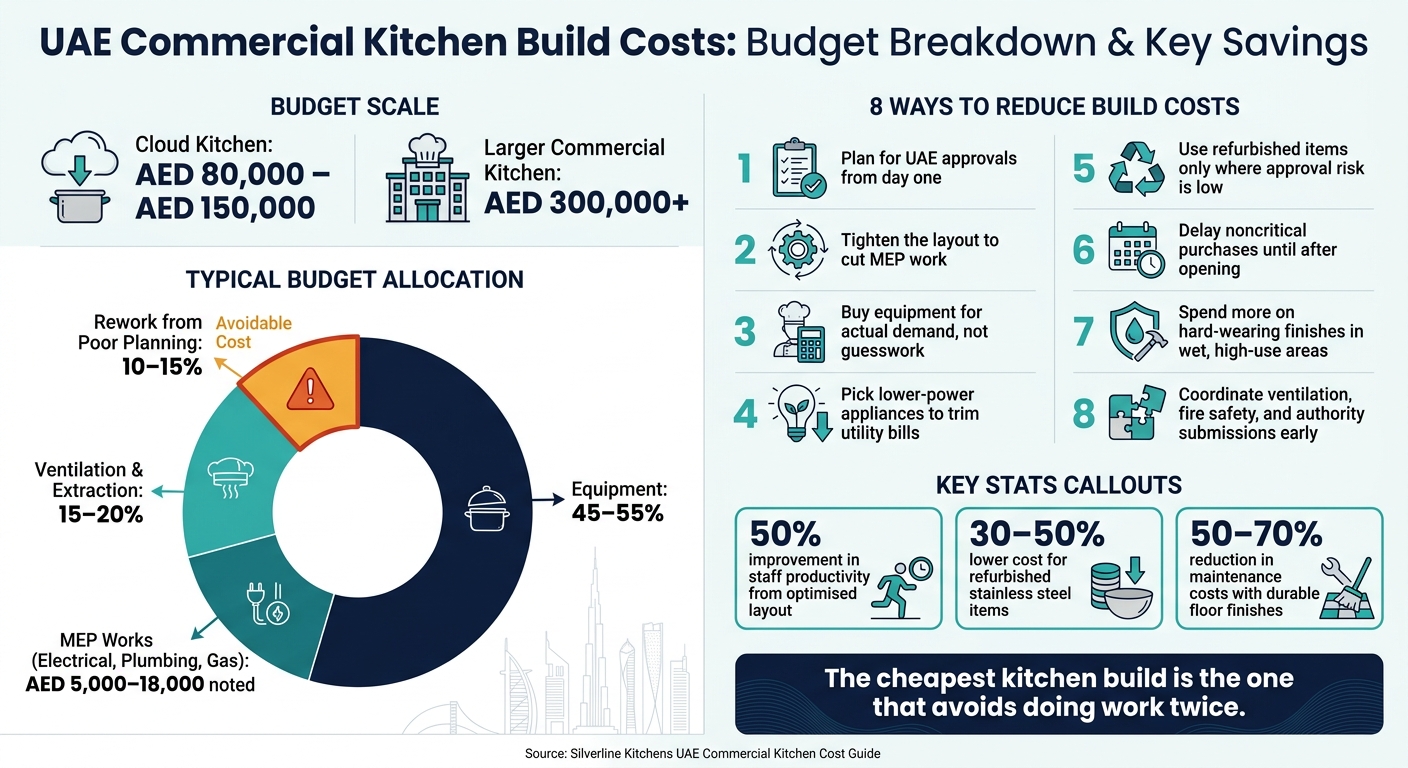
UAE Commercial Kitchen Build Costs: Budget Breakdown & Key Savings
Quick comparison
| Cost-saving move | Main cost it cuts | Main risk it lowers | Main long-term effect |
|---|---|---|---|
| Early UAE-compliant planning | Rework, change orders | Approval rejection | Better workflow |
| Better kitchen layout | MEP and fit-out spend | Redraws and site changes | Less wasted movement |
| Right-sized equipment | Overbuying | Capacity or food-safety issues | Lower power use |
| Energy-efficient appliances | Utility and cooling load | Mismatch with approved loads | Lower monthly bills |
| New vs refurbished buying | Upfront equipment spend | Inspection and breakdown risk | Repair and energy costs |
| Phasing noncritical items | Opening-day cash out | Delaying needed items by mistake | Better cash flow |
| Durable finishes | Early replacement | Failed hygiene checks | Lower cleaning and repair spend |
| Early ventilation and fire coordination | Duct and ceiling rework | Civil Defence issues | Better system performance |
If you’re building in the UAE, the short version is simple: lock the design, approvals, services, and equipment list early, then spend only where it protects opening date, compliance, and running costs.
What Drives Commercial Kitchen Costs in the UAE
Commercial kitchen costs in the UAE usually come down to a few big pieces: design approvals, MEP works, extraction and fire suppression, equipment, finishes, and day-to-day running costs. The catch is that these costs don’t sit in neat little boxes. They affect each other. One poor call early on can push up spend somewhere else later.
Equipment is the biggest single cost, and it usually takes up 45% to 55% of total project spend. Ventilation and extraction come next at around 15% to 20% of the budget. In the UAE, that part carries even more weight because of the intense heat and humidity. A mid-sized restaurant kitchen may need ventilation sized for up to 10,000 cubic metres of air per hour. That’s a serious system, not a minor add-on. The next sections show how these savings show up on actual projects.
MEP works are another area where costs can creep up fast. Electrical panel upgrades, three-phase power connections, and grease trap installation all add to the bill. On their own, MEP works can range from AED 5,000 to AED 18,000 depending on site conditions. If the layout wasn’t coordinated with the MEP contractor from day one, that number can jump in a hurry.
Approvals also play a big part. In the UAE, the process changes by emirate and may involve Dubai Municipality, Civil Defense, DEWA, or ADAFSA. If drawings are late or inaccurate, you’re not just dealing with paperwork. You’re dealing with resubmissions, site rework, and rent on a space that’s leased but still not open for business. Those delays can add 10% to 15% to the total budget.
Cheap choices can also cost more later. Materials that don’t handle moisture well can warp or swell in high-heat, high-steam kitchen areas, which may lead to full replacement within a few years. Equipment that uses more power than needed pushes up utility bills and adds extra load to the building’s cooling system. Savings only hold up when design, equipment, and approvals are planned together. The next sections break these costs into practical decisions that cut spend without forcing redesigns. The biggest savings start before construction begins.
1. Work with Silverline Kitchens for Early UAE-Compliant Planning
Most kitchen budget blowouts in the UAE begin before site work starts. The early concept stage is where costs either stay under control or start drifting. If you plan for UAE approvals from day one, you give the project a much better chance of staying on track. That’s why early compliant planning is the first smart cost-control step.
Upfront AED Savings
Submitting coordinated layout drawings early helps avoid rework that can add 10% to 15% to the project budget. That’s not a small hit. Silverline Kitchens can coordinate grease trap planning, stainless steel fabrication, and MEP requirements early, which cuts down on late change orders.
Lifecycle Operating Cost Impact
Early planning also helps the kitchen run better after handover. Clear zoning for prep, cooking, plating, and storage reduces cross-traffic and helps size the ventilation system to match the actual cooking load. A well-planned layout can improve staff productivity by up to 50%. Over time, that can ease labour pressure and cut mistakes during service.
UAE Compliance Risk Reduction
In the UAE, approvals shape the programme. A rejected drawing from Dubai Municipality or Civil Defence can delay a project by at least two weeks. Early planning helps make sure the layout, finishes, and utility requirements match the right authority from the start. And this part matters: rules can change by emirate, free zone, and landlord, including contractor lists and inspection criteria.
Effect on Opening Timeline
A standard commercial kitchen fit-out in the UAE takes 16 to 24 weeks when approvals and design move in parallel. Starting approvals on day one keeps design, food-control submissions, and fire-safety reviews moving at the same time. That reduces redesign work, which often pushes opening dates further out.
Once approvals are aligned, the next savings come from optimising the layout to cut MEP and fit-out costs.
2. Optimise the Kitchen Layout to Cut MEP and Fit-Out Costs
Once approvals are in motion, the layout becomes your next big cost control point. Equipment placement shapes how much plumbing, drainage, gas and electrical work the space will need. Put things in the wrong spots, and pipe, cable and duct runs get longer fast. That’s why layout has such a direct effect on MEP and fit-out waste.
Upfront AED Savings
One practical way to bring down fit-out spend is zone-based planning. Keep prep, cooking, plating and storage in clear areas so services stay grouped instead of spreading across the full floor plan.
For example, placing dishwashing, prep sinks and wash areas together keeps drainage and water supply in one part of the kitchen. That cuts the amount of pipework needed under the floor. In the same way, lining up heavy cooking equipment along one wall or a central island helps bring gas and electrical points into one cluster. Shorter service runs usually mean lower labour, material and coordination cost.
Lifecycle Operating Cost Impact
A well-planned layout does more than reduce the day-one bill. It also makes the kitchen easier to run. Clear circulation trims walking time, reduces service hold-ups and makes cleaning less of a chore.
There’s also the ventilation side. When cooking equipment and ventilation hoods are lined up properly, the extraction system is easier to size with accuracy. In the UAE, ventilation systems usually make up 15% to 20% of total kitchen build spend, so avoiding an oversized setup can save a fair amount.
Modular equipment on casters can help too. If the menu shifts or service volume changes later, mobile units are simpler to move. That can reduce the need for permanent MEP rerouting, which often comes with a high price tag.
UAE Compliance Risk Reduction
Grease trap access and handwashing stations need to be built into the layout from the start. Leave them too late, and small mistakes can turn into expensive rework. The Dubai Universal Design Code also requires aisles to be at least 1.2 metres wide for safe staff movement.
Designing aisle widths, sink positions and grease trap access around these rules from day one helps avoid redraws and site changes. Late layout revisions can add 10% to 15% to the total budget.
Effect on Opening Timeline
It also pays to verify site dimensions before submission. If fire-safety drawings don’t match the actual ceiling height on site, Civil Defence may ask for a re-submission. That can leave you paying rent on a unit that still hasn’t opened.
Checking measurements before drawings go in helps lower that risk and keeps the approval process on track.
Once the layout is fixed, the next savings come from choosing equipment that fits the menu load.
3. Right-Size Equipment to Match the Menu and Service Volume
Once the layout is locked, equipment sizing becomes one of the biggest cost levers in the project. In a UAE commercial kitchen build, equipment often makes up 45–55% of total spend. And this is where small mistakes get expensive fast.
If you go too big, you pay more upfront, use more power, and increase ventilation load. Go too small, and service slows down when demand spikes. On top of that, food may sit outside safe holding temperatures during busy periods.
Upfront AED Savings
Start with demand forecasting, not a best-case fantasy or a theoretical maximum. Look at your daily output, peak covers or orders, menu complexity, storage needs, and service style before choosing equipment. The goal is simple: match the equipment list to how the kitchen will actually run.
A practical rule is to size the equipment list for 20% above projected peak demand. That gives you some breathing room without pushing you into a larger and more expensive spec than the operation calls for. It also keeps procurement tied to the build sequence instead of drifting off course.
Lifecycle Operating Cost Impact
Right-sized equipment helps you avoid paying to run and cool capacity you don't use. That's the hidden drain many operators miss. A bigger unit doesn't just cost more to buy. It can also cost more every day it sits there half-used.
When refrigeration, cooking, and holding capacity match the business mix, the kitchen runs with less waste through slower periods. Put plainly: don't buy spare capacity you'll power and cool every single day.
UAE Compliance Risk Reduction
Undersized refrigeration, cooking, and holding equipment can struggle to maintain temperature control at peak load. That's where food safety risk starts to creep in, and in the UAE, that can lead to municipal compliance issues.
Careful capacity planning helps equipment stay stable during busy service windows, when the pressure is highest and margins for error are slim.
Effect on Opening Timeline
Lock in equipment specifications early so the layout can be aligned with Civil Defence and Food Control Department approvals. If sizing changes late, the knock-on effect is hard to ignore: substitutions, redraws, and procurement delays.
Early coordination keeps the project moving and cuts the rework costs that come from poor planning.
4. Choose Energy-Efficient Appliances to Lower Utility Bills
In the UAE heat, energy-efficient equipment can cut utility bills and reduce the cooling strain inside the kitchen. Once your equipment list is locked, efficiency becomes the next big cost call. Size affects capacity. Efficiency affects what you keep paying every day.
Upfront AED Savings
Efficient appliances give off less heat. That can shrink the hood size, shorten duct runs, and lower the cooling load. In plain terms, a cooler kitchen may need less extraction work, which can trim fit-out spend before opening.
Lifecycle Operating Cost Impact
Low-energy refrigeration and LED lighting reduce daily power use and help control long-term operating costs.
UAE Compliance Risk Reduction
Utility savings are only part of the story. Appliance specs also shape approval drawings and inspection sign-off. If the equipment does not match the approved electrical load and fire-suppression design, you could end up doing rework during inspection.
Effect on Opening Timeline
Send appliance data sheets early so municipal review doesn't slow down procurement or handover. A review window of 5–10 working days is a smart allowance.
5. Compare New vs Refurbished Equipment by Risk and Payback
Refurbished equipment can cut costs, but only if maintenance, energy use, and approval risk stay under control. So yes, price matters. But the real payback comes from the full picture: what it costs to run, how often it needs service, and whether it clears approvals without drama. That’s why refurbished equipment is a risk-based call, not an automatic saving.
Upfront AED Savings
Refurbished units can cost 30–50% less than new equivalents. That kind of saving is easiest to defend on simple stainless steel items like prep tables and shelving.
Powered equipment is a different story. The sticker price may look lower at first, but the gap can narrow once you add delivery, installation, testing, and any electrical work needed to suit the building load. A unit that seems like a bargain can end up costing more than expected before it’s even switched on.
Lifecycle Operating Cost Impact
Older refurbished appliances usually use more power. In a UAE kitchen, that extra consumption builds up over time. If the equipment runs all day, small gaps in power draw don’t stay small for long.
You also need to budget for more frequent servicing and parts that may be hard to find, especially for discontinued models. And in a commercial kitchen, downtime isn’t just annoying. It hits revenue directly.
UAE Compliance Risk Reduction
Extraction systems, gas appliances, fire suppression units, and mechanical ventilation must meet UAE Civil Defence Fire Life Safety (FLS) requirements and Dubai Municipality Food Code standards. A refurbished unit may not come with the paperwork needed for approval. If that documentation is missing, you could face resubmission and delays to opening.
"Every kitchen we deliver is built to meet UAE Food Code and Dubai Municipality standards, ensuring smooth inspections and approvals." - Silverline Kitchens
New equipment from a UAE supplier usually comes with a 2-year warranty and aftercare, and it is more likely to pass approval the first time. That matters when opening dates are tight and rent, payroll, and fit-out costs are already ticking away. Once the approval-critical items are locked in, you can phase noncritical purchases later.
Effect on Opening Timeline
Locally available refurbished stock can look like a fast fix, especially when new imported units may take 6–12 weeks to arrive. On paper, that sounds like an easy way to save time.
But there’s a catch. If a refurbished appliance fails inspection or needs changes to meet current standards, the delay from redesign and re-approval can wipe out the early saving. In practice, it makes more sense to buy new equipment for extraction, gas, fire suppression, and ventilation, and keep refurbished purchases for low-risk stainless steel items.
sbb-itb-19c3c9a
6. Phase Noncritical Purchases Without Delaying Opening
Once your high-risk equipment choices are set, the next place to save is simple: delay only the items that don't affect inspections or opening day.
Not every item has to be installed before you unlock the doors. A smart way to trim upfront spend is to split purchases into day-one and phase-two items. That helps you spend less at launch without slowing down compliance. The line is clear: hold back secondary items, but don't touch anything linked to approvals or safe operation.
Upfront AED Savings
Deferring noncritical items can free up cash right when pressure is highest - just before opening, when rent, payroll and supplier deposits are all pulling from the same budget.
Good phase-two candidates often include:
- Modular prep stations
- Specialised appliances for secondary menu items
- Secondary cabinetry
If your expected day-one volume doesn't support a high-capacity unit, it's often smarter to wait until actual demand shows you need it.
Lifecycle Operating Cost Impact
Use demand forecasting to work out the minimum equipment needed for the first three months of trading. Then keep phase-two purchases tied to menu expansion, not core service capacity.
UAE Compliance Risk Reduction
Some items should never be deferred. That includes grease traps, ventilation, fire suppression, non-absorbent surfaces, handwashing stations and core MEP work - including DEWA-compliant electrics, plumbing lines, gas lines and drainage. Miss any of these, and you could end up with rework costs of 10% to 15% of the project budget.
Effect on Opening Timeline
If compliance-critical items are confirmed and the main MEP work is done, delaying noncritical purchases should have no effect on your opening date.
The critical path still stays the same: inspections, approvals and core fit-out. What changes is the amount of cash you need on opening day.
Next, cut long-term spend by using durable finishes in the highest-wear areas.
7. Use Durable, Low-Maintenance Finishes in High-Wear Areas
Finish choices affect costs for years. In a UAE commercial kitchen, the wrong surface can push cleaning spend up and lead to early replacement. So this isn’t just a design call. It’s a budget call too.
Upfront AED Savings
Tiles and basic roll-on epoxy can look cheaper at the start. But in high-traffic kitchens, they often end up costing more over time.
Basic roll-on epoxy usually costs AED 80 to AED 180 per m² installed, but it often fails within two to three years in busy UAE kitchens. Self-levelling epoxy, on the other hand, costs around AED 150 to AED 320 per m² at 3 to 6 mm thick and can last 8 to 15 years under heavy use.
In wet areas like cooking lines and dishwashing zones, anti-slip epoxy costs AED 200 to AED 380 per m² and tends to give better long-term value.
Lifecycle Operating Cost Impact
The right floor system can cut maintenance budgets by 50% to 70% over its lifespan. That gap matters.
A seamless, non-porous surface is easier to clean, needs fewer chemicals, and tends to need fewer repairs. It’s the sort of choice that keeps paying you back month after month.
The same idea applies to fixtures that take a beating every day. Grade 304 or 316 stainless steel costs 30% to 50% more than mild steel, but it can last 10 to 15 years in the UAE’s humid climate.
UAE Compliance Risk Reduction
Dubai Municipality and ADAFSA require kitchen floors to be impervious, seamless, smooth, and sloped to drainage. Floor-to-wall junctions should also be coved, which helps remove corners where dirt and bacteria can build up.
Wet zones should meet R10 to R13 anti-slip ratings under UAE occupational safety rules. If finishes don’t meet those standards, you could end up with failed inspections and costly emergency rework. Using HACCP-aligned finishes makes auditor sign-off much easier.
Once finishes are fixed, the next avoidable cost usually comes from late coordination of ventilation, fire safety, and approvals.
Effect on Opening Timeline
Self-levelling epoxy usually needs 1 to 5 days to cure, so that time has to be built into the fit-out programme. Miss that window, and other works can start tripping over each other.
A common mistake is skipping proper subsurface preparation, such as shot-blasting or grinding the base. That shortcut can lead to bubbling and peeling within two to three years. Build curing time into the programme early so floor works don’t clash with ventilation, fire safety, and approvals.
8. Coordinate Ventilation, Fire Safety and Approvals Early to Avoid Redesigns
Once the layout is set and the equipment is sized, the next place costs can spiral is services coordination. If ventilation and fire safety are handled late, you often end up with rerouted ducts, altered ceilings, and another round of submissions. That can hit hard, with redesign-related costs reaching 10% to 15% of your total build spend.
Upfront AED Savings
Get coordinated ventilation and fire-safety drawings submitted at concept stage, not after the fit-out is already under way. This matters because ventilation alone makes up 15% to 20% of total kitchen build spend.
That means grease duct routing, hood positions, and the make-up air plan need to be locked in before site work starts. If those decisions come late, changes on site can get expensive fast. Early coordination cuts down on rerouting and repeat submissions, which is where the AED savings often show up first.
Lifecycle Operating Cost Impact
Ventilation should be designed around the actual cooking load from day one. In a mid-sized UAE restaurant, the system may need to move up to 10,000 m³ of air per hour. That is not a small detail. It affects equipment choice, duct sizing, power demand, and how the kitchen performs during service.
Built-in refrigeration also needs its own airflow and clearance. Without that, units can overheat in extreme UAE summer temperatures, which puts strain on the system and can lead to avoidable operating issues.
UAE Compliance Risk Reduction
Fire suppression, DEWA-compliant electrics, and ventilation need to line up before submission. If they do not, late changes to duct runs, ceiling structures, or suppression layouts can become expensive and slow to fix .
In plain terms, one drawing decision can knock into three other trades. That is why early coordination matters so much in UAE fit-outs, where approvals and site execution are tightly linked.
Effect on Opening Timeline
A full restaurant fit-out in the UAE usually takes 16 to 24 weeks, and kitchen extraction and food-control approvals sit on the critical path. If you start authority submissions with the first coordinated drawings, you have a better shot at avoiding the back-and-forth of resubmissions.
Those early coordination calls on hoods, ducts, electrics, and fire systems often decide whether the project moves cleanly or loses weeks to changes on site.
Comparison Tables to Support Budget Decisions
The tables below help you compare the spend choices that carry the most risk. Start with equipment. Then use the finish table to spot the difference between actual savings and the kind that come back to bite you later.
New vs Refurbished Equipment
For safety-critical items, buy new. Refurbished can work, but only for non-mechanical items where approval risk is low.
Use this table to pick the lowest-risk option for each line item.
| Equipment Type | New Purchase Pros | Refurbished Pros | Key Risks (Refurbished) | Best Use Case |
|---|---|---|---|---|
| Extraction & Fire Safety | Guaranteed Civil Defence/FLS compliance | Lower upfront cost | Approval failure; fire hazard | Always buy new |
| Stainless Steel Tables | Custom sizing for layout | Major AED savings | Minor surface scratches | Prep areas and storage |
| Grease Traps | Meets DM Technical Guideline No. 13 | Lower upfront cost for non-permanent sites | Corrosion if mild steel; leaks | Permanent kitchens |
| Refrigeration | Precise temperature control; lower MEP load; warranty support | Lower initial investment; immediate availability | Seal failure; high energy consumption; hygiene risk | Backup storage; non-critical prep zones |
Finish Materials
The same rule applies to surfaces: a lower upfront price only helps if the material holds up over time.
Use this table to choose the lowest-risk option for each line item.
| Material | Typical Cost Range (AED) | Cleaning Demand | Expected Lifespan | Hygiene & Compliance Notes |
|---|---|---|---|---|
| Self-Levelling Epoxy | AED 150–320 / sqm | Very low (seamless) | 8–15 years | DM/ADAFSA aligned; NSF-certified options available |
| Anti-Slip Epoxy | AED 200–380 / sqm | Moderate (grit texture) | 8–12 years | Needed for wet zones and wash-up areas |
| Porcelain/Ceramic Tiling | AED 6,000–20,000 (project) | High (grout lines) | 5–10 years | Grout traps bacteria; prone to cracking under heavy impact |
| Stainless Steel Worktops | Custom fabrication | Low (wipe-down) | 15+ years | Industry standard; heat-resistant; fully disinfectable |
| Quartz/Granite | AED 150–600 / sqm | Low | 10–20 years | Best for light prep only; can chip in heavy commercial use |
The next section covers the mistakes that usually wipe out these savings.
Common Mistakes That Increase Kitchen Build Costs
Most kitchen cost blowouts come back to five mistakes you can avoid: procurement, layout, ventilation, materials, and load planning. One thing links all of them. If you disrupt the build sequence, the savings from a smart design can disappear fast.
Ordering equipment before approvals are final is one of the costliest errors in UAE kitchen fit-outs. It locks cash into items that may need to be replaced or reordered later. Once approvals are in place, procurement should follow the approved drawing set, not an earlier draft.
Placing refrigeration units next to heat-generating equipment adds operating cost you don’t need. Refrigeration should sit away from fryers, ovens, and dishwashers. Heat exposure pushes up power use and cuts equipment life. The sticker price may look similar, but the long-term cost tells a different story.
Undersizing make-up air leads to weak extraction and can overload the HVAC system. A mid-sized UAE restaurant may need ventilation sized for up to 10,000 m³/h. When duct sizing and air balance aren’t planned well, the result is noise, poor extraction, and HVAC strain. It can also lead to unplanned electrical panel upgrades after handover. Ventilation takes up 15–20% of the total kitchen budget, so it needs to be treated as a core design item, not something to sort out later.
Choosing cheap, short-life materials only looks like a saving on day one. Low-cost MDF, laminates, and generic veneers can swell, peel, and fail under steam and deep cleaning. The better value comes from materials that last longer and cut rework.
Ignoring electrical load planning creates costs that often stay hidden until late in the project. Missing total load data can force unplanned panel upgrades. When load planning is missed, those upgrades often happen mid-project, when changes are harder and more expensive.
Avoiding these errors helps protect both the budget and the opening date. Fix them early, and the savings from earlier design decisions are far more likely to stay intact through handover.
Conclusion
The lowest-cost kitchen builds in the UAE come from making the right calls on layout, MEP, ventilation, fire safety, and equipment from day one. Once rework starts, early savings can disappear fast. Oversized systems do the same thing.
Every saving covered in this article comes back to one idea: coordinate the design, approvals, and equipment before any work begins. That early planning keeps costs under control. Leave changes until later, and those savings often turn into redesigns, panel upgrades, and approval delays.
The aim is simple: build a compliant kitchen that opens on time and runs well at the lowest realistic total cost. In UAE kitchen projects, the cheapest build is the one that doesn’t need to be done twice.
FAQs
What should I budget first?
Budget for compliance and layout planning first. If you leave this too late, redesigns and rework can eat up 10% to 15% of your total budget.
Get detailed, compliant layout drawings submitted early. That gives you a better shot at meeting UAE fire safety, ventilation, and food safety rules before procurement starts.
After that, put your money into the must-haves: high-quality core equipment first, then set aside enough for critical infrastructure like electrical upgrades and ventilation.
When is refurbished equipment worth considering?
Refurbished equipment can make sense when you want to cut upfront spend, especially for non-critical appliances or when you're testing a new idea on a tighter budget.
That said, reliability and compliance come first. Any refurbished unit should meet current Dubai Municipality and Civil Defence standards. If it doesn't, you could end up facing fines or being told to replace it.
For critical systems like refrigeration, new energy-efficient models are often the better financial choice over time. The sticker price may be higher at the start, but lower running costs can make up for it.
Which items can I buy later?
You can cut upfront costs by phasing noncritical purchases, such as specialised equipment you don’t need for day-one operations or compliance.
Lock in HVAC, ventilation, and fire safety systems during the initial build. Those are part of the core setup, and delaying them can cause problems later. On the other hand, you can hold off on secondary appliances or extra prep units.
A smart place to focus your early spend is essential, high-impact energy-efficient equipment, especially primary refrigeration. That gives you the basics you need to operate well, while buying you time to see how your volume and menu take shape.
