


A commercial kitchen layout can affect your profit every single day. In the UAE, a better kitchen design can cut labour waste, trim utility bills, lower food waste, reduce downtime, and help you avoid approval delays that add 10–15% to project cost.
Here’s the short version: if I spend more upfront on the right layout, ventilation, fire-safe planning, and hard-wearing equipment, I can often get that money back through lower monthly costs. The article shows this with clear examples, including a AED 500,000 redesign that saves AED 120,000 a year and pays back in about 4.2 years, plus ventilation case studies with annual savings from AED 13,531.54 to AED 38,667.
What matters most:
- Layout and zoning: less walking, less waiting, better staff flow
- Ventilation: lower fan and cooling costs in UAE heat
- Fire and code planning: fewer approval issues and less rework
- Equipment choice: lower repair cost and less lost production
- ROI tracking: watch labour, utilities, food waste, and downtime before and after changes
If I want to judge whether a kitchen investment makes sense, I should keep it simple: compare upfront cost against yearly savings and check the payback period.
| Area | Main cost impact | What the article points to |
|---|---|---|
| Layout | Labour time | Better flow can cut wasted movement |
| Ventilation | Electricity and cooling | DCKV can trim fan energy by 50–60% |
| Compliance | Rework and delays | Early approval work can avoid 10–15% extra cost |
| Equipment | Repairs and downtime | Better-spec units often cost less over time |
The core point is simple: good kitchen design is not just about fit-out - it is about margin, payback, and lower running cost over the life of the kitchen.
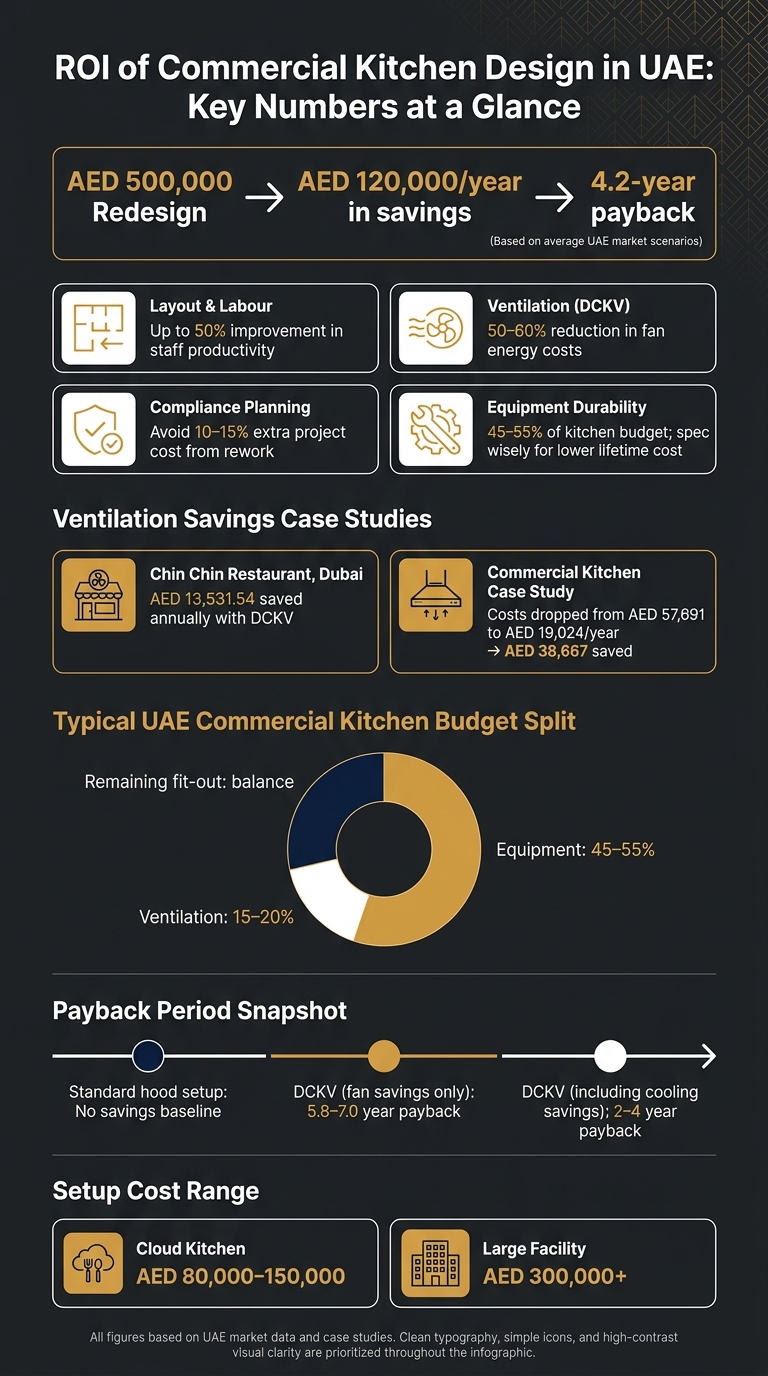
ROI of Commercial Kitchen Design in UAE: Key Numbers at a Glance
Labour savings start with layout, flow, and zoning
After labour cost, layout is the fastest place to cut waste. A poor setup turns every shift into a lot of extra walking, waiting, and staff getting in each other’s way. People backtrack. Paths cross. Someone needs space, but another person is already there. Bit by bit, the whole kitchen slows down.
The fix is simple in theory: build a kitchen where movement is short, logical, and easy to repeat.
Fewer steps and faster ticket times through better layout
A well-planned kitchen supports one-way flow. That means staff spend less time walking and more time getting food out. When stations line up with the way work actually moves, service feels smoother and ticket times come down.
It’s also far cheaper to plan workflow before fit-out than to fix layout problems after opening.
Zoning for hygiene and productivity under UAE requirements
In the UAE, layout also needs to support hygiene and food-safety zoning. Clear prep, cook, wash, and storage zones reduce cross-traffic, help teams move faster, and support hygiene compliance. Custom stainless steel fabrication can make that flow work properly, instead of forcing the team to work around off-the-shelf equipment.
Comparison table: fragmented layout vs zone-based workflow
The table below shows how that difference affects daily output and labour use.
sbb-itb-19c3c9a
Energy, ventilation, and fire-safe design protect operating margin
Once layout cuts labour waste, energy use and compliance become the next big profit levers. In many UAE kitchens, exhaust and make-up air sit among the heaviest utility loads. If the system is poorly designed, you feel it every month in the electricity bill.
How ventilation design affects your monthly electricity bill
Demand-controlled kitchen ventilation uses hood sensors and variable-speed fans to match exhaust output to the actual cooking load. Put simply, when the line is quiet, the system doesn’t keep running flat out. That cuts energy use without slowing service.
The savings can be material. A UAE case study for Chin Chin Restaurant in Dubai recorded annual savings of AED 13,531.54 after switching to demand-controlled ventilation. Another commercial kitchen case study showed utility costs dropping from AED 57,691 per year to AED 19,024 per year - a saving of AED 38,667 annually.
For a mid-size Dubai restaurant operating 14 hours a day, 365 days a year, with a 5 kW combined fan load, a DCKV upgrade that cuts fan energy by 50–60% can reduce annual fan electricity costs from about AED 11,240 to around AED 4,490–5,630.
Fire-safe design that reduces approval delays and shutdown risk
In the UAE, ventilation and fire safety have to be planned as one system. Exhaust ducts must discharge to the exterior, and grease-exhaust hoods need an approved wet-chemical suppression system with automatic gas and power shutoff.
The trouble starts when these items are treated as late-stage add-ons. A duct routed through a shared shaft, or a suppression system bolted on later without proper links to gas solenoid valves and fan controls, can lead to objections during Dubai Civil Defence approval. That can mean redesign, rework, and delayed opening. And that eats into project return before the kitchen serves its first cover.
When ducting, shutoff logic, and cleaning access are designed together, rework drops and approvals tend to move with fewer setbacks. In ROI terms, the cost avoided from a delayed opening or forced shutdown can outweigh the extra spend needed to get the fire-safe design right from day one. It helps protect launch dates and keeps the kitchen focused on profit instead of repairs.
Comparison table: standard hood setup vs demand-controlled compliant system
All figures below are illustrative, based on a mid-size restaurant kitchen operating 14 hours per day, 365 days per year, with a 5 kW combined exhaust and make-up air fan load. If the upgraded package costs about AED 40,000 more than a basic setup, fan savings alone suggest a payback of roughly 5.8–7.0 years; including cooling savings can shorten this to about 2–4 years.
| Factor | Standard constant-volume setup | Demand-controlled compliant system |
|---|---|---|
| Annual fan energy use | ~25,550 kWh | ~10,200–12,800 kWh |
| Annual fan energy cost | ~AED 11,240 | ~AED 4,490–5,630 |
| Annual energy saving | - | ~AED 5,610–6,750 |
| AC load reduction | Minimal | 20–30% lower |
| Fire/compliance status | Higher redesign risk | Designed to UAE code from outset |
| Indicative payback period | - | Roughly 5.8–7.0 years on fan savings alone; often 2–4 years once cooling savings are included |
Once airflow and compliance are fixed, the next ROI lever is equipment that lasts longer and is easier to maintain.
Durable equipment and maintainable design reduce downtime and waste
Once ventilation and compliance are sorted, equipment choice becomes the next big ROI lever. In the UAE, equipment often accounts for 45–55% of a kitchen budget. That means a poor spec doesn’t just hurt at purchase time. It can lead to more maintenance, more downtime, and earlier replacement later on.
Choosing equipment for lifespan, cleaning access, and serviceability
The gap between lower-spec equipment and tougher, longer-lasting units usually shows up after opening day. Equipment that’s easier to clean and service is less likely to create delays. And units on casters can be moved or reworked as demand shifts.
That matters in day-to-day operations. If a team can clean a unit properly and a technician can reach the parts that need attention, the equipment is more likely to stay efficient and last longer. The result is steadier output and less waste.
How maintenance-ready design improves payback on kitchen investment
Maintenance-ready design means choosing equipment with accessible components, standard parts, and clear service intervals.
When a technician can get in, find the issue, and fix it fast, the kitchen loses less revenue to unplanned stoppages. That has a direct effect on payback. Less downtime means the original investment starts working harder, sooner.
Comparison table: low upfront equipment vs higher-durability specification
A higher upfront spend on durable, serviceable equipment can lead to a lower lifetime cost. Here’s where that gap tends to show up.
| Factor | Low upfront specification | Higher-durability specification |
|---|---|---|
| Purchase cost | Lower initial spend | Higher initial spend |
| Useful lifespan | Shorter | Longer |
| Maintenance burden | Higher | Lower |
| Access for cleaning and servicing | More difficult | Easier |
| Downtime risk | Higher | Lower |
| Long-term value | Often weaker over time | Typically stronger over time |
The lowest purchase price rarely gives the best return. In a high-use kitchen, durable, serviceable equipment cuts repair costs, replacement pressure, and lost output. That’s why equipment choice should be judged on lifetime cost, not purchase price alone.
Putting the numbers together for UAE kitchen projects
A simple ROI model for restaurants, cloud kitchens, and production facilities
The easiest way to judge a kitchen project is to turn operating gains into a plain payback test.
Start by listing your current monthly costs in the areas that design can change:
- labour
- energy
- downtime
- rework
Then estimate the monthly savings. Better zoning can trim labour waste. A UAE-specified ventilation system can cut energy strain and improve day-to-day working conditions. Movable modular equipment can reduce downtime and limit costly rework when the setup needs to change.
Once you have those numbers, you can size the project and decide where each dirham should go first. Divide the total project cost by annual savings, and you get your payback period in months or years.
The setup cost can vary a lot. A small cloud kitchen usually costs AED 80,000 to AED 150,000 to set up, while a large facility can go past AED 300,000. Equipment often makes up 45–55% of total spend, and ventilation takes 15–20%. That means even small spec changes in those two areas can shift payback the fastest.
Fastest-payback priorities
Once the budget is clear, the next step is deciding what comes first.
Layout should lead the list. Zone-based planning can improve staff productivity by up to 50% from the first week of operation, and it also supports HACCP compliance. That’s a big jump, especially in a busy kitchen where every extra step turns into wasted time.
Ventilation comes next. It takes a fair share of the budget, and in UAE conditions, it has a direct effect on how the kitchen runs day after day. If the airflow is wrong, the whole space feels it.
Approval-ready design should come right after that. Sending detailed drawings to Civil Defence and the Food Control Department early can help avoid rework costs that may add 10–15% to the total budget. In plain terms, paperwork done late often costs more than people expect.
Conclusion: design choices that improve profit over the life of the kitchen
Every big kitchen design choice has a money outcome attached to it.
Layout, ventilation, compliance, and equipment choices don’t work on their own. They stack up. One good call supports the next one, and one poor call can do the same in the other direction. Over time, that shows up as lower operating cost, fewer delays, and better long-term margin.
FAQs
How do I calculate kitchen ROI?
Calculate payback period and ROI to see whether a project makes financial sense.
Payback period = initial project cost ÷ estimated annual savings
This shows how long it takes to recover what you spent. A shorter payback period is usually better.
ROI = ((net profit − total investment) ÷ total investment) × 100
For total investment, include all upfront and running costs tied to the project, such as:
- purchase price
- installation
- staff training
- utility costs
- maintenance
For net profit, count both added income and day-to-day savings. That can include higher revenue, lower energy bills, and fewer repair costs.
In the UAE, 15% ROI is often seen as a strong benchmark. If you're tracking performance more often, 10% quarterly ROI is an ideal target in many cases.
Which upgrade pays back first?
Usually, high-efficiency equipment pays for itself first.
Combi ovens and blast chillers often bring ROI in 12 to 18 months through lower energy use. Other energy-saving equipment can pay back in 6 to 18 months, depending on how heavily it’s used.
Sometimes, the savings show up much sooner. Specialised energy-saving tech can deliver measurable results in 4 to 6 weeks. And because refrigeration units run all day and night, they often make the fastest dent in energy costs.
How can I avoid UAE approval delays?
Prioritise compliance from the design stage. Work with consultants or partners registered with Dubai Municipality and Dubai Civil Defence, and submit kitchen layouts plus detailed MEP drawings for approval before construction starts or any equipment is purchased.
The design should follow the required workflow, use DCD-certified fire-safe materials and systems, and include complete, accurate documentation. If the approved plans don’t match the final installation, there’s a good chance the site will fail inspection.
