


If you run a restaurant in the UAE, HACCP is not optional in daily kitchen work. You need a HACCP-based food safety system, clear temperature controls, staff checks, and records that inspectors can review on the spot.
Here’s the short version:
- HACCP means spotting food safety risks before food is served
- The main risk points are receiving, storage, prep, cooking, cooling, reheating, hot holding, and service
- Common checks include chilled food at ≤ 5 °C, frozen food at ≤ -18 °C, cooking high-risk food to 75 °C, and hot holding above 60 °C
- Dubai and Abu Dhabi both expect records, not just a written plan
- Dubai also expects digital records, regular temperature logging, and a certified Person in Charge on each shift
- Staff must know what to do when a limit is missed, such as rejecting a delivery, reheating, chilling faster, or discarding food
- A Dubai study found HACCP use linked to a 36% drop in violations, including 21.10% fewer temperature issues and 40.17% fewer cleaning and cross-contamination issues
In simple terms, I’d read this article as a guide to one thing: how to keep food safe and show proof of control every shift.
What matters most is not long paperwork. It’s:
- clear CCPs
- usable logs
- cleaning records
- corrective action notes
- staff training
- a kitchen flow that keeps raw and ready-to-eat food apart
The article also makes it clear that inspectors may ask both for records and for staff explanations. So the system has to work on the floor, not just on paper.
That’s the core message of the article: know the risk points, control them with set limits, and record what happened in plain, usable logs every day.
UAE HACCP Requirements and Food Safety Expectations
Which Restaurants Need a HACCP-Based System
Most commercial food businesses in the UAE need to run a HACCP-based food safety management system. Federal Law No. 10 of 2015 makes the person in charge responsible for making sure food is safe and fit for people to eat. For restaurant teams, that covers the whole process: receiving, storage, preparation, cooking, cooling, and service.
Dubai Municipality's Food Code 2.0 says food establishments must put in place an FSMS based on Codex HACCP principles or ISO 22000. It puts extra focus on higher-risk operations, including outdoor catering, sites serving schools, day-care facilities and hospitals, staff accommodation, and employee canteens.
In Abu Dhabi, ADAFSA Regulation 6/2010 and related resolutions call for HACCP-based systems across food businesses, including restaurant chains, hospital main kitchens, labour camp canteens, and hypermarkets, with compliance deadlines tied to each business category. Smaller restaurants are not exempt. They still need HACCP controls for high-risk foods such as cooked poultry, buffet dishes, prepared salads, chilled desserts, and cooled foods.
In day-to-day terms, these rules affect every handoff from delivery through to service.
Documents and Records Inspectors Expect to See
Inspectors want proof that HACCP is being used every day, not just filed away in a folder. That usually means the HACCP plan, hazard analysis, CCP list, monitoring records, and supporting logs. They also look for temperature logs that show who carried out the check, when it was done, the reading, and what corrective action was taken if something went wrong. Cleaning and sanitation schedules, corrective action records, staff training certificates, and supplier delivery check records are also standard checks.
In Dubai, records must be kept on approved digital platforms such as FoodWatch or DMChecked. Temperature logs need updating at least every four hours, and training certificates must be uploaded. Third-party audit reports should be kept for four years and shown during inspections. In Abu Dhabi, ADAFSA reviews can be more technical at the licensing stage, especially for larger or higher-risk sites, with close attention on corrective actions and verification steps.
Dubai Municipality also requires a certified Person in Charge (PIC) on each shift. This person should be able to read CCP records, explain critical limits, and approve corrective actions on the spot. Inspectors may speak directly to staff and ask them to explain CCPs and corrective actions. If answers don’t line up, that can flag a problem.
UAE Food Safety Expectations by Authority
| Authority | Likely Business Scope | Key HACCP Documents | Inspection and Operational Focus |
|---|---|---|---|
| Dubai Municipality | Restaurants, catering, cloud kitchens, four- and five-star hotel kitchens | HACCP plan, hazard analysis, CCP list, temperature logs, training records, third-party audit reports | Digital records on FoodWatch/DMChecked; PIC certification; temperature logs every 4 hours; corrective action records; supplier delivery checks; audit reports retained 4 years |
| ADAFSA (Abu Dhabi) | Restaurant chains, catering companies, hospital kitchens, labour camp canteens, hypermarkets | HACCP plan with flow diagrams, hazard analysis, monitoring records, corrective actions, verification records | Detailed technical review at licensing; ongoing compliance with seven HACCP principles; CCP monitoring records; cooling and cooking temperature logs; staff training evidence; supplier traceability |
Once these documents and checks are in place, the focus shifts to how the seven HACCP principles are used across receiving, storage, prep, cooking, cooling, and service.
sbb-itb-19c3c9a
The 7 HACCP Principles Applied to Daily Restaurant Operations
With the HACCP plan and records in place, these seven principles show how a kitchen manages food safety every day. They turn the HACCP plan, logs, and corrective-action records into day-to-day kitchen work.
Hazard Analysis, CCPs, and Critical Limits
Hazard analysis looks at what can go wrong at each stage of food flow: receiving, storage, prep, cooking, cooling, and service. It covers biological, chemical, physical, and allergen hazards at each stage. At receiving, one risk might be chilled chicken arriving too warm. In prep, it could be allergen cross-contact between a nut-based sauce and a salad. During service, it might be cooked rice sitting in the danger zone for too long.
After mapping the hazards, the next step is to identify Critical Control Points (CCPs). These are the steps where a control measure is needed to keep food safe. Common CCPs include receiving chilled deliveries, chilled storage, cooking poultry and minced meat, cooling cooked rice and curries, reheating, hot-holding buffet dishes, and cold-holding high-risk foods such as dairy desserts and prepared salads.
Critical limits set a measurable boundary for each CCP. Each limit should be written as one clear rule based on °C, time, or both. For example, chilled deliveries of raw poultry should be received at or below the required cold chain temperature, and hot-held food must stay well above the danger zone throughout service. The limit needs to be clear enough to check with a probe thermometer during service.
Monitoring, Corrective Actions, and Verification
Monitoring is the routine of checking whether each CCP stays within its critical limit. It should be done on a schedule, by named staff, at set times. Receiving staff check delivery temperatures and packaging condition. Prep staff start cooling logs and label products with the date and time. Cooks probe cooked food and record the reading. Supervisors carry out line checks during service and review hot-holding and cold-holding units at set intervals.
Once a limit is in place, the kitchen has to check it every time as required. If a limit is missed, the corrective action should already be clear. Staff should not have to guess. If hot-held food drops below limit, reheat it only if time and product safety allow; otherwise discard it. If cooling food has not reached the target temperature within the required time, it may need to be portioned into shallower containers, stirred, or iced down and then checked again. If the temperature cannot be verified or the time in the danger zone is too long, the food should be discarded. Every corrective action should be recorded with the date, time, product, measured temperature, action taken, and supervisor sign-off.
Verification is the final check. A supervisor or food safety manager reviews logs, looks for repeat deviations, and confirms thermometer calibration. Daily logs, corrective actions, and review help show that control is in place.
Table: The 7 HACCP Principles in Restaurant Practice
| HACCP Principle | What It Means | Where It Applies in Restaurant Operations | Record or Control Measure Used |
|---|---|---|---|
| Hazard analysis | Identify biological, chemical, physical, and allergen hazards | Receiving, storage, prep, cooking, cooling, serving | Hazard analysis worksheet / flow diagram |
| Critical control points (CCPs) | Find the steps where control is essential | Cooking poultry, cooling rice, hot-holding buffet items, chilled storage | CCP list / process map |
| Critical limits | Set measurable safe boundaries in °C and time | Internal cooking temperatures, fridge temperatures, cooling deadlines, hot-holding thresholds | Temperature limits documented per CCP |
| Monitoring | Check whether each CCP stays within its limit | Daily fridge checks, cooking probes, cooling checks, hot-holding rounds | Temperature logs / visual checks |
| Corrective actions | Define what to do when a limit is breached | Reheat, chill faster, discard, segregate, fix equipment | Corrective action form / incident record |
| Verification | Confirm the system works in practice | Supervisor log review, thermometer calibration, internal audits | Verification checklist / calibration log |
| Documentation and records | Keep evidence of control measures and outcomes | Receiving to service | Delivery logs, cooking logs, cooling logs, cleaning schedules, corrective action records |
Next, these principles must be applied across receiving, storage, prep, cooking, cooling, and service.
Building a HACCP Plan Across Each Stage of Food Flow
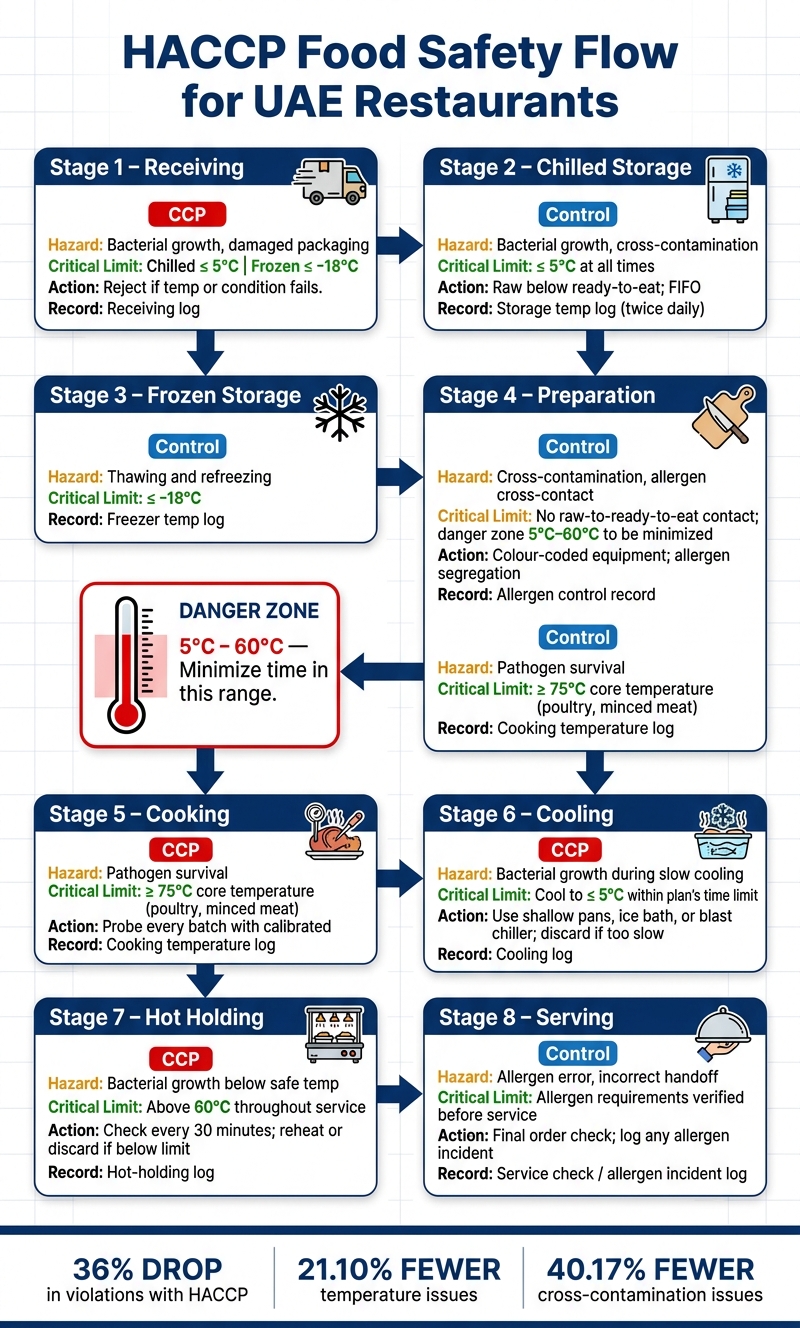
HACCP Food Safety Flow: Critical Control Points & Temperature Limits for UAE Restaurants
Process Controls from Delivery to Service
Use the HACCP plan like a flow map: receiving, storage, preparation, cooking, cooling, and service. At each stage, set one clear control.
Receiving is where checks start. Accept food only from approved suppliers. At the door, check vehicle hygiene, packaging condition, expiry dates, and delivery temperature. Chilled high-risk food such as poultry, seafood, and dairy must arrive at ≤ 5 °C, while frozen goods must arrive at ≤ −18 °C. If a delivery fails the temperature or condition check, reject it. Then record the supplier, product, temperature, and reason.
Storage is about temperature and separation. Keep chilled food at ≤ 5 °C and frozen food at ≤ −18 °C. Store raw meat, poultry, and seafood below ready-to-eat food, in dedicated containers. Use FIFO and carry out daily expiry checks.
Preparation is the stage where cross-contamination is most likely. Use separate boards and knives for raw and ready-to-eat food. Label allergens clearly. Use dedicated tools, or clean and sanitise them between uses. Keep food out of the 5 °C to 60 °C danger zone for as little time as possible.
Cooking is a CCP. Cook every batch of high-risk food, especially poultry and minced meat, to the plan’s critical limit. Use a calibrated probe thermometer to check the core temperature. A common plan limit is 75 °C at the core.
Cooling is also a CCP, and here both time and temperature matter. Cool cooked food to ≤ 5 °C within the time limit set in your HACCP plan. Shallow pans, smaller portions, an ice bath, or a blast chiller can help. If food is still cooling too slowly, discard it and record what happened.
Hot holding during service must keep food above 60 °C. If food is reheated, return it to hot holding only after it reaches the safe core temperature.
Serving is the last handoff. Check each order against allergen needs before it leaves the kitchen. If there is any allergen incident, record it at once.
Daily Logs, Cleaning Schedules, and Corrective Action Records
Once the controls are set, records show the checks were actually done. For every shift, keep receiving logs, storage temperature logs, hot-holding checks, cleaning schedules, and corrective-action records. Each one shows that the control was checked and, if needed, fixed.
A receiving log should include the date, time, supplier name, product, batch reference, delivery temperature, packaging condition, and the decision to accept or reject.
Storage temperature logs should be completed at least twice a day for every chiller and freezer. Record the unit ID, the actual temperature, and any corrective action if the reading falls outside the critical limit.
During service, hot-holding logs should record temperatures at set intervals. For buffets and events, this is often every 30 minutes. If food drops below the required limit, note the corrective action clearly.
A cleaning schedule should state what is cleaned, who is responsible, how often it is cleaned, which chemical is used, the right concentration, the contact time, and the supervisor sign-off. This should cover surfaces, equipment, fridges, freezers, slicers, drains, and customer-contact areas.
A corrective action record should be completed any time a critical limit is missed or a hygiene standard is broken. Record the date and time, the process step involved, the product affected, the immediate action taken, a short root-cause note, and the supervisor sign-off.
Table: Process Step, Hazard, Control, and Required Record
| Process Step | Likely Hazard | CCP or Control Measure | Example Critical Limit | Record to Complete |
|---|---|---|---|---|
| Receiving | Bacterial growth; damaged packaging; expired stock | CCP – approved supplier check and delivery temperature check | Chilled foods ≤ 5 °C; frozen foods ≤ −18 °C | Receiving log (date, temp, supplier, decision) |
| Chilled storage | Bacterial growth; cross-contamination | Control – temperature monitoring and separation | ≤ 5 °C at all times | Storage temperature log (twice daily minimum) |
| Frozen storage | Thawing and refreezing; bacterial growth | Control – temperature monitoring | ≤ −18 °C | Freezer temperature log |
| Preparation | Cross-contamination; allergen cross-contact | Control – colour-coded equipment; allergen separation | No raw-to-ready-to-eat contact; allergen segregation maintained | Allergen control record; prep checklist |
| Cooking | Survival of pathogens in high-risk foods | CCP – core temperature probe per batch | ≥ 75 °C core for poultry and minced meat | Cooking temperature log (product, temp, time, staff) |
| Cooling | Bacterial growth during slow cooling | CCP – time and temperature control | Cool to ≤ 5 °C within the plan's time limit | Cooling log (start temp, intermediate checks, final temp) |
| Reheating | Survival of pathogens after prior cooling | CCP – rapid reheat to safe core temperature | Reheat rapidly to safe core temperature before hot holding | Reheating log (product, temp, time, staff) |
| Hot holding | Bacterial growth below safe holding temperature | CCP – temperature checks during service | Above 60 °C throughout service | Hot-holding log (every 30 minutes during service) |
| Serving | Allergen error; incorrect order handoff | Control – final order check and allergen confirmation | Allergen requirements verified before service | Service check; allergen incident log if needed |
These controls are much easier to follow when the kitchen layout supports the flow instead of working against it.
Kitchen Design, Equipment, and Next Steps
How Kitchen Layout Supports HACCP Compliance
That food-flow plan only works if the kitchen layout backs it up.
A well-planned kitchen supports one-way food flow and keeps raw and ready-to-eat areas apart, which helps cut cross-contamination. UAE food safety guidance says food should move in one direction, with raw and ready-to-eat zones kept separate. That separation also needs to be physical. Raw meat, poultry, and seafood prep areas should sit away from cooked and ready-to-eat zones.
Handwash sinks should be placed where staff can use them at the right moment, not after the fact. Surfaces also matter. Floors, walls, worktops, and ceilings should have smooth, non-porous, washable finishes that are easy to clean and sanitise. Shelving should stay at least 15 cm off the floor, and aisles should be more than 90 cm wide.
Grease traps and hoods should be set up so staff can reach them easily, which makes weekly cleaning far less of a headache. Refrigeration should match the kitchen’s output, and units should be placed where temperatures can be checked each shift without slowing the team down.
It also helps to ask for as-built layout plans for your HACCP file. That way, the flow diagram matches the kitchen inspectors will actually see.
Conclusion: The Controls and Records That Matter Most
HACCP is a control system, not paperwork for the sake of paperwork.
Records only matter when they show what’s happening in the kitchen each day. Temperature logs, corrective action records, and cleaning schedules need to be filled in during the task itself, not pieced together at the end of a shift.
The core controls are clear CCPs, complete temperature logs, and corrective-action records. Abu Dhabi requires temperature, maintenance, and calibration records to be kept for three years, so it makes sense to put a simple, steady filing system in place early.
Once the layout is set, day-to-day compliance comes down to the records staff complete on the floor. A food-safe layout makes HACCP easier to run, and when the kitchen already supports the flow, daily checks become part of the normal routine. That’s what regulators want to see: a system that spots hazards, controls them at key points, and shows proof through records completed on the floor, every shift.
FAQs
How do I start a HACCP plan for my restaurant?
Start by bringing management and kitchen staff together, then map every step from receiving ingredients to service. From there, run a hazard analysis to spot biological, chemical, and physical risks at each stage.
Next, identify Critical Control Points (CCPs) and set clear critical limits, such as cooking beef to 71°C. Then put monitoring, corrective actions, verification audits, and clear documentation in place so the process stays on track day after day.
What records should I keep ready for inspections?
Keep clear, up-to-date records that show how you manage food safety and day-to-day standards. This should include:
- temperature logs for refrigeration, freezers, and cooking units
- CCP monitoring logs, deviations, and corrective actions
- cleaning schedules and grease trap maintenance records
- staff food safety and HACCP training certificates
- pest control, supplier audit, and inspection records
The Person In-Charge should also keep a dedicated HACCP corrective action log.
Who should manage HACCP on each shift?
In the UAE, every food establishment must appoint at least one certified Person In-Charge (PIC) to oversee food safety and manage Critical Control Point (CCP) monitoring.
The PIC holds overall responsibility. But day-to-day shift duties, such as pre-shift hygiene checks and temperature readings, should be assigned clearly to named staff members.
For each task, spell out:
- the method
- the timing
- the person responsible
