


Transforming an empty warehouse into a fully functional cloud kitchen in the UAE involves navigating strict regulations, optimizing workflow for food delivery, and ensuring scalability. This case study highlights the step-by-step journey, focusing on:
- Adhering to UAE food safety and fire safety standards.
- Securing approvals from Dubai Municipality (DM), Dubai Civil Defence (DCD), and the Department of Economy and Tourism (DET).
- Designing HACCP-compliant zones for unidirectional food flow.
- Upgrading utilities, drainage, and fire suppression systems to meet 2026 regulations.
- Setting up a multi-brand facility with clear brand separation and shared resources.
Key Takeaways:
- Budget for regulatory fees and unexpected costs (set aside 30% contingency).
- Choose equipment suited for the UAE's climate and regulations.
- Plan layouts early to avoid costly redesigns.
- Focus on simple, efficient workflows to meet high delivery demands.
This project, managed by Silverline Kitchens, demonstrates the importance of detailed planning and compliance to achieve a successful launch and long-term operational efficiency in the UAE's competitive food delivery market.
Project Overview and Planning
Warehouse Background and Business Model
The project focused on transforming a vacant warehouse in an industrial area on the outskirts of Dubai. This location was chosen strategically to keep overheads low while staying within reach of key residential zones. The first essential step was to confirm F&B zoning with both the landlord and the municipality before proceeding with the lease - an oversight here could lead to expensive setbacks.
The business model selected was a multi-brand cloud kitchen, which operates several virtual restaurant brands from a single production facility. This model is designed to maximise revenue per square metre but comes with added regulatory challenges. Authorities require clear brand separation and dedicated storage areas for each concept sharing the facility.
Goals and Key Performance Indicators
From the beginning, the project team focused on setting measurable goals rather than vague objectives. The primary goal was achieving full regulatory compliance, ensuring 100% adherence to the UAE Food Code, HACCP principles, and Dubai Municipality (DM) standards.
Approval timelines were treated as critical KPIs. The team aimed to have design and drawing submissions reviewed by DM within 7 to 14 working days, while the final site inspection and operational clearance were targeted for completion within 3 to 7 working days. A key objective was to pass the DM site inspection on the first attempt, as failing this step could lead to redesigns, delays, and postponed trade licence activation.
"A poorly planned kitchen design is the number one reason approvals get rejected." – Kitchen Works
Another major focus was workflow efficiency. The kitchen layout needed to ensure a strictly unidirectional food flow - Receiving → Storage → Preparation → Cooking → Serving → Washing - eliminating any cross-movement between raw and cooked areas.
These well-defined goals provided a clear roadmap for Silverline Kitchens to execute their role effectively.
Silverline Kitchens' Role in the Project
Silverline Kitchens played a pivotal role as the end-to-end project partner, tasked with turning the business model into a fully compliant, operational kitchen. Their responsibilities included site evaluation, space planning, designing HACCP-compliant zones, custom stainless-steel fabrication, sourcing equipment, coordinating with MEP teams, and managing the entire approvals process with DM and Dubai Civil Defence.
One of their first actions was conducting a utility capacity audit, which assessed DEWA’s electrical load, water connection points, and the feasibility of using LPG versus piped natural gas. This step, often overlooked by operators in a rush to launch, is crucial in shaping equipment choices and avoiding unexpected infrastructure upgrades later. Silverline Kitchens also prepared all MEP drawings and exhaust ventilation layouts needed for submission, ensuring no room for improvisation during construction.
Step-by-Step Warehouse Conversion
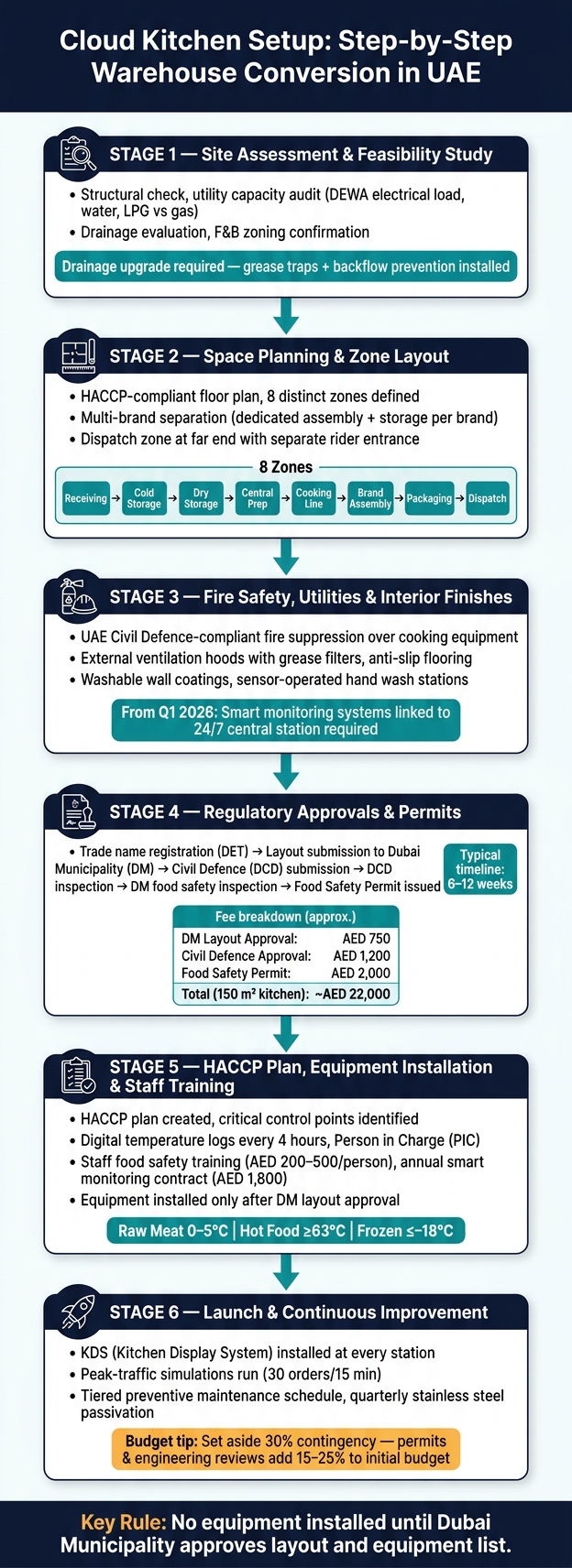
Cloud Kitchen Setup Process: From Empty Warehouse to Operational Kitchen in UAE
Site Assessment and Feasibility Study
Before any modifications began, Silverline Kitchens carried out a detailed evaluation of the Dubai warehouse. This included examining its structural soundness, utility capacity, drainage setup, and zoning compliance for food production. These checks ensured that the project would align with both regulatory requirements and operational goals established during the planning stage.
One key focus was determining if the warehouse could handle a smooth food flow - from receiving ingredients to washing and preparation - without bottlenecks, even during peak demand.
A major discovery was the need to upgrade the existing drainage system. To meet regulations, grease traps with proper slopes for backflow prevention had to be installed. Spotting this issue early saved the project from costly redesigns later. With feasibility confirmed, the team moved forward with detailed planning and layout design.
Space Planning and Zone Layout
Once the feasibility study was completed, Silverline Kitchens developed a precise floor plan. The layout adhered to Dubai Municipality’s strict zoning rules, ensuring clear separation between areas like raw food preparation, cooking, washing, and storage.
Since this was a multi-brand operation, each brand required its own dedicated assembly station and storage space. Shared cold and dry storage areas were carefully arranged to avoid cross-contamination between brands. Practical measures, such as colour-coded chopping boards and bins, were integrated early in the design process to meet inspection standards.
The dispatch zone was placed at the far end of the facility, completely separate from the cooking area. This design choice kept delivery riders out of the kitchen floor, reducing hygiene risks and operational disruptions.
Fire Safety, Utilities, and Interior Finishes
With the layout finalised, attention turned to fire safety systems, utilities, and interior finishes. Construction progressed in three key areas simultaneously: fire safety installations, mechanical/electrical/plumbing (MEP) work, and interior upgrades - all aimed at achieving the efficiency goals set at the start.
Fire safety systems were installed to meet UAE Civil Defence standards, including fire suppression systems over cooking equipment and the removal of exposed wiring across the kitchen. Ventilation hoods with grease filters were ducted externally to manage heat and odour, meeting UAE regulations.
Interior finishes were chosen to withstand the UAE’s demanding kitchen environment. Anti-slip flooring was installed throughout, while walls were coated with smooth, washable surfaces. Ceilings were kept light-coloured and free of cracks or exposed conduits. Multiple hand wash stations with automated taps, soap, and sanitiser dispensers were placed strategically in preparation zones. All materials and fittings met food-grade standards, with adequate spacing around equipment for thorough cleaning - an essential detail for passing final inspections.
HACCP-Compliant Kitchen Design and Workflow
Zoning Based on Food Flow and Safety
Dubai Municipality enforces a strict unidirectional food flow that ensures food moves in one direction: Receiving → Storage → Preparation → Cooking → Packaging → Dispatch → Washing. This approach is designed to prevent any backtracking or the crossing of raw and cooked food zones. Following this principle, the kitchen was divided into eight distinct zones: Receiving & Inventory, Cold Storage, Dry Storage, Central Prep, Cooking Line, Brand Assembly, Packaging & Labelling, and Dispatch.
Each zone had a specific purpose, and staff were restricted to their designated areas during service. The dispatch area even featured a separate entrance to keep delivery riders away from food production areas. For the multi-brand setup, unique colour-coded chopping boards and bins were assigned to each brand to minimise the risk of cross-contamination.
Once the zones were defined, the next focus was on choosing equipment that met compliance standards and could handle the demands of UAE kitchens.
Equipment Selection for UAE Cloud Kitchens
When selecting equipment, the priorities were clear: compliance with regulations and reliable performance in the UAE's challenging conditions. Every piece of equipment had to feature smooth, food-grade surfaces that were easy to clean, with enough space around them for thorough maintenance.
High-capacity exhaust hoods with grease filters were installed above all cooking stations, with external ducting to handle the region’s high ambient temperatures effectively. Grease traps were also integrated into the drainage system to meet environmental standards and prevent backflow issues.
Hand wash stations were equipped with sensor-operated taps, a detail that Dubai Municipality inspectors pay close attention to. Non-compliant hand wash stations and ventilation issues are among the most common reasons for inspection failures in the UAE.
To avoid costly mistakes, Silverline Kitchens ensured that no equipment was installed until Dubai Municipality approved the layout and equipment list. Any mismatch between installed equipment and the approved MEP (Mechanical, Electrical, and Plumbing) drawings could lead to inspection failures and expensive replacements.
Workflow Optimisation Methods
With zoning and equipment decisions in place, the workflow was fine-tuned to reduce unnecessary movement. Fryers were placed near packaging zones, refrigeration units were located directly beside prep counters, and shared equipment was positioned centrally. This setup allowed staff from different brand stations to access shared tools without crossing into other zones.
To further enhance efficiency, a Kitchen Display System (KDS) was installed at every station. This system displayed incoming orders digitally, reducing confusion in the multi-brand environment and improving order accuracy, especially during busy periods.
Before finalising the layout, simulated peak-traffic scenarios - such as processing 30 orders within 15 minutes - were run to identify bottlenecks. These tests helped pinpoint areas for improvement, allowing for station adjustments before construction began.
sbb-itb-19c3c9a
Regulatory Compliance and Approvals in the UAE
UAE Food Safety and Civil Defence Standards
Running a cloud kitchen in the UAE involves adhering to strict regulations for both food safety and fire safety. Food safety is governed by Federal Law No. 10 of 2015, with enforcement handled by local authorities. Meanwhile, fire safety falls under the Dubai Civil Defence (DCD), which oversees systems like gas lines and fire suppression. From Q1 2026, DCD will also require smart monitoring systems linked to a 24/7 central station. Securing both food and fire safety approvals is mandatory before obtaining a food permit.
Failing to comply with these regulations can lead to severe penalties. Violations of technical food regulations can result in fines ranging from AED 10,000 to AED 100,000, with repeat offenders facing doubled fines. Operating without a valid Dubai Municipality (DM) Food Safety permit can incur fines of up to AED 50,000.
"The cost of compliance is predictable and manageable. The cost of non-compliance is not." - Kayrouz & Associates
This dual approach to food and fire safety ensures a streamlined process for obtaining permits.
Permits, Plan Submissions, and Inspections
The approval process for a cloud kitchen follows a structured sequence, with several steps running in parallel to reduce timelines. Typically, the entire process takes about six weeks, although a window of 8–12 weeks is more realistic for a Dubai-based facility.
The journey begins with trade name registration through the Department of Economy and Tourism (DET). Next, detailed kitchen layout plans - including MEP (mechanical, electrical, and plumbing) designs, drainage systems, equipment placement, and food flow diagrams - are submitted to DM's Food Safety Department. Construction or fit-out work only begins after layout approval, preventing costly redesigns.
Simultaneously, the Civil Defence submission covers fire safety elements like kitchen hood suppression systems, heat detectors, and the 2026-mandated K-class wet chemical suppression systems, which include post-discharge cleanup protocols. The DCD inspection must be completed before DM conducts its food safety inspection.
For a 150 m² cloud kitchen, total fees are approximately AED 22,000, which includes:
- AED 750 for DM layout approval
- AED 1,200 for Civil Defence approval
- AED 2,000 for the Food Safety Permit
HACCP Plan, Staff Training, and Monitoring
Once the necessary approvals are secured, the focus shifts to operational readiness and compliance. A HACCP plan (Hazard Analysis and Critical Control Points) is created to ensure unidirectional food flow and identify critical control points throughout the process, from receiving to serving. Daily logs are implemented to monitor temperature checks, supplier compliance, and corrective actions in case of deviations.
Temperature control is a key focus:
- Raw meat: Stored between 0–5°C
- Hot food: Held at a minimum of 63°C
- Frozen items: Kept at –18°C or below
Digital temperature logs are updated every four hours to ensure compliance. A Person in Charge (PIC) is appointed, completing mandatory food safety training as required by UAE law.
Staff training, costing AED 200–500 per person, covers food safety protocols, hygiene practices, and obtaining Occupational Health Cards. Additionally, an annual smart monitoring contract, priced at AED 1,800, is activated. This contract is essential for both new permits and annual renewals for all F&B establishments in the UAE.
Launch, Performance, and Lessons Learned
Performance Metrics and Efficiency Results
Once permits were secured and staff were trained, live operations officially kicked off. The focus was on three main metrics: ticket times, order accuracy, and production capacity - all established during the planning phase.
The redesigned open, linear layout - streamlining the flow from receiving to prep, cooking, and dispatch - made a noticeable difference. By eliminating cross-traffic between stations, efficiency improved significantly. The use of a Kitchen Display System (KDS) further enhanced operations, ensuring smoother order management across virtual brands. This not only improved order accuracy but also kept prep times consistent.
Additionally, the custom stainless steel equipment proved highly durable, standing up to the UAE’s challenging heat and humidity conditions.
These operational adjustments laid the foundation for ongoing improvements.
Maintenance and Continuous Improvement
While the launch was largely successful, a few challenges surfaced early on. Limited storage access and ventilation imbalances were quickly addressed within the first month of operations.
Silverline Kitchens played a vital role post-installation, offering support for equipment servicing and compliance updates. This was particularly useful given the frequent regulatory changes in the UAE. A tiered preventive maintenance schedule was implemented, including daily cleaning of filters and coils, alongside periodic professional inspections. This strategy has been shown to significantly reduce unplanned downtime and repair expenses over the course of a year.
To further protect equipment, quarterly passivation of stainless steel surfaces was introduced. This step was essential for preventing corrosion in areas with high moisture levels.
These measures not only resolved initial hiccups but also provided valuable insights for future setups.
Key Takeaways for Cloud Kitchen Setup in the UAE
Looking back at the project, several important lessons stand out.
- Budget for surprises. Permit fees, engineering reviews, and inspections frequently add 15–25% to the initial budget. For older buildings, these costs can climb even higher. Setting aside a 30% contingency fund is a smart move.
- Plan for the climate. From the outset, choose tropical-rated refrigeration and install high-capacity ventilation. This avoids the need for expensive retrofits later.
- Start with a lean menu. Launching with too many SKUs can slow down ticket times and lead to higher food waste. Keep it simple at the start.
- Align with regulations early. Make sure zoning, HACCP flows, and fire safety considerations are integrated into the design from the very first draft. Adding these elements later can be both time-consuming and costly.
FAQs
What approvals do I need before fitting out a cloud kitchen in Dubai?
Before launching a cloud kitchen fit-out in Dubai, you’ll need to secure several important approvals. First, apply for a fit-out permit from Dubai Municipality, Trakhees, or the relevant authority. This permit covers changes to structural elements, MEP (mechanical, electrical, and plumbing) systems, and ventilation setups.
Next, obtain a fire safety NOC from Dubai Civil Defence. This ensures that your kitchen’s fire suppression systems, alarms, and exhaust systems meet safety requirements.
Finally, a food safety permit from Dubai Municipality is essential. This permit ensures your kitchen complies with HACCP guidelines and UAE health regulations. These steps are crucial to meet local standards and operate smoothly.
How do I design a HACCP-compliant, one-way food flow in a warehouse space?
Creating a HACCP-compliant one-way food flow starts with organising the kitchen into clearly defined zones. These zones should follow a logical sequence: receiving and storage → preparation → cooking → assembly and pick-up → cleaning. This setup ensures that both food and staff move in a single direction, reducing the chances of backtracking and contamination.
To maintain food safety, it's essential to separate raw and ready-to-eat areas. This prevents cross-contamination, a critical requirement in any HACCP plan. For kitchens preparing food for multiple brands, shared zones can be used strategically, but assembly stations must remain separate for each brand. Additionally, placing the dispatch area away from the main kitchen traffic ensures smoother operations and avoids unnecessary bottlenecks.
By organising the kitchen flow this way, you can create a safer and more efficient environment that meets HACCP standards.
What are the most common reasons Dubai Municipality or Civil Defence inspections fail?
Inspections frequently fall short because construction begins without obtaining layout approval or due to deviations from the approved plans. Additional issues often include failing to separate raw and cooked food preparation areas properly, insufficient ventilation systems, and grease filters that do not meet required standards. Similarly, grease traps that are either incorrectly installed or entirely missing can cause problems.
Other factors that can lead to rejection include not adhering to HACCP standards, using surfaces that fail to comply with regulations, and lacking adequate refrigeration or dishwashing facilities. These oversights can significantly impact the outcome of the final assessment.
